

5 Car Flops That Ended Entire Brands
There are many cars that define a single brand, like the now-discontinued R8 supercar for Audi, the 911 for Porsche, and the S-class for Mercedes. However, while each of those was the epitome of success for its respective maker, there are plenty of examples where the exact opposite was true. Certain automakers have released cars that were such failures that the entire company went down with the vehicle itself. Some were cases of the upfront investment being too high and unsustainable, others caused backlash or triggered investigations, and still others became the source of public ridicule for the respective brand that made it.
The cars on this list are not merely awful cars — there are plenty of bad vehicles that sell perfectly well. In most cases, in fact, when a car company makes a dud, it absorbs the loss, shelves the car, and moves on. However, the examples on this list are special cases — where the flop was terminal, and accountants, engineers, executives, and marketers all went down with the ship. Across the board, these stories are about brands that once had thousands of employees, fully-equipped factories, and lots of history, being reduced to a cautionary tale and a few surviving examples at auction. Today, none of these brands exist in the automotive world — not even as part manufacturers, which truly speaks to the level of demise that has been suffered. With all that said, here are five cars that killed the brand that made them.
Edsel Ranger and Corsair
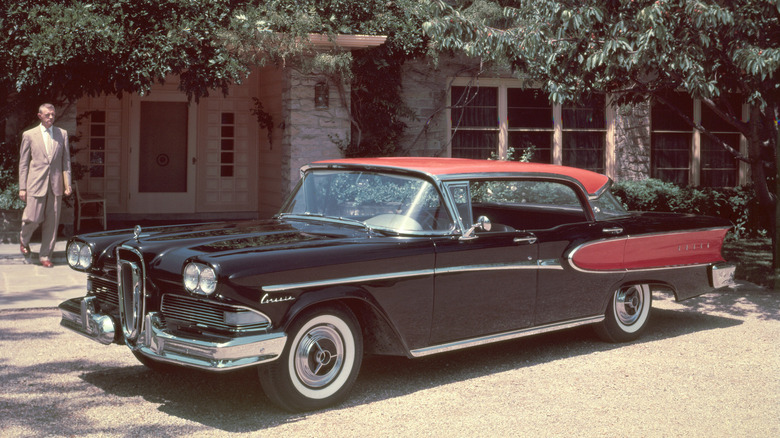
It's well-known that Lincoln is the luxury arm of the Ford Motor Company, and it's been that way for a while now. However, for a very brief period of time in the late 1950s, the Edsel brand that sat between the two nameplates, so named in honor of Henry Ford's son. It's worth mentioning that Edsel Ford had passed in 1943, so he wasn't around to oversee the brand named after him.
The lineup consisted of four distinct vehicles, beginning with the low-tier Ranger, going all the way up to the flagship Corsair. Now, the Edsel brand was very clearly designed to compete with General Motors' Oldsmobile, but the timing of the launch was extremely poor, in hindsight. At the end of the 1950s, the U.S. was beginning to enter an economic recession, which usually translates to lower consumer spending overall.
Furthermore, Ford had invested a purported $250 million — that's just under $3.12 billion in 2026, adjusted for inflation — and had driven consumer expectations to the moon via forceful marketing. Add to that the high purchase prices of models ($3,072 for the 1959 Corsair when new, for example), and you get a storm of factors that made Edsel models unprofitable. Additionally, the public and press had a field day with the design of the model lineup, often comparing the front fascia to the seat of a toilet. It's safe to say that the Edsel range of vehicles was a complete flop for the Blue Oval, and the brand was shuttered in 1960 after just three years of vehicle production.
DeLorean DMC-12
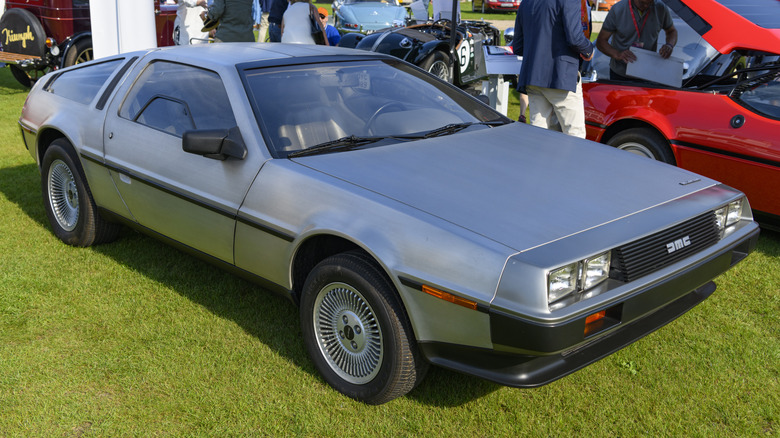
Everyone is familiar with the DeLorean DMC-12, the iconic wedge-shaped supercar that featured in the hit film "Back to the Future" from 1985. Given that the vehicle in question is a pop culture icon, it might seem a little stretched to claim that this is the car that made the company go belly-up, but it's true. You see, a number of factors came together to pave the way for DeLorean's spectacular nosedive into infamy.
First, the DMC-12 suffered from a number of quality flaws — attributed to a workforce that wasn't trained in automotive manufacturing, though this is debated. Then, just like with the Edsel cars from above, the car's delays meant that it launched in 1981, just as two recessions were hitting the U.S., which reduced demand for luxury goods. Additionally, company founder John DeLorean was arrested and brought up on drug-related charges, which permanently damaged the brand's reputation, even though he was cleared of any wrongdoing down the line.
And then you had the biggest issue that can plague a consumer — the price. Initially (at least around the planning stages), the DMC-12 was supposed to have retailed at around the $12,000 mark (hence the "12" in the name), equivalent to about $44,000 in 2026, adjusting for inflation. The launch price was north of $25,000 — more than double the target — which is about $92,000 when adjusted for inflation. The car wouldn't become popular till much after the company had fizzled out.
Tucker 48
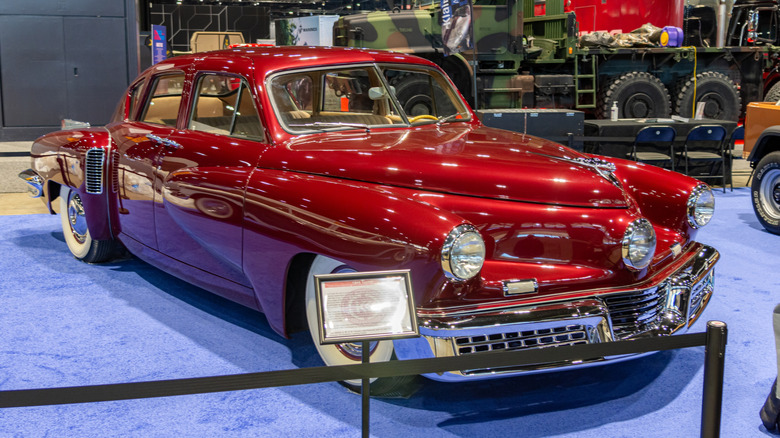
The Tucker 48 — so named ostensibly because it was released in 1948 — was the only car that the short-lived Tucker Corporation ever made. It, too, shares a number of commonalities with the DeLorean that we just covered. Both companies only made one car, that lone vehicle model caused both manufacturers to go out of business, and both owners were arrested and later acquitted — leading to irreversible reputational damage to the respective companies. For Preston Tucker, the head of the company, he was arrested in 1949 on suspicion of stock fraud, though he was later found not guilty.
However, the massive SEC (Securities and Exchange Commission) investigation that had led up to his arrest had forever tainted the company's name. For its part, the Tucker 48 was a four-door vehicle with a streamlined design and an engine that was actually derived from that of a helicopter. Specifically, this engine was a 5.5-liter , six-cylinder motor that made 166 hp and 372 lb-ft of torque, which it sent to the wheels via a manual (later automatic) transmission. A defining feature of the Tucker 48 was the headlight mounted to the nose of the car, which was flanked by two normal headlights in the usual position. In the (roughly) two years that the brand was around, it made a whopping 51 vehicles, of which around 48 are believed to survive today. After Tucker's arrest crashed the company, production wrapped up; surviving examples sell for millions at auction today.
Studebaker Avanti
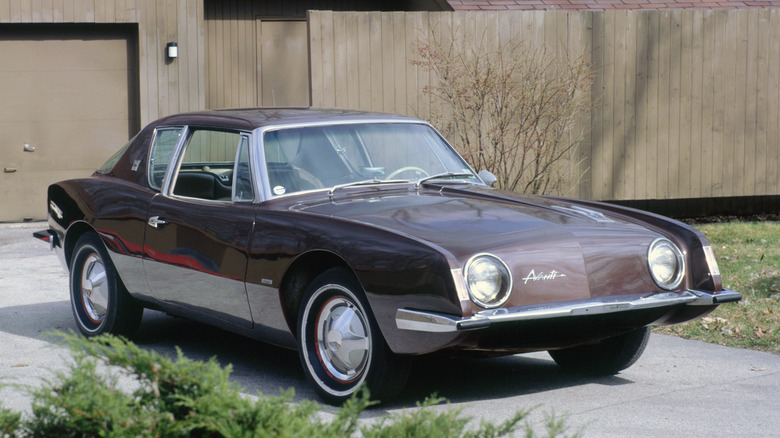
Studebaker was a company that had an extremely storied history, beginning by producing horse-drawn carriages, then moving onto electric cars, and eventually, gas-powered ones. The company also made trucks for the U.S. war effort in the first half of the 1900s, though by the middle of that century, it was struggling financially. Towards the end of the 1950s, Studebaker had merged with Packard — another household automotive name of the time — in a move that would prove disastrous.
Unable to throw good money after bad, the Studebaker-Packard company would cease to produce Packard vehicles in 1956. In a final, desperate bid to wing back the young consumer, Studebaker launched the Avanti, which was a series of fiberglass-bodied cars with youthful, progressive styling for the time. However, fiberglass was not exactly a mainstream material — especially in the automotive world of the 1960s — and the supplier that was supposed to make the material had ridiculous levels of delays. This led to customers canceling their orders, and Studebaker was bled of its cash reserves.
As a result, the company would shut its main U.S. plant in 1963, though commercial operations did trail along for a bit more. Then the Ford Mustang launched in 1964 and the Chevrolet Camaro in 1966; any hope of Studebaker's comeback was likely obliterated with the huge success that those two cars enjoyed. Studebaker stopped producing cars altogether in '66 and merged with Worthington to make the Studebaker-Worthington Corporation in 1967.
Pontiac Aztek
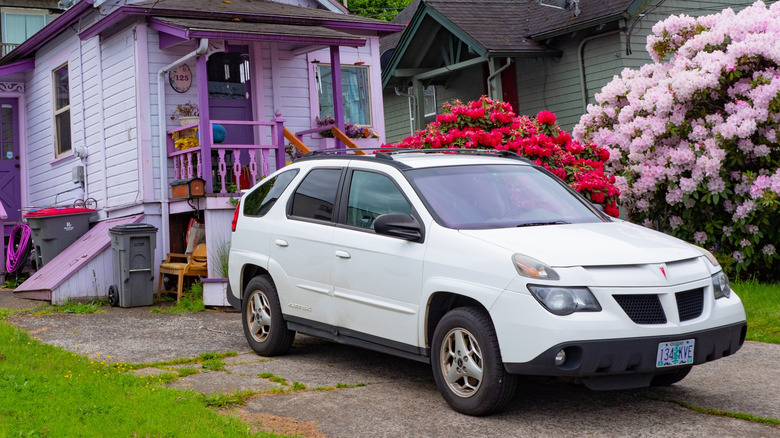
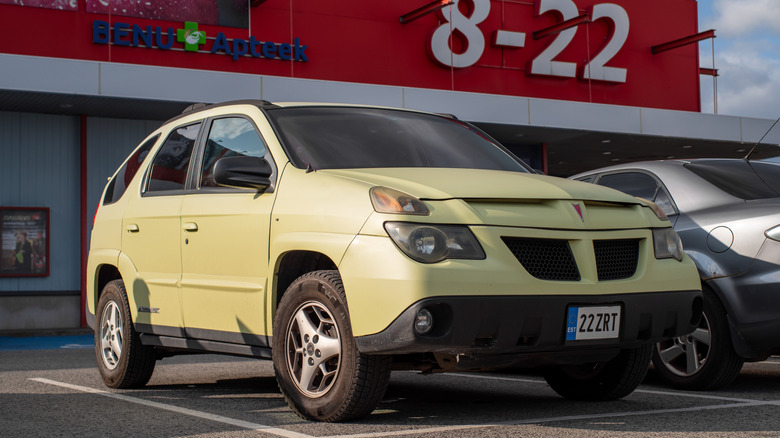
If you say the sky is blue, there will always be someone who will insist on sticking their head out a window to check if that statement is true. Perhaps the closest we ever got to universal agreement on a topic was regarding the Pontiac Aztek, however — especially with regards to its styling. Everyone from the press, enthusiasts, and laypeople all unilaterally seemed to agree that this vehicle was just gosh-darn ugly. With its split-unit headlights, divided-mustache grille, and haunched, bulbous look, you'd have been hard pressed to find someone who liked (or even simply tolerated) the Aztek.
Furthermore, Pontiac was supposed to be the brand that targeted the younger consumer with sporty, trendy, modern designs and unmatched performance; think of the Trans-Am Firebirds of old. For a brand that had become synonymous with youthful energy — and to an extent, rebellion — the Aztek was quite the shocking product, and not in a good way at all. It launched with a 3.4-liter, V6 engine that made 185 hp and 210 lb-ft of torque, which were figures that didn't exactly help this SUV's case. It did gain a bit of fame after it featured in the hit TV series "Breaking Bad", though initial reception was quite poor. There can be no doubt that the Aztek did serious reputational damage to Pontiac, playing a major part in the downfall of the nameplate shortly thereafter. It shuttered in 2010 after a government bailout forced General Motors to kill certain brands.