

4 Common Problems With Disc Brakes
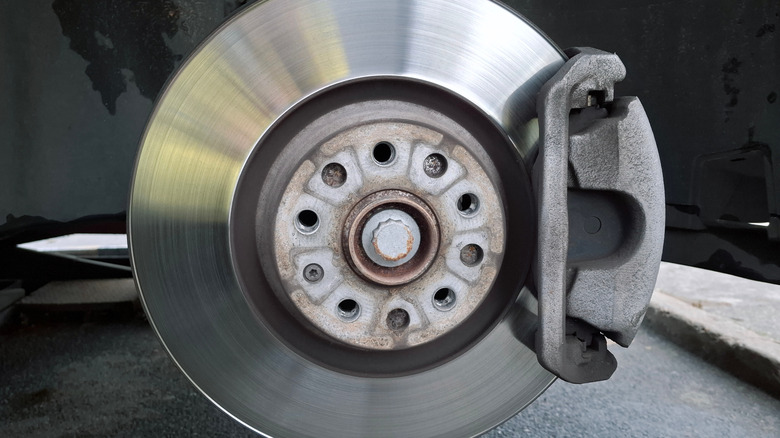
Apart from many older vehicles and modern trucks that still use drum brakes, most of the cars you see on the road today have at least front disc brakes, if not discs all-around. Your typical disc brake functions the same whether on a car or a bicycle — it's a caliper that clamps onto a rotor, itself attached to the wheel hub.
Think of it like this: Imagine an old Walkman CD player that starts playing. You use your hand to grab the CD and it stops; that's the same principle at work here. The caliper is your hand, and the rotor is the CD. Every time you press the brake pedal, you're squeezing that hand on the CD and causing it to slow down. It's an exceptionally efficient system, allowing for great heat dissipation and stopping power, especially with high-performance drilled and slotted rotors. But no system is perfect — sure, your brakes are pragmatically one of the most important and powerful systems on your car, but they're not invincible.
In here, we'll take a look at a few common problems associated with your typical disc brakes on modern cars. That's not to say that these brakes are unreliable, merely that these are some effects one can expect if they don't do the maintenance. Brake pads and, to a lesser extent, rotors are perishable parts. They wear out over time, especially through abuse and/or neglect. Moreover, different materials react differently depending on how you drive the car. It sounds complicated, but diagnosing these issues isn't actually that daunting, as you'll see. Let's get into it.
Badly worn or cracked brake pads: Grinding noises and general sluggish braking
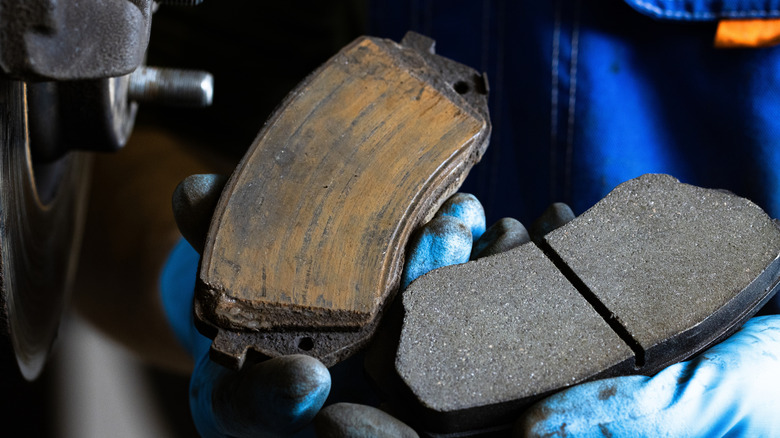
Pretend for a second that you're holding a glass cup, preventing it from falling to the ground through the surface area and adhesion of your fingertips. That's a normal brake pad, essentially gripping the disc and slowing the car down under normal conditions. The problem comes when all that wears down or even cracks, in which case it's like trying to hold a glass using another glass. The friction means you have to put a ton of pressure on it to get the same force — something you can't reasonably do in a braking system. So instead, you simply glide through that red light.
Granted there are a number of differences between drum and disc brakes, but they ultimately both use friction material to slow down. That friction material wears off after a while — manufacturers know this, which is why you'll see brake pad change intervals listed in your manual. If you ignore these intervals, then your pads may become excessively worn or even damaged.
Obviously, the single most recognizable sign of worn brake pads is the brakes simply failing to stop at the level they used to. This will likely be accompanied by squealing, which isn't actually the backing plate rubbing on the rotor (yet); many manufacturers use little metal tabs as warnings that your brakes are bad. This will soon give way to actual grinding noises, however, and that's the metal backing plate pressing up onto the rotor. That creates a ton of heat and can eventually warp and damage core components of the braking system.
Brake caliper issues: Pulling to one side, brake dragging
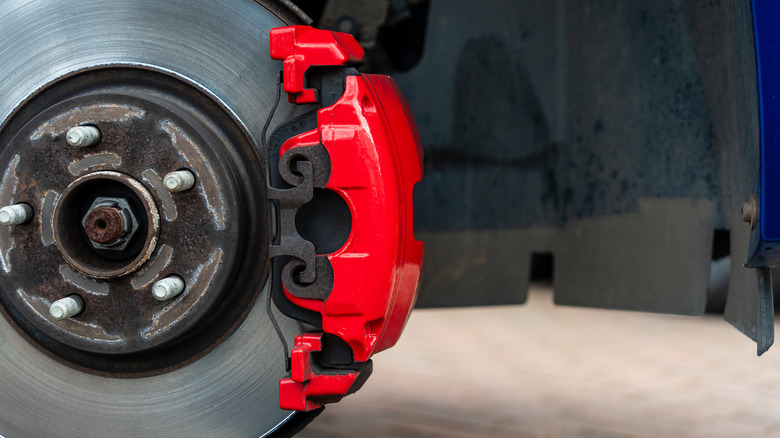
Disc brake calipers are essentially vice grips. As such, you have a pad on the front and rear of the caliper, allowing it to clamp down effectively. Normally these pads wear over relatively similar timeframes; ideally, the entire surface area of both pads contacts the brakes at the same time. That's the job of your caliper's piston — some cars with particularly large or high-performance brakes may have two or even more pistons. Among the most effective are the Bugatti Chiron's 3D-printed brakes with an astonishing eight pistons; these act to distribute the load of all that stopping power across the entire brake pad.
So what happens if one of these pistons were to fail, or the pistons were stuck open? You end up with one brake pad wearing out and the other not, a seized-on brake caliper, or your car pulling to one side under braking because the calipers aren't in sync with one another anymore. This could subsequently lead to further complications such as the brake pad surface cracking from overheating, abnormal pad wear between the inner and outer surfaces, or the caliper itself failing entirely.
The easiest way to tell if you have a bad caliper is that characteristic pulling sensation. If a brake is stuck on, even just a little bit, your car will pull to one side as if you had a bad alignment. This is generally accompanied with a distinct burning smell as the affected brake overheats. Your brakes might also feel spongy because everything is working out of sync now. It's a dangerous condition to leave unattended, and will eventually lead to brake failure on that wheel.
Warped rotors: Pulsating brake pedal
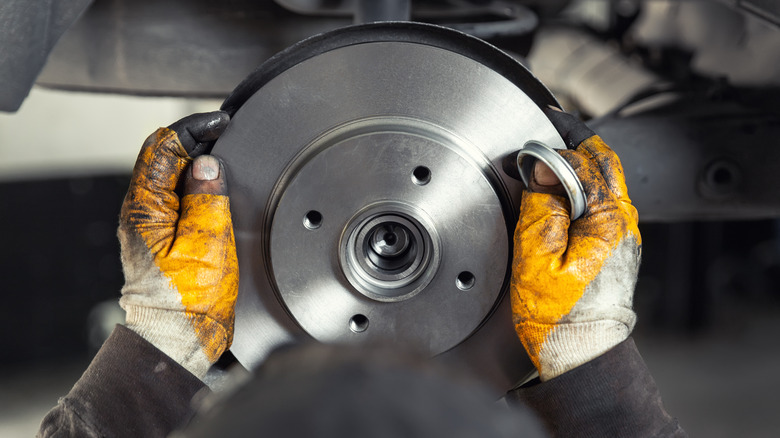
Possibly the most characteristic element of a disc brake is what it's named for: the brake disc. Generally referred to as a brake rotor or simply rotor, it's composed of a variety of materials depending on application, ranging from basic steel discs up to multi-core carbon ceramic units for applications like Formula 1. They're generally fitted on a wheel hub directly behind the rim, though some specialist vehicles like the Jaguar XJS have inboard brakes, positioned close to the rear differential. In either case, because they're hard-linked to the axle, stopping them means stopping the axle — by extension, stopping the car.
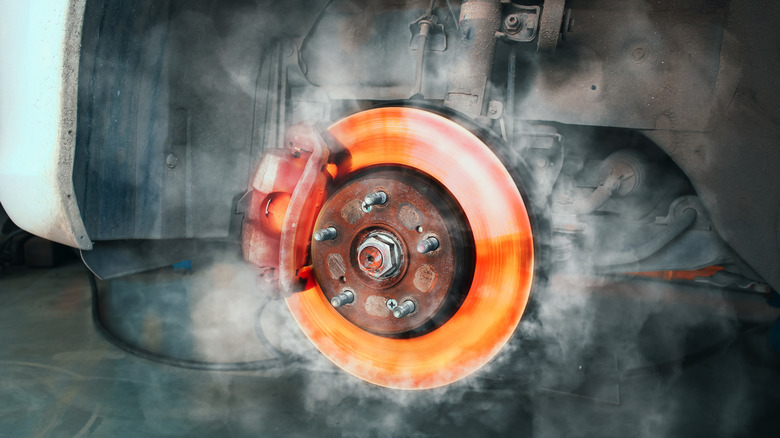
Of course, problems arise when these discs aren't actually perfectly disc-shaped. Brake rotors can get damaged, scratched, or warped, generally as a result of overheating. The way brakes work is by converting the kinetic energy of the moving vehicle into thermal energy, like what happens when you grab onto a slipping rope and get rope burn. Similarly, overheating your brakes can compromise their structural integrity in different ways; high-school science taught us that heat expands and softens materials, and brake rotors are no exception. This can also glaze the rotors, meaning it polishes the face of the rotor with a glass-like sheen — again, not ideal for good braking performance.
As the brake rotor warps, you'll start to feel pulsating sensations as the pad "skips" across its surface. The piston is experiencing different pressures as the pads move with the rotor, leading to poor braking performance. You might also feel shuddering in the steering wheel if it's the front brakes, or hear a rhythmic thumping noise under braking.
Braking system hardware malfunctioning: Abnormal feeling brake pedal
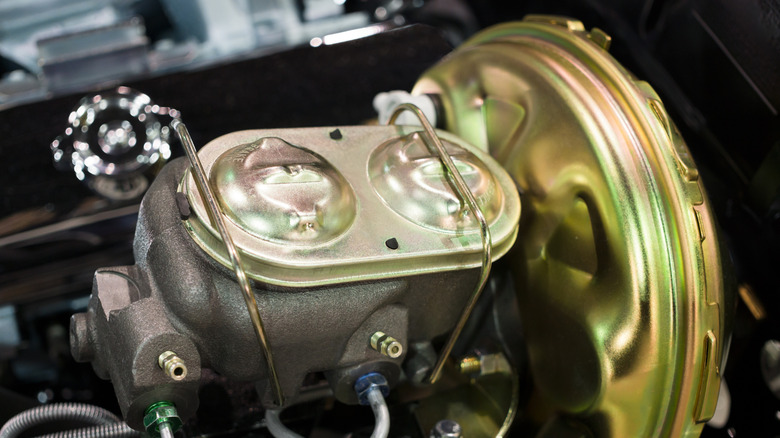
Your braking system isn't just a direct hard-line connection between the pedal and the caliper; there's a whole bevy of actors moving the levers behind the curtain to make it all work properly. Starting with the pedal itself, you have the return spring and button going to the master cylinder. Pressing the brake pedal pushes on the brake booster, which uses vacuum pressure to amplify your pedal input. This in turn connects to the brake master cylinder, whose job it is to push brake fluid throughout the system. There are many kinds of brake fluid, but all are incompressible, meaning they transfer the force through the brake lines to the caliper.
All this hardware has a few distinct failure points. For instance, one of the most common is springing a leak in a brake line, in which case you're replacing the fluid in there with air. Unlike brake fluid, air is very much compressible, meaning pressing on an air pocket won't actually do anything. Brake fluid under load is like a wall; air under load is a balloon.
Other elements could be just as readily affected. Your ABS module could stop working, resulting in your car's brakes locking up. You might lose pressure in the brake booster, which doesn't necessarily make the brakes fail — but it does mean you'll have to push like mad to get the pedal to go down. The reverse is true if the master cylinder dies; then the pedal simply won't do anything and your brakes have failed. In other words, different system failures result in the pedal itself behaving differently, so learning how to identify one failure from another can be helpful when bringing it to the shop for repair.
Our methodology
In this article, we discuss problems specifically to do with disc brakes and the systems that support their operation, so anything affecting drum brakes more than disc brakes (like brake fade, for example) are ignored. That said, there are still multiple other problems shared between the two systems.
In addition to our mechanical knowledge and history, we used various sources from respected outlets, reputable organizations, and technicians for the breakdown of what happens when presented with these problems. Symptoms and consequences were prioritized based on commonality and severity, so while these are the most likely outcomes of these specific circumstances, they're not the only outcomes. Other, rarer issues can cause similar behavior, or rise out of these existing conditions.
Moreover, we assumed average everyday driving, as opposed to abusive situations such as frequent heavy braking, track use on street brakes, frequent heavy-duty towing, and similar applications. We also assumed that the car was in relatively good working order otherwise, so no alignment or suspension problems that could complicate or interfere with the brakes' operation. These are purely and solely braking-related issues.
Our selection process revolved around taking the most common issues from each subsystem peculiar to the disc brake — the pad, rotor, caliper, and hardware assembly.