

Why Do Some Older Semi Trucks Have Two Gear Shifts?
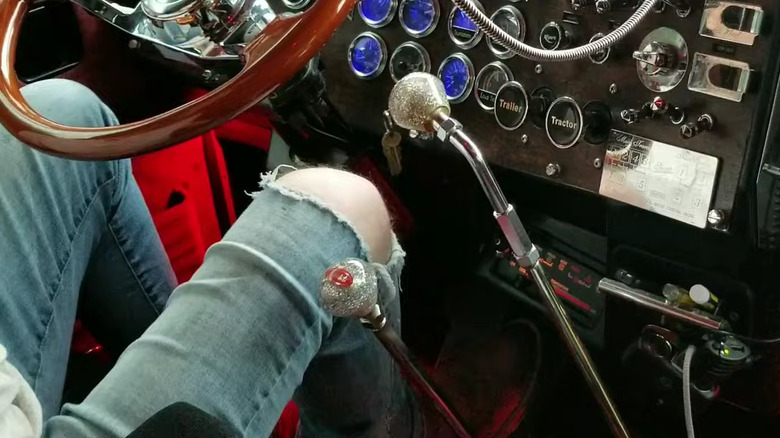
When you think about driving a manual transmission in the city, the first image that probably comes to mind is rowing through gears during rush-hour traffic. That's enough of a pain to dissuade many people from buying a stick shift, but imagine having 10, 15, or even more gears to cycle through. Such is the world of the classic truck's manual transmission, a system so packed with gears that it requires two shifters to function properly.
Hop into an old manual truck, and you'll see two sticks, plus a high-low splitter, and have no idea which shifter does what. Despite its apparent complexity, however, it's actually quite straightforward — all it does is multiply the number of gears you have. At its heart, a twin-stick setup is basically two transmissions coupled together. You have a main and an auxiliary gearbox, the latter of which has its own set of gears.
You shift up a gear with the main shifter, then shift with the second shifter to split that gear. In other words, instead of a true six-speed, it's a twelve-speed: first gear, first-gear-and-a-half, second gear, and so on. You multiply the first gearbox by the second to get the true gear count. So, for instance, a six-speed with a four-speed auxiliary is effectively a 24-speed truck. Still confused? That's understandable; this is a relatively oddball setup by modern standards, so let's break it down further.
How a twin-stick works
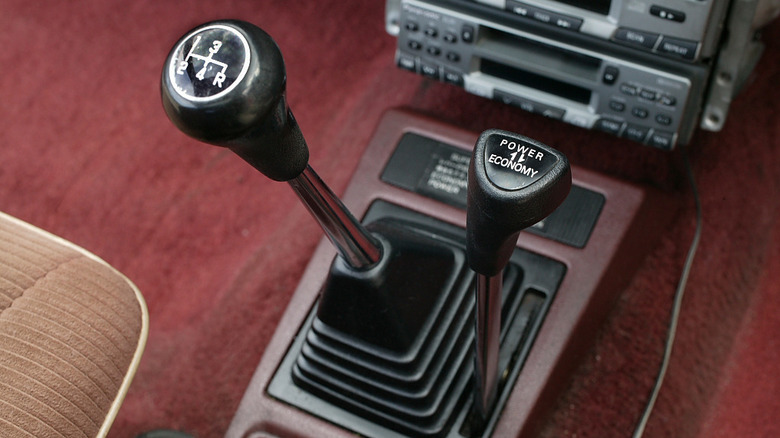
Twin-sticks weren't just used in trucks. Mitsubishi actually had a twin-stick setup in its late-'70s Mirage, which paired a traditional four-speed with an auxiliary shifter. While it's not a truck, we'll use this car as a more grounded example to illustrate how twin-stick manuals work.
Next to the Mirage's shifter was a separate lever that moved forward and backward, labeled "Power" and "Economy," respectively. That separate lever controlled its own gear ratios, meaning the car ran at higher RPMs in the "Power" mode. This effectively gave these Mitsubishis an eight-speed transmission — four gears in "Power" and four gears in "Economy." In practice, if you actually wanted to use it as an eight-speed, you'd shift to first-Power, then first-Economy, then second-Power, second-Economy, and so on. Basically, you'd be constantly rowing between the two shifters, changing between low and high ranges with that second shifter.
The same principle applies to trucks with two gear shifts: you, as the driver, must cycle through ranges for every gear to make full use of the transmission. Of course, that's not always required in practice. Hardly anyone would willingly cycle through all those gears if they didn't have to, so you're more likely to just run these cars or trucks through whatever range you need to reach top speed while skipping unnecessary gears, especially if you have a semi-truck with a particularly powerful engine. That is, unless you're hauling heavy loads — that's when the twin-stick setup really comes into its own.
Why the twin-stick was necessary
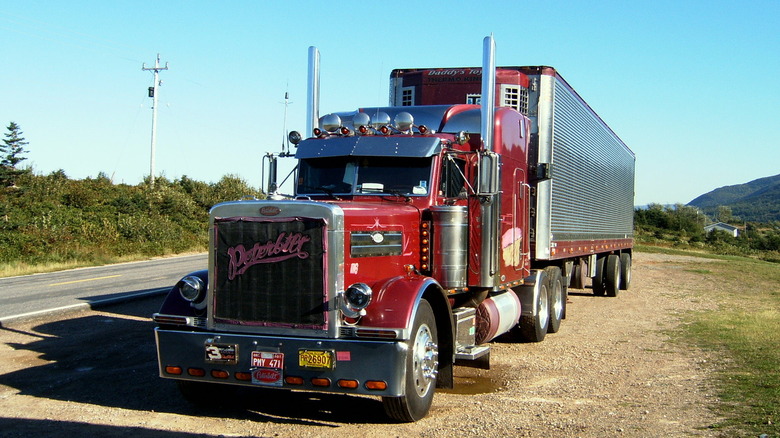
Imagine you have a logging truck in the Pacific Northwest and you've just loaded it up with a massive shipment of fresh lumber. Much of the driving is down the Pacific Coast Highway, but it's all hills for the next few miles as you navigate the job site. That's where these transmissions really make sense.
Put simply, a twin-stick provides the driver with enough low-range options to carry cargo of any reasonable size up and down grades. Engines make peak power and torque within a particular rev range, and you want the engine in that range so you have maximum power when you need it. Having more gears lets you vary your speed while maintaining that ideal RPM. Low-range gears are for hills, and the longer high-range gears are for when you finally hit the highway.
That said, just because a truck has, let's say, 18 forward gears total doesn't mean you'll be rowing through all 18 gears every single time. You'll want to know when to shift (and which gears to shift to) for good fuel economy, sure, but beyond that, it's about keeping the truck going and the engine from bogging down. Again, there's no magical rule about gears or revs, because it varies not only with the truck and its gearbox, but also with the cargo you're hauling. If you're running empty, you might only need six high-range gears, whereas a full load may demand all 18. But having that option is why the twin-stick exists in the first place, and why it stayed relevant until more modern gearboxes came about.