

Here's When To Shift Gears For Better Fuel Economy
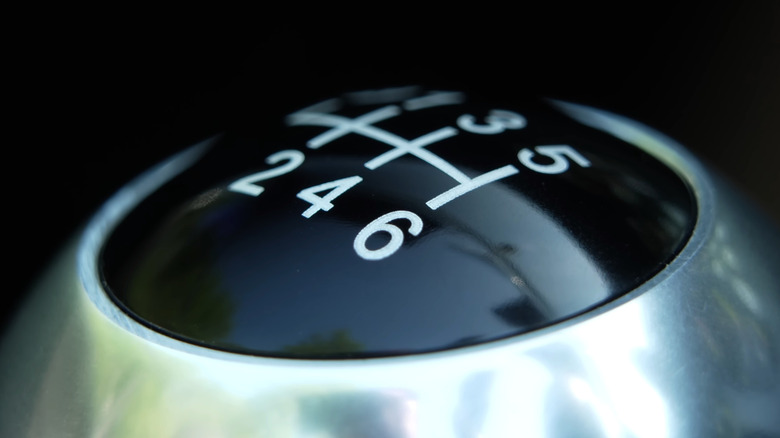
One nice thing about most modern cars is that they're economical and packed with technology designed to keep them that way. Eco modes, direct injection, turbocharging a smaller engine, aerodynamic efficiency, and so on, but what if you wanted to go low-tech? Then you'll be looking at lower RPMs, but not too low, and here's why.
First things first: Because today's automatic transmissions typically shift gears for you, we'll instead focus this article on transmissions where you do the shifting, whether it's a pure manual transmission or something like a dual-clutch transmission, or DCT. When it comes to automatics, the honest answer is just one sentence: Put the car in Drive and let it do the work for you. Things get a little more complicated when you're the one choosing the gears, though. In a typical manual transmission, common sense dictates that if you want good MPG, it's likely not a good idea to rev the engine within an inch of its life. That said, it's also not smart to lug your engine, either; rather, there's a sweet spot somewhere in there.
What exactly is that sweet spot, though? That's honestly hard to say since it's highly vehicle-dependent. There's no "golden rule" like you have to change gears at this specific RPM to be economical. But there are generalized guidelines for you to follow — for instance, trucks like changing gears in lower RPM bands than cars, generally speaking. And if your car's engine is lugging, then that's not exactly economical, either; not to mention it's terrible for your engine.
The word of the day: Hypermiling
What exactly is hypermiling, and why does it matter here? In short, hypermiling is the practice of driving as efficiently as humanly possible. It's not exactly a science in the strictest sense; it's more of a hobby or personal undertaking, yet it produces tangible results — obviously, those results vary significantly, since everyone has different commutes and vehicles. But it's been around long enough that there are general guidelines on how to hypermile. These guidelines will demonstrate how and when to shift to maximize fuel economy.
First things first: Where in the RPM band is a car most efficient? Don't think of it strictly in terms of the RPM, but rather the throttle input you're applying, meaning how far down you're pressing the gas pedal. Why does that matter, though? Because the harder you press the throttle pedal down, the more fuel the car uses. Think of it like a volume knob from 1 to 100. You want the least amount of pedal usage to maintain speed as possible; that'll give you the best efficiency for any given speed.
Consistency is key here. You want to make sure your car is always moving at a constant speed in that efficient power band, regardless of what that speed is. Hard acceleration and braking waste energy (thus, fuel); cars are big and heavy, and take a lot more energy to get going than to maintain speed, as anyone who's manually pushed a car will tell you. That's why hypermilers avoid unnecessary braking, even in heavy traffic — just leave the car in gear and let the idle carry you.
Okay, but what gear should I be in?

This goes back to the problem of consistency. It's not a matter of what gear you should be in, but rather what gear is the car happiest in, and there's no simple dashboard number that's going to tell you what the perfect gear is. It's generally something you have to learn through experience — if the car sounds "rough," then it's time to shift up or down. So while yes, it's generally accepted that higher gears and lower RPMs mean more fuel efficiency, that's not always the case.
Bear in mind the purpose of a car is to get from Point A to Point B. Lugging your engine by constantly running in too high a gear at too low an RPM is an excellent way to figure out how far away the nearest tow truck is, and the whole point here is saving fuel and money. Likewise, hard acceleration and staying in low gears longer than necessary are also bad for fuel economy; rather, aim for a gear that involves the least effort to maintain your speed while also keeping the revs as low as is comfortable in your car. Generally, that'll be somewhere around 2,000 to 2,500 RPM at highway speeds in many modern cars — funnily enough, manufacturers want their cars geared efficiently to help bolster those MPG numbers as well, so they'll help you out there.
In short, maintain a consistent average speed, don't drive like a maniac, and stay in as high a gear as you can without risking engine damage — fifth or sixth gear in most modern cars at highway speeds, and that's all there is to it. Obviously, these speeds and RPMs will differ depending on your circumstances, but that's a general rule of thumb for all drivers.