

4 Car Brands Bringing Back The Inline-6 Engine
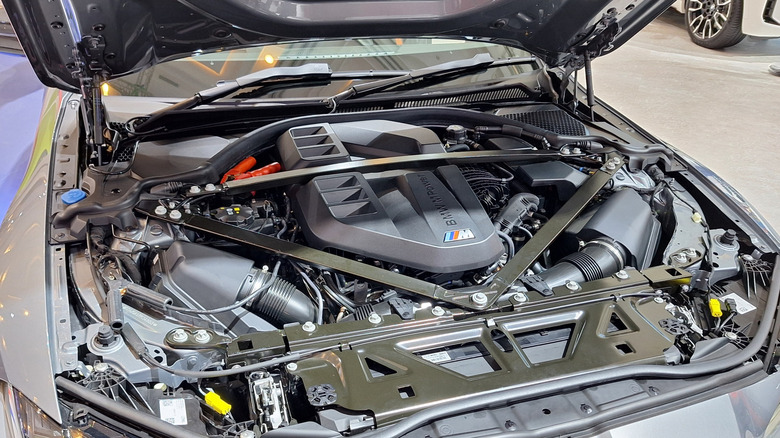
There appears to be a trend toward the return of the six-cylinder engine, with all cylinders arranged in a straight line. This is what's called an inline six, as opposed to a V6, which has its cylinders split into two banks of three each.
There are notable benefits to inline six-cylinder engines compared with their V6 counterparts. For one thing, they are much simpler to produce, requiring only one cylinder head and one exhaust manifold, instead of the two of each necessary with a vee-engine layout. Another advantage of the inline six is that it is extremely smooth-running, with no need for the added expense and development of balancing shafts. The inline six is also much more efficient, with lower energy losses due to its inherently smoother operation.
Of course, even though this article is about the return of the inline six, we should give a shoutout to the brand that has stuck with the inline six for nearly as long as it has been in existence — BMW. Its first inline six was an aircraft engine developed a year after its founding in 1916, with its first automotive engine in 1933. It has continued to build on this foundation, steadily developing its inline six to a very high level of efficiency and power. Let's now focus on the newly developed inline-six engines entering the market from a variety of automakers.
1. Mazda
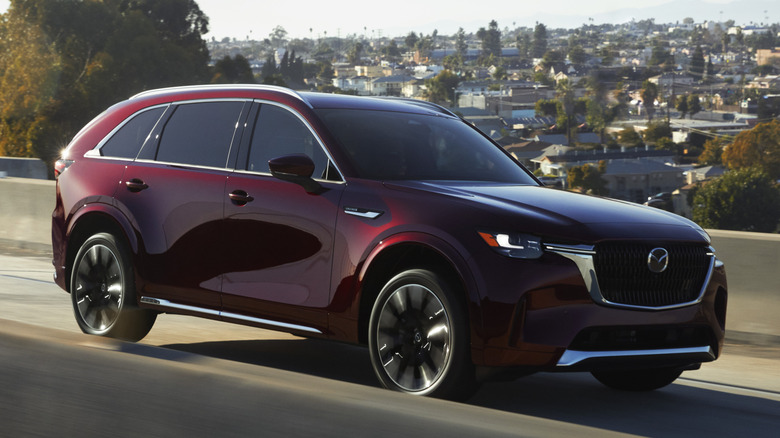
Mazda has introduced its first inline six engine in the company's 106-year history. The company that rolled the dice (and lost) on the rotary engine has decided to make another big bet on a new engine type. Its version of the inline-six has a displacement of 3.3 liters and is made in two versions: one producing 280 horsepower and the other 340 horsepower, both aided by a turbocharger and a mild hybrid system. This engine also features a 12:1 compression ratio, which is fairly high for pairing with a turbo. First introduced in the U.S. in Mazda's CX-90, the engine is one of the features that make the Mazda CX-90 stand out from other three-row SUVs.
One more reason that Mazda has chosen to use an inline six is its ongoing desire to move upmarket relative to other brands that it is typically shopped against. By going with an inline six, Mazda products with this engine can be easily compared to those from Mercedes-Benz, BMW, and even Land Rover, all of which use inline sixes. This also gives these Mazda vehicles the same long-hooded proportions as its upscale competitors. A rear-wheel-drive-based AWD system completes the comparison with the Mazda's more expensive competition.
The 340-horsepower version of the Mazda 3.3-liter inline-six in the CX-90, in performance testing by Car and Driver, did 0-60 mph in 6.3 seconds, with the quarter-mile going by in 14.7 seconds at 99 mph. It is also available in Mazda's CX-60 and CX-70 models.
2. Stellantis
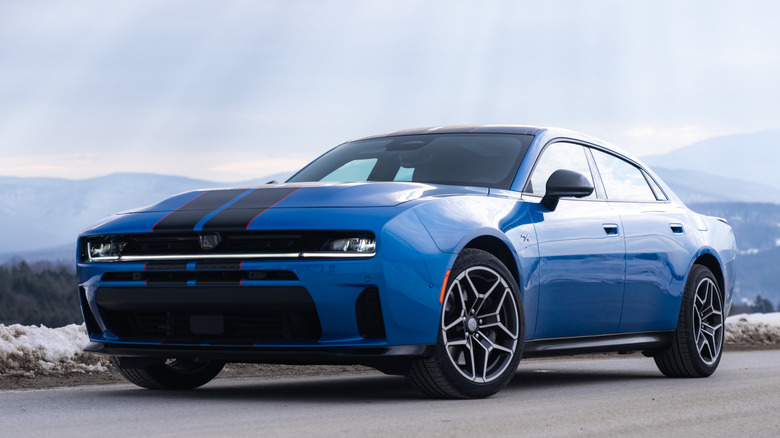
Stellantis has created a new inline six-cylinder engine called the Hurricane, which it has fitted to the Dodge Charger, the Ram 1500, and the Jeep Grand Wagoneer. It is a 3.0-liter twin-turbocharged engine with outputs of 420, 540, or 550 horsepower, depending on the vehicle selected. The most powerful version of the Hurricane, the 550-horsepower Dodge Charger Scat Pack, has plenty of power. And even though the Hurricane was originally intended to replace the 5.7-liter HEMI V8 in these vehicles, the Ram 1500 has brought the HEMI back to its lineup for the 2026 model year, giving V8 pickup truck lovers who don't mind a performance loss their engine of choice.
In performance testing by Car and Driver, the Dodge Charger Scat Pack pulled a 0-60 mph run in 3.7 seconds, while the quarter-mile whizzed by in 12.1 seconds at 116 mph. The Charger Scat Pack routes its power through an eight-speed automatic transmission before sending it to all four wheels. The Ram 1500 pickup offers either rear-wheel drive or four-wheel drive with an eight-speed automatic and features 420- or 540-horsepower versions of the Hurricane, for which Car and Driver reports 0-60 mph times between 4.9 and 4.2 seconds. The Jeep Grand Wagoneer uses a single 420-horsepower version of the Hurricane with rear-wheel drive or four-wheel drive and an eight-speed automatic to claim a 0-60 mph time of 5.5 seconds, according to Motor Trend. These are all pretty fast times for an inline six.
3. Mercedes-Benz
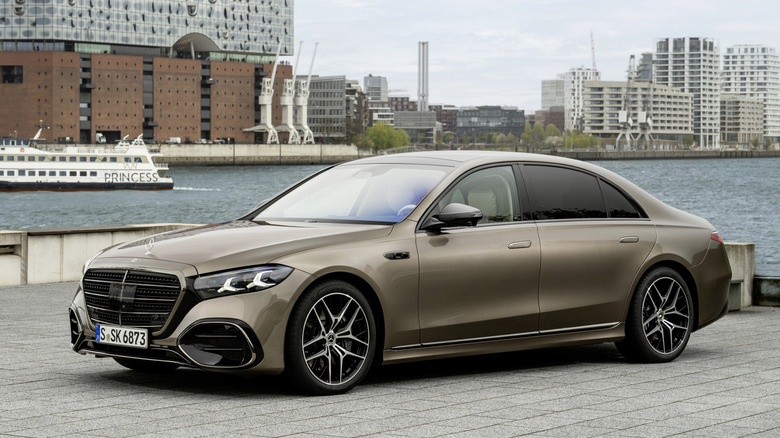
Mercedes-Benz has recently re-embraced the inline six after a period of V6 preference during the 1990s. It has developed a turbocharged inline-six engine that meets the needs of today's vehicles. The latest version is called the M256 Evo, a 3.0-liter engine that produces either 442 horsepower in its mild-hybrid, 48-volt version or 503 horsepower as a PHEV with added boost from a single electric motor. This engine's power flows through a nine-speed automatic transmission before being distributed to all four wheels. The PHEV version of this engine, fitted to the Mercedes-Benz S 580e and tested by Car and Driver, managed a 0-60 mph time of 3.9 seconds, with a quarter-mile time of 12.6 seconds at 112 mph.
The Mercedes-Benz M256 Evo works its magic through the use of a 48-volt integrated starter/alternator that adds 23 horsepower, an electric supercharger that keeps the turbo spooled up, a larger turbocharger that provides a high volume of boost, the elimination of drag-inducing accessory drive belts, and particulate fuel traps for the high-pressure fuel injectors. It all adds up to a more compact inline six that still delivers around 15 percent better fuel economy than the previous V6. The Mercedes-Benz M256 Evo inline-six engine is a definite advancement over the previous V6 engine, adding the smoothness, structural simplicity, and inherent efficiency that the inline-six is renowned for.
4. Land Rover
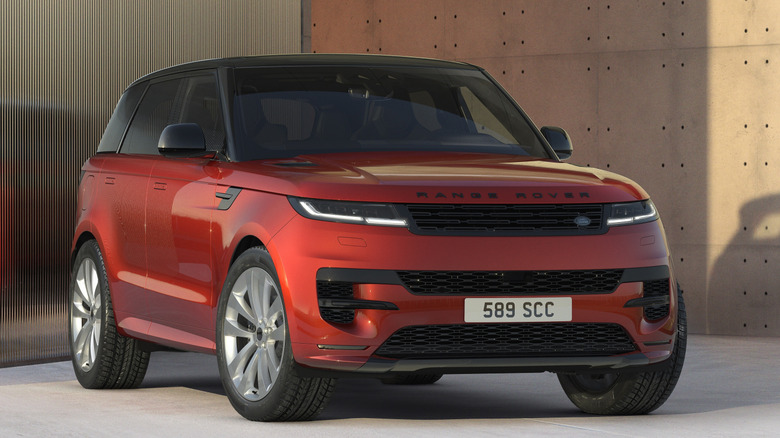
Land Rover is one more automaker that has made an inline-six engine. Its engine is the six-cylinder version of the Ingenium, which started out as a four-cylinder engine and was extended by adding two more cylinders. As with any inline-six, the benefits of this layout include smoother running and a lower parts count than a V6. In addition, the inline-six can share parts like pistons and connecting rods with the four-cylinder version, which uses the same bore and stroke measurements.
The all-aluminum Land Rover Ingenium inline-six has numerous similarities to the Mercedes-Benz engine. It has a 3.0-liter displacement, uses both turbocharging and supercharging, and comes in 48-volt mild-hybrid and PHEV versions. Other features of the Land Rover engine include roller bearings for the camshaft, continuously variable valve lift, and a hybrid system that stores braking energy in a battery and uses it to start the car from rest. Power outputs are 395 horsepower for the mild hybrid and 542 horsepower for the PHEV. An eight-speed automatic transmission sends the inline six's power to all four wheels, since four-wheel drive is standard equipment.
Performance testing of the Land Rover Range Rover with the mild hybrid system by Car and Driver produced a 0-60 mph time of 5.5 seconds. The Range Rover's quarter-mile time was 14.2 seconds at 97 mph.