

93 Octane Vs 91 Octane: What's The Difference Between These Fuel Types?
As gas prices increase, you may be wondering what level of premium fuel you actually need. Some car manufacturers recommend or require premium gasoline, but with the national average reaching $5 a gallon, it's tempting to just stick with the lowest grade. Is premium gas actually necessary? Before you forgo the higher octane gas, it helps to know the difference between octane levels.
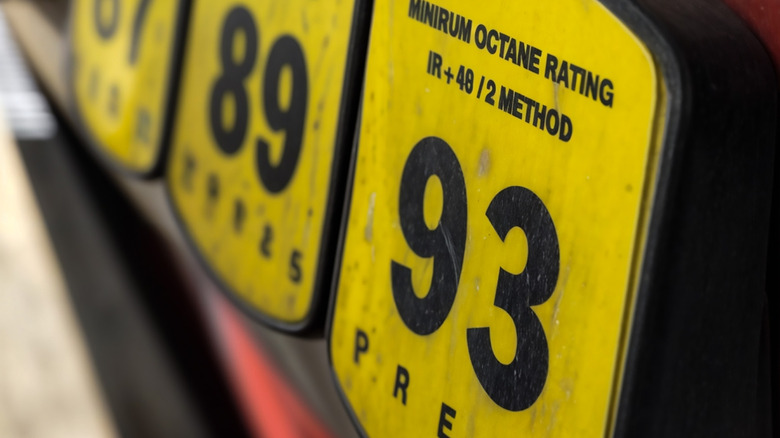
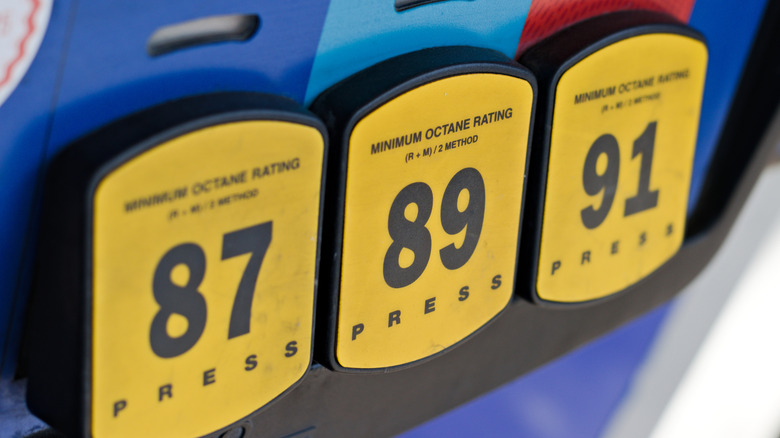
Gas' octane rating measures fuel stability. The higher the rating, the higher the pressure at which the fuel will ignite in the engine. This means that higher octane fuel is more stable. Gas stations in the United States have three grades of gasoline — regular (lowest octane, usually 87), mid-grade (usually 89 to 90), and premium (highest octane, usually 91 to 94). However, the exact octane level will vary based on the state. Generally, the western half of the country carries 91 octane fuel, while the eastern half carries 93 octane fuel.
If you are just commuting to work, you may not notice the difference between 91 and 93 octane. However, drivers looking to track their car may want to use 93 if it's available — the same engine can make more horsepower with 93, since it can handle more pressure before it combusts. There may be a slight boost in the car's performance.
Can you use 87 octane in a performance car?
The debate over 91 versus 93 octane doesn't have a clear answer in the car community, largely due to the various availabilities across the country and the minimal difference that it provides for many drivers — unless your car engine is tuned for 93 octane. However, most car enthusiasts are aligned on one thing: avoid 87 octane if you are driving a performance car.
Using regular fuel instead of premium will reduce your horsepower output and efficiency, which is clearly not ideal for anyone wanting the most out of their performance car. You're not going to see car enthusiasts jump at the chance to reduce their horsepower, even if the price is a bit cheaper at the pump. You'll lose efficiency anyway, so it may not even save you the money you hoped for.
On the bright side, it will likely not damage your engine if that was your concern. Modern vehicles have computers that can adjust the engine's performance when lower octane fuel is detected. If you hear a knocking sound however, that could mean the lower octane fuel is causing premature combustion — although there are a few other possibilities.