

What's The Difference Between Michelin And Uniroyal Tires?
In 1990, French tire maker Michelin acquired Uniroyal Goodrich Tire Company, with the corporation becoming one of the largest tire suppliers in the world in the process. Today, Uniroyal remains one of several tire brands owned by Michelin, alongside the likes of BFGoodrich, Riken, and Kleber. Each brand under the Michelin umbrella caters to a slightly different type of buyer, and many are also targeted to certain global tire markets.
Michelin remains the group's premium brand, with a large variety of tires that cater to virtually every major market segment. The brand is widely considered to be one of the best on the market, topping consumer satisfaction surveys and collaborating with high-end automotive brands like Ferrari and Bugatti. That premium positioning is reflected in Michelin's pricing, but the high treadwear ratings and mileage warranties that accompany many Michelin models act as reassurance that the brand's tires are worth the investment.
In comparison, Uniroyal's focus is on affordability and value for money. Its tire range is much more limited than Michelin's, and its models are mostly designed to appeal to the mass market. Most models still come with competitive mileage warranties, although reviews regarding their performance and longevity are limited. In our comparison of major tire brands, Uniroyal finished a lowly 18th out of 21 brands, while Michelin took the first-place spot.
Uniroyal is positioned as a more affordable mass-market brand
Its production facilities stretch across multiple continents, but many Uniroyal tires for the U.S. market are still made in North America. Outside of the U.S., things look a little different. In Europe, the Uniroyal name is licensed to another major tire company, Continental, which makes a unique range of models for the region.
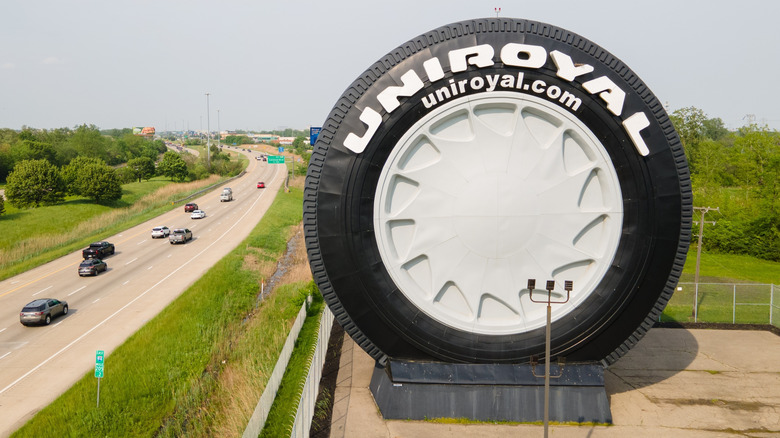
European buyers are also likely unaware of a local landmark that has kept the Uniroyal brand memorable for many Detroit-area auto enthusiasts. The 80-foot-high giant Uniroyal tire still stands proudly alongside I-94, where it has been in place since the mid-'60s. It was originally designed as a Ferris wheel for the New York World's Fair, and the tire maker had planned to sell the structure after the fair concluded. No buyers came forward, and so the company decided to transport it to Detroit to serve as a piece of oversized advertising instead.
Michelin doesn't have an equivalent landmark, although the iconic Michelin man is one of the best-known mascots in the automotive world. The image of the man made entirely of tires has been around since the company's earliest days, and that's why he's made of white tires and not black tires. Back when Michelin was founded in the late 1880s, the bicycle and horse carriage tires that the company initially manufactured were made of white rubber. Michelin is one of the oldest tire brands, but Uniroyal is almost as historic, having been around since the early 1890s.