

Every Major Robot Lawn Mower Brand Ranked Worst To Best
We may receive a commission on purchases made from links.
How many hours do you spend taking care of your lawn each week? For some, especially those who would call their outdoor space a garden, no number is too high. They like spending time outside, embellishing decorative plants, taking care of a small patch of vegetables, and yes, mowing the lawn. But if you're part of the huge number of people who enjoy a neat lawn but not the work it requires, you may be interested in a robot lawn mower.
Robot mowers are the distant yard cousins of robot mops and vacuums. While the two species look nearly identical at a glance (a few big robot vacuum brands even make robot mowers), they're actually quite different. The mowers are equipped with blades, of course, but they also need to cover more ground on a single charge. They almost always use GPS and may even support cellular data, in case they move outside the Wi-Fi network. And they're a lot more expensive: This is a market where $1,000 is considered a small budget.
A robot lawn mower might look familiar even if you've never used one, but there are a few things worth learning about these machines before making your purchase. That's why we decided to take a deeper look at some of the major brands of robot mowers (and their most popular products) and rank them from worst to best.
5. Greenworks
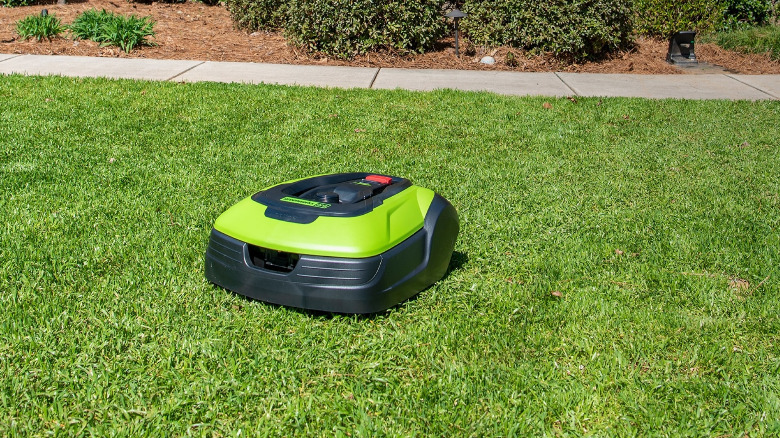
Greenworks makes a lot of gardening and yard maintenance tools, and while its bread and butter is standard yard mowers, the company also makes a couple of very popular automatic robot lawn mowers. The premium robot mower model from this brand is the $1,600 Optimow 50H, which can cut up to half an acre with a single charge, but it's designed to deal with areas of up to a full acre. It does so thanks to an autonomous operating system that features programmable schedules, sensors and GPS tracking, and a rain guard system that stops the mower from going out too soon after a downpour.
The Optimow 50H has decent user reviews on Lowe's and was recommended by PCMag. The $1,000 Optimow 25 isn't quite as popular, with less than four stars out of five on Lowe's and a middling review from AllMachines. Greenworks also sells a few other robot mowers called AI Mowbots, but these are relatively new and have few user reviews that go from middling to very negative, and no professional reviews. If you want to make an informed purchase, you may want to ignore these models until more users have a chance to test them.
For being such a large brand of yard power tools, Greenworks doesn't offer a lot of robotic lawn mowers, and what it has is quite expensive and too always popular. Even the Optimow 50 has a lot of negative reviews on Greenworks' website. Unless you find an exceptional deal on one of these robots, you'll probably be better served by a different brand.
4. Gardena
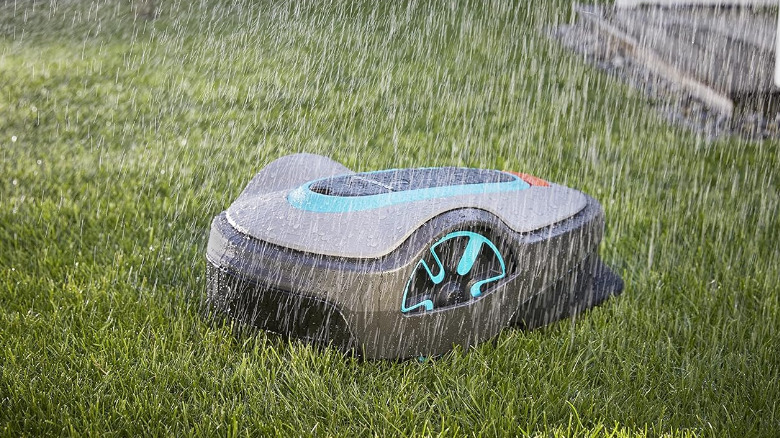
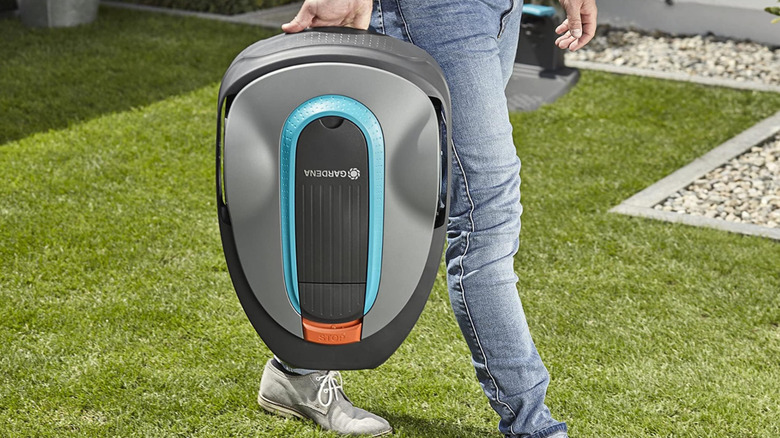
Gardena isn't a household name in outdoor power tools, but it was mentioned by both Consumer Reports and PCMag for being a good budget choice for small lawns. Actually, "budget" is an understatement: With its most expensive model coming in at $700, Gardena is flat-out cheap.
Gardena makes three models of robot mowers: the Sileno Minimo, the Sileno City, and the Sileno Life. They all need boundary wire and support for a Bluetooth app, but not GPS or sensors. The Minimo, as the name suggests, is the most basic model. If you've watched a very dumb robot vacuum do its thing, bumping into furniture and going through the same spots over and over again, you'll know exactly what to expect from the Minimo. That said, if your lawn is small enough, you may not need a smart machine. The cheapest Minimo comes in at about $350, and it only supports 2,700 square feet of lawn. The bigger version of the Minimo can go up to 5,400 square feet, but costs $200 more.
The Sileno City is very similar to the Minimo, as it too has two versions to deal with small and not-so-small yards of the same size as the other Silenos. The main difference is that the City can deal with slightly more severe slopes (30% incline against the 25% of the Minimo) and can be configured directly on the machine, as well as supporting app commands via Bluetooth. Finally, the Sileno Life can deal with yards of up to 8,100 square feet and promises very quiet operations. Otherwise, it doesn't seem to be any smarter than the rest of the lineup.
3. Husqvarna
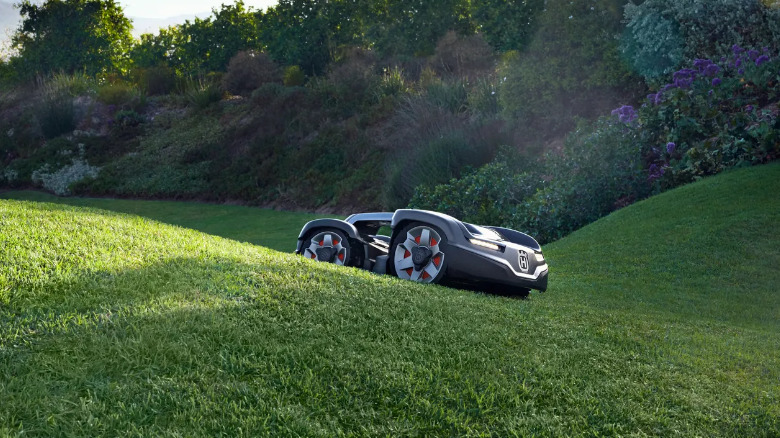
Husqvarna sells both residential and commercial robotic mowers, but we'll focus on the residential side only. Of the seven residential mowers available from Husqvarna at time of writing, the Automower 435X AWD seems to be the best deal among the cheapest options. It received positive professional reviews, and while user opinion is not exactly brilliant (it has an average rating of 3.5 stars on Husqvarna's store), the most common issue seems to be a lack of quality control, with parts breaking soon after purchase. As for positives, the 435X AWD seems to handle slopes much better than most other robots.
Husqvarna's prices are rarely competitive, and its mowers are no exceptions. This brand might make some excellent robot lawn mowers, but they all range from $2,500 to $5,000, and that's ignoring the commercial models. The 435X AWD is priced at $3,000 — if you think that's too expensive, wait until you learn that it used to cost $5,000 just a few years ago. The brand offers a cheaper model, the Automower 410Q, but at $2,500, it's hardly a budget-conscious choice. Plus, user reviews point to all the potential problems of the 435X AWD, and then more.
Other Husqvarna robot mowers have better reviews and presumably fewer issues, but you pay dearly for the comfort. That's true for all the Husqvarna mowers we looked at, but at least with the Automower 435 iQ AWD you can rest safe. This $5,000 robot has 4.8 stars on Husqvarna's store, and deals with slopes up to 70%. It comes with a four-year warranty and an autonomy of almost a full acre, and should be very quiet, at least compared to a traditional mower.
2. Eufy
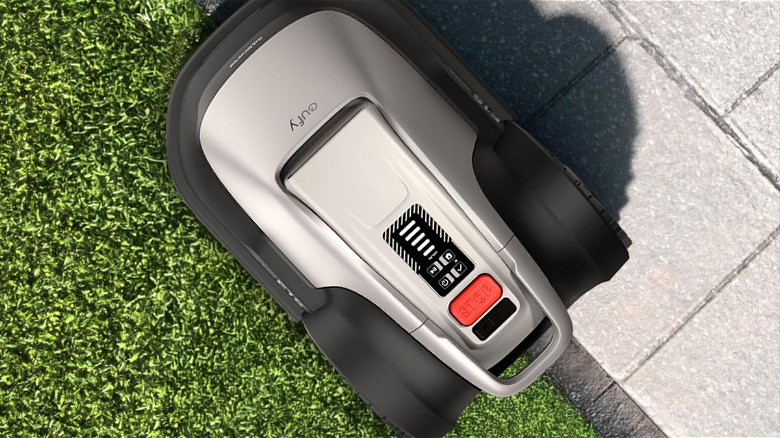
Eufy, maker of outdoor lights and affordable robot vacuums, sells just two models of robot mowers, the E15 and E18. Both have received an impressive number of positive reviews by professional publications, so they must be doing something good. The Eufy E15 is the cheapest of the two, currently sold for $1,300 on Amazon, and comes with both GPS and camera sensors, Wi-Fi and support for cellular data, and a schedule system. As for negatives, reviews note that it does not deal well with potholes and steep inclines. No Eufy robot requires a manual setup, as they create their map of your garden by wandering around, but it may still get stuck if you don't manually apply no-go zones.
The Eufy E18 is a similar beast, with one of the main improvements being a larger lawn capacity (0.3 acres against the 0.2 of the E15). That seems reasonable, seeing as this product is only $100 more expensive than the other Eufy. Both robots support a max incline of 18 degrees, so they only really work on flat or mostly flat lawns, and refuse to operate during the night, when there isn't enough light for their sensors to protect the machine and any animal or object in its way.
Both mower bots are almost always heavily discounted, so don't let that 46% off pressure you into buying now; It will still be there next week. All in all, if you're looking for a robot mower with a simple setup and an approachable price, and your lawn is quite small, Eufy could be the brand for you.
1. Segway
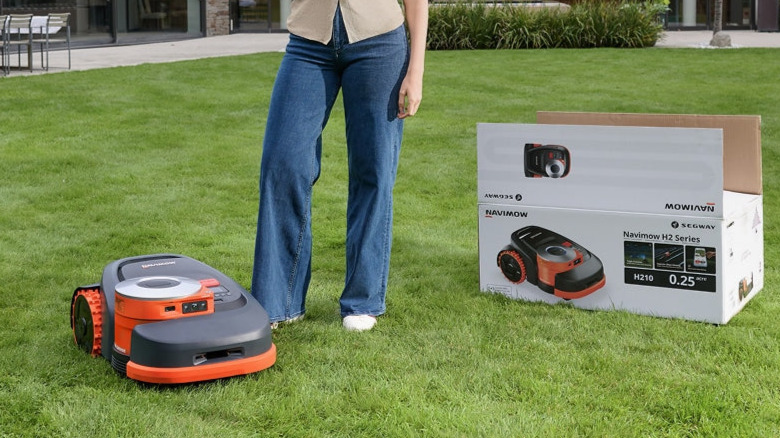
Segway makes a lot of different robot mowers and none of them are cheap, but most come with great recommendations. They're divided into the I, X, and H series, plus the Terranox series aimed at professionals. The Segway i110N was highlighted by Popular Mechanics as the mower that brings "professional-grade GPS navigation" to an entry-level model of $1,100, and for the price it's certainly a feature worth highlighting. The small ¼ acre of autonomy for the larger model (1/8 acre for the i105N) are not quite on par with other models in this price range, but the dedicated app supports customized mowing areas with complex schedules, making this mower usable on larger lawns, too, with a bit of effort.
The H series represents the middle ground in the brand's offering. It comes with GPS and support for cellular data and Wi-Fi, but doesn't deal with slopes quite as well as the X series, even if it gets pretty close. At $1,800 for the new-ish H210 model that can cover ¼ acre in one charge, the H series is not cheap, but it's a good deal cheaper than some comparable mowers from other brands. The H2 models can also create a GeoSketch, a realistic map of your yard, through their camera, which is then available on the companion app.
As for the X Series, the Segway Navimow X390 has received positive professional reviews and some recommendation from buyers, but the price of $5,000 is hard to get over. It has a very long battery life of 240 minutes and cover 2.5 acres of lawn, is relatively quiet (60 dB) and pretty fast, and supports both Wi-Fi and cellular data. Like most Navimow models, the X390 does not need boundary wire.
Methodology
To create this list of well-known brands of robot lawn mowers, we relied on reviews and roundups by professional tech and hardware websites like PCMag, Consumer Reports, and Popular Mechanics. The brands that were highlighted most often, positively or negatively, were considered to be the most popular. When it came to selecting the individual robot mower models that would represent a brand's whole output, we used both professional and user reviews to find a range of well-regarded products that fit various price ranges and use cases.