

4 Things That Can Cause A Grinding Noise When Shifting Gears

Whenever you feel a grind, jerk, or resistance, it could be your car telling you that something inside the transmission or clutch system isn't working the way it should. Grinding gears in particular are often a sign that the transmission might not be in order. And the longer you ignore it, the worse it's going to get. But to understand why it occurs, and how to avoid it in the first place, you need to understand what's supposed to happen when you shift gears.
To change gears smoothly, your engine and wheels need to be in sync. Specifically, the input and output shafts in your gearbox must be moving at the same speed before a gear can engage cleanly. If they're not able to sync up, that forces the gears to engage while moving at different speeds. The result is that unmistakable grinding sound you hear when driving.
In modern manual vehicles, there's a component called a transmission synchronizer, also called synchro, that helps facilitate this process, which is why shifting feels smoother than with a vintage car, for instance, or a commercial truck. However, when that component begins to degrade, it disrupts the synchronization process and eventually causes grinding. For automatic transmissions, although not as frequently as in manual cars, grinding can also occur due to contaminated transmission fluid, a faulty torque converter, or worn internal gears. Let's go over each potential cause in detail, so you understand what's going wrong and whether your driving or maintenance habits might be making it worse.
1. Damaged synchronizers
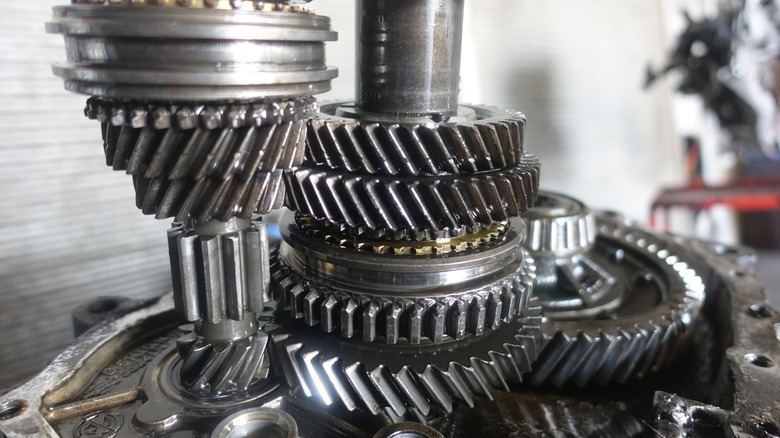
If the grinding in your car happens consistently in one particular gear, damaged synchronizers are likely the cause. In a manual transmission, synchronizers function like small individual clutches, each assigned to a gear. Their main role is to spin at the same speed as the output shaft before the gears connect. This process is what allows you to shift smoothly. But when it fails, the gears are forced to engage while still moving at different speeds, and that mismatch is exactly what produces that harsh collision of metals.
These rings are typically made from either brass or steel. Brass is more common and works well under normal driving conditions, but wears out faster. Steel handles heat and heavy use better, though it synchronizes more slowly and costs more. Either way, both types wear down over time — it's just a question of when.
Several other factors, however, can speed up how quickly they wear down. The most significant is aggressive shifting. When driving, if you have a habit of forcing the gear lever without fully pressing the clutch pedal, you're overloading the friction surfaces on the synchro rings, causing them to degrade faster than they normally would. Overheating from heavy-load driving also doesn't help matters. This will result in some of your car components facing more stress than they are designed to handle. If your synchronizers are worn out, the fix is to replace them. Attending to it quickly is important so it doesn't lead to broader transmission damage.
2. Low or contaminated transmission fluid
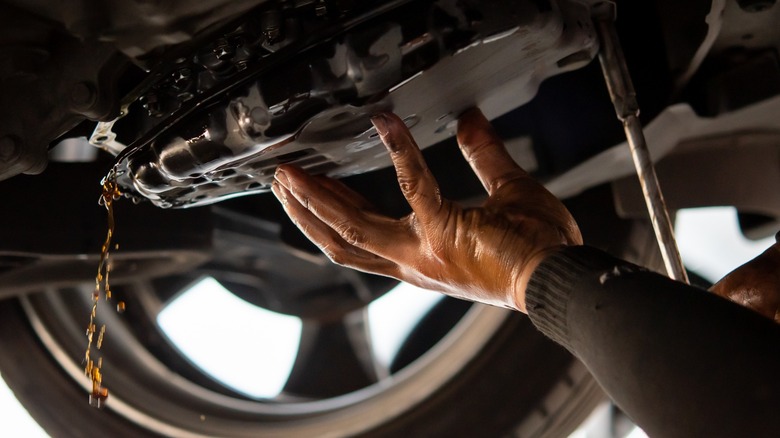
Transmission fluid is very important to the functioning of your transmission system in multiple ways. It acts as a lubricant, reducing friction between the moving metal parts inside the transmission. It also serves as a coolant, preventing components from overheating while you're driving. And in automatic transmissions, it maintains the hydraulic pressure that makes gear shifts possible in the first place. Basically, your transmission system relies on it to keep internal components moving freely and quietly.
But when the fluid level drops too low, air gets mixed into the fluid, which reduces its ability to lubricate and cool effectively. Metal components that were previously separated by this fluid begin to make direct contact with one another, and the resulting friction produces the grinding noise you hear during gear changes. More importantly, if this continues unchecked, this kind of friction increases wear across other components and generates heat that pushes the transmission toward overheating.
You'll most likely experience the same thing if your fluid gets contaminated. Once this happens, its chemical properties break down, and it loses its ability to do its job properly. One key thing to look out for is that the fluid begins to darken and develop a burnt smell. In severe cases, contaminated fluid can even contribute to burnt torque converters and damaged valves, leaving you with a deep hole in your wallet. Of all the causes of grinding gears, this one is arguably the most preventable. All you need to do is regular maintenance. Make sure your fluid never runs low and always do routine transmission fluid changes.
3. Malfunctioning clutch
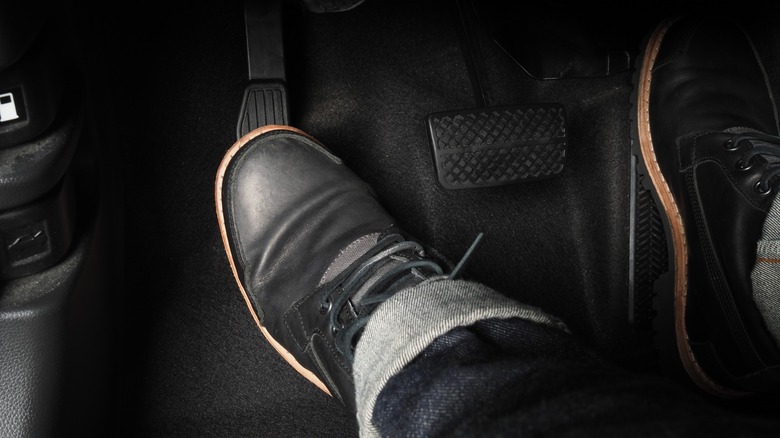
Despite the dominance of automatic-transmission vehicles, there are still cars that offer manual transmissions. If you drive one, the clutch is one of the components you use the most, so when it's not working as it should, the effects are easily noticeable. Simply, it is what separates the engine from the transmission. When you press the clutch pedal down, you are telling the engine and the gearbox to temporarily stop communicating, which gives you the window you need to move the gear lever cleanly from one gear to the next. If the clutch fully disengages and then re-engages smoothly, the gear change is seamless. But if it doesn't, it can cause your car to grind.
The most common reason a clutch reaches this point is simple wear. The clutch relies on friction material to transfer power from the engine to the transmission. This friction material degrades over time through normal use until it can no longer make the clean contact it needs to. It then gets to a point where the clutch begins to slip or fails to engage properly. Any of these can cause the unsettling jolt you feel when the car does not shift properly.
Beyond normal wear, certain driving habits can be harming your transmission. One of the most damaging is riding the clutch, which means keeping the pedal partially engaged rather than fully up or fully down. It's a common mistake that can ruin your engine. Also, hesitating while changing gears can put additional strain on the clutch assembly. While it's natural for your clutch to eventually wear out, you'll be doing yourself a lot of good if you catch it early. It is a far less expensive repair than one that has been driven into the ground.
4. Faulty torque converter
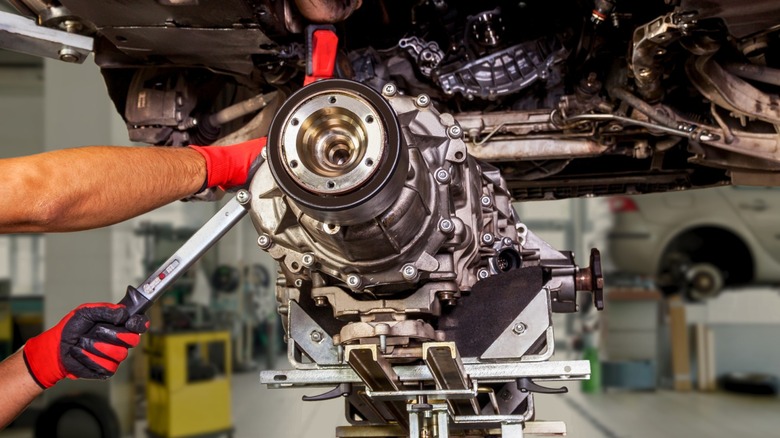
The torque converter performs the function of a clutch in an automatic-transmission vehicle. Just like the clutch, it sits between the engine and the gearbox and serves the same fundamental purpose: connecting and disconnecting power between the engine and the transmission. Inside the torque converter, four main components work together, namely the pump, the turbine, the stator, and the transmission fluid that flows between them.
The engine powers the pump, which keeps fluid flowing through the converter. That fluid flow turns the turbine, which is linked to the transmission, and that's how power is transferred to the wheels. The stator sits between them, redirecting fluid to improve efficiency, particularly at lower speeds. When any component within that system wears out or is damaged, it can lead to slipping gears, vibration, and unusual noise.
Several things can cause a torque converter to deteriorate. High mileage is the most common one. The internal components simply wear down over time with accumulated use. Overheating is another major factor. Towing heavy loads, driving in extreme temperatures, or a cooling system that is not doing its job properly can all generate excessive heat inside the transmission, damaging the internal components of the converter.
Aside from the grinding noise, a faulty torque converter can give you a serious headache if you don't attend to it early. Because it regulates the flow of fluid throughout the system, a failing converter can cause the transmission fluid to overheat, which in turn accelerates wear across the entire transmission. So, once you notice the grinding noise or any of the other indicators we listed above, it's best to take your vehicle to a mechanic to prevent a complete transmission failure.
How we compiled this list
We started by going over consumer forums like Reddit to get a good sense of what drivers were actually dealing with. That includes which gears were often grinding, under what conditions, and how they ended up resolving it. From there, we consulted trusted repair shops and transmission specialists to see what the experts had to say about what usually causes these grinding noises. Once we had a shortlist of problems, we went over detailed mechanic breakdowns on each one to understand why it occurs and what often makes the damage worse.
Since grinding noises can happen in both manual and automatic transmissions, we tried to include causes that apply to both. In most cases, you'll still need a mechanic to diagnose and recommend a repair plan. Our goal, however, is to help you understand what could be going on under the hood and when it might be dangerous to ignore the noise, so you're in a much better position to decide what to do next.