

5 Hypercars Faster Than A Kawasaki Ninja H2R Motorcycle
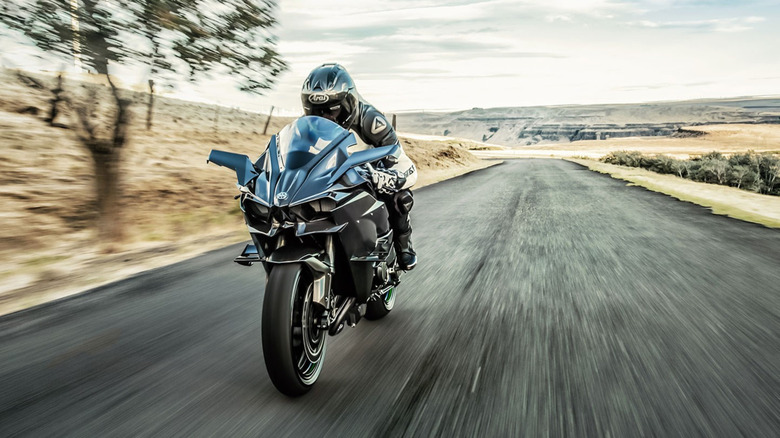
It might have debuted over a decade ago, but the Kawasaki Ninja H2R is still the fastest production motorcycle in the world. In the hands of Kenan Sofuoglu, it reached a top speed of 248.5 mph over the Osman Ghazi Bridge in Turkey back in 2016. Sofuoglu is a 5-time Supersport World Champion, and he said at the time of the record that his H2R could not have gone any faster. In the intervening years, no one else has matched his record.
It appears that the H2R isn't going to be giving up its crown anytime soon, but even if the world of two-wheeled record setters hasn't changed over the last ten years, the same cannot be said for those on four wheels. A string of new hypercars has emerged to compete for the title of world's fastest production car, including a brand new competitor that set an all-out record in 2025.
Some manufacturers have claimed that their cars are even faster than the current records, although they haven't officially tested their limits just yet. We'll leave them to one side here and focus on hypercars that have set verified speed records, with each one being able to hit a top speed that's so fast it would leave even the Ninja H2R in the rear-view mirror in a suitably long drag race.
Hennessey Venom GT — 270.5 mph
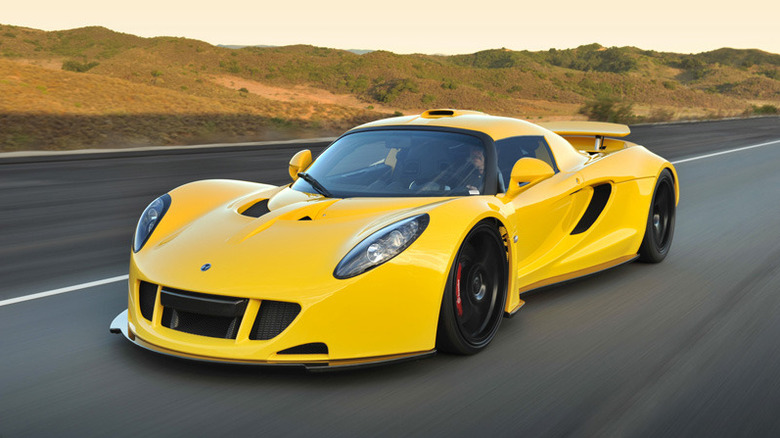
Even before the Ninja H2R completed its record-breaking run, hypercars had already significantly eclipsed its top speed. As far back as 2010, Bugatti had set an independently verified speed record of 268 mph, and by 2014, the Hennessey Venom GT had taken the crown, hitting a verified one-way top speed of 270.5 mph. The record attempt took place at the Kennedy Space Center, with the Venom GT making full use of the center's 3.2-mile runway. However, it didn't set a Guinness World Record because of NASA's restrictions on a return pass.
At first glance, the Venom GT looks like a stretched Lotus Elise. This was no coincidence: Hennessey did indeed base its hypercar on the Elise, but fitted it with an LS engine making 1,244 horsepower. That combination of a light British-designed chassis and American power proved to be an extremely effective one, catapulting John Hennessey's eponymous brand into the big leagues and rivaling established hypercar makers like Bugatti and Koenigsegg.
Hennessey has since launched a follow-up hypercar called the Venom F5, and John Hennessey has promised that it's capable of exceeding 300 mph. In 2022, it reached a speed of 271.6 mph in testing, just about beating the Venom GT, but at the time of writing, it has yet to cross the 300 mph barrier in an independently verified run. When we drove the Venom F5, we certainly thought it felt fast enough to reach the milestone, but even the older Venom GT could still comfortably outpace the Ninja H2R, given a long enough runway.
Koenigsegg Agera RS — 277.8 mph
Achieving ever faster speeds isn't simply a matter of having a hypercar that's up to the task. In an interview with Top Gear, Christian von Koenigsegg said that "it's all down to tires," as well as being able to find a long enough stretch of asphalt to complete the run. He claimed that his brand's Jesko Absolut hypercar could reach a top speed of more than 311 mph, which would make it the fastest production car in the world. However, he hasn't been able to put that claim to the test in the real world yet.
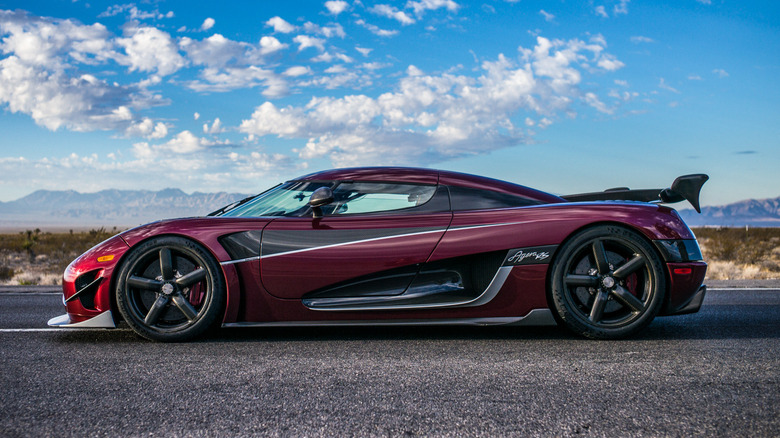
Instead, the Koenigsegg with the fastest two-way top speed is the Agera RS, which clocked an average of 277.8 mph on a closed Nevada highway in 2017. When it was fed E85 fuel, the Agera RS produced 1,360 horsepower from its twin-turbo 5.0-liter V8 engine. Even using gasoline, it still churned out up to 1,160 horses.
To be able to reach such dizzying speed, the Agera RS needed to be very light as well as very powerful. Koenigsegg manufactured the chassis from carbon fiber and honeycomb aluminum, while the bodywork was constructed from carbon fiber and Kevlar. Even the car's wheels were hollow and made from carbon fiber to keep weight to a minimum.
SSC Tuatara – 295 mph
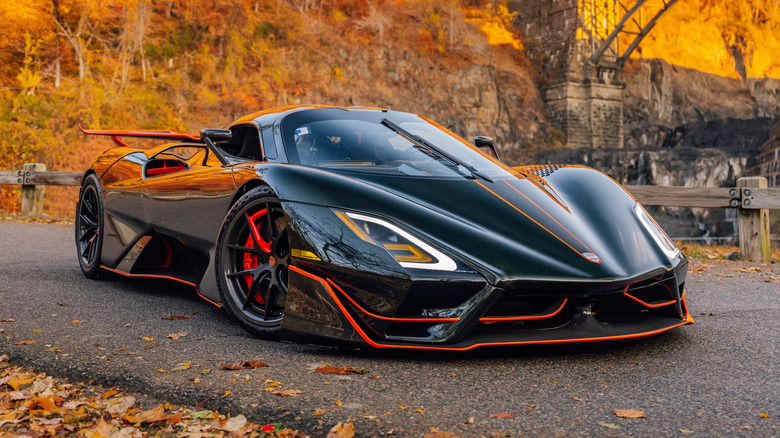
You might expect the question of the SSC Tuatara's top speed to be an easy one to answer. Unfortunately, not even its maker has ever been able to provide a single, undisputed figure. SSC originally claimed to have hit a top speed of 331 mph in testing, which would have made the Tuatara the fastest car in the world by a significant margin. After a lot of scrutiny of its claims, the company was forced to admit that it didn't actually hit that speed.
Nonetheless, it vowed to continue testing the Tuatara, this time enlisting independent specialists to prove that the car could actually stake a claim to being one of the fastest hypercars on the planet. In 2022, the company announced that it recorded a top speed of 295 mph during a test run that was independently verified by data specialist Racelogic. However, it still wasn't able to break the 300 mph barrier that they'd vowed to hit, despite claiming that during the 295 mph run, the hypercar had more to give.
Despite the early controversy, SSC has now provided enough evidence to suggest that the Tuatara is indeed one of the fastest cars on the planet. The company hasn't given up on its goal of surpassing 300 mph, but even if it manages that, a couple of even speedier rivals stand in the way of its push to become the world's fastest hypercar.
Bugatti Chiron Super Sport 300+ — 304.8 mph
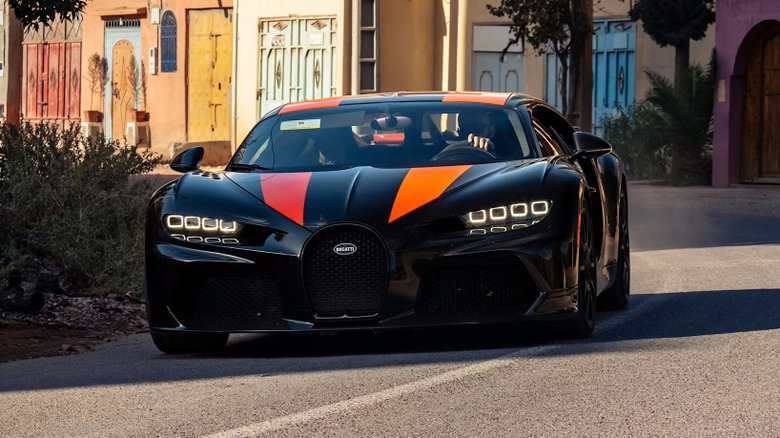
The first car to break past the 300 mph barrier was the Bugatti Chiron Super Sport 300+, which achieved a top speed of 304.8 mph with multiple speed record holder Andy Wallace at the wheel in 2019. Bugatti tested the car at the Ehra-Lessien track in Germany, and Wallace claimed in a Car and Driver interview that the location was actually a limiting factor in the final speed.
He said that the Chiron's "speed trace hadn't leveled out [and] it was still climbing" by the time he had to pump the brakes to enter the track's banked curves. Even if the car could perhaps have achieved slightly more, Bugatti has claimed that it's no longer interested in top speed runs. Even if newer cars may hypothetically go faster one day, the brand's stance at the time of the record was that it had no interest in testing it out.
It remains to be seen whether Bugatti sticks to its word of keeping the Bugatti Chiron Super Sport 300+ as the official fastest car in the brand's history. It had already tweaked the Chiron's engine for additional horsepower, with the record-breaking car making 1,600 horsepower, just over 100 more than the original car. It's not implausible to think that the appearance of a new, upstart Chinese competitor might have been enough to get Bugatti engineers working on reclaiming the brand's crown.
Yangwang U9 Xtreme — 308.4 mph
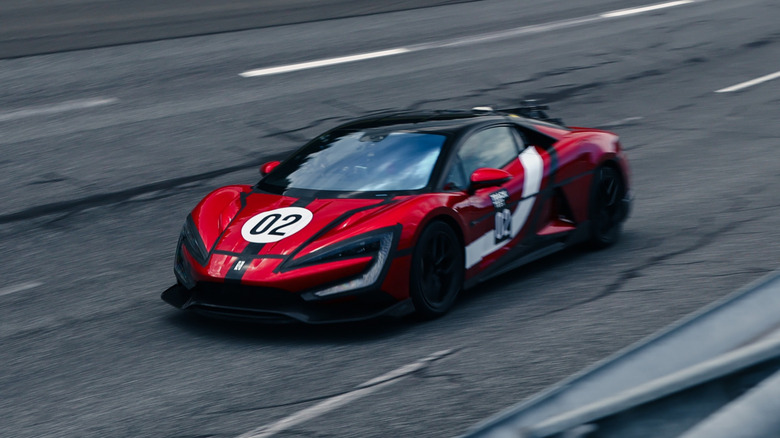
Even if you're not familiar with the Yangwang name, it's safe to assume that most enthusiasts are well aware of its parent company, the Tesla-rivaling Chinese automaker BYD. At the ATP Automotive Testing track in Papenburg, Germany, Yangwang took its U9 Xtreme hypercar to a top speed of 308.4 mph in 2025. That makes it the fastest car in the world, yet it achieved the feat using only battery power. The car was built on a 1,200V architecture and featured a specially designed battery that could discharge significantly faster than the brand's previous efforts.
Like all the other cars here, the U9 Xtreme isn't simply a one-off prototype. A production variant of the car is available to collectors, although production is capped at 30 examples. It has also been able to earn the title of fastest production electric car around the Nürburgring.
A prototype from rival Chinese carmaker Xiaomi managed to go even faster, while Xiaomi's fastest production car is only a few seconds behind the U9 Xtreme. Historic brands like Bugatti might be walking away from record chasing, but the new crop of Chinese companies is doing the opposite. One day, a Chinese manufacturer might even develop a faster production motorcycle than the Kawasaki Ninja H2R, but for now, the Japanese icon still rules the roost in the bike world.