

4 Reasons You Might Not Want To Buy A Toyota RAV4
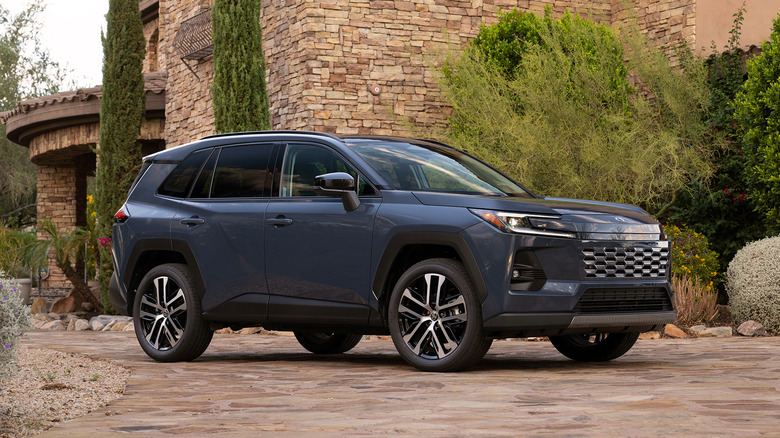
In 1989, Toyota unveiled an unconventional concept car dubbed the RAV-FOUR. SUVs were gaining traction and Toyota was eager to add to its lineup, which already included the 4Runner and the Land Cruiser by that point. The concept RAV-FOUR was something different, with a striking resemblance to the Geo Tracker, combined with the rugged, open-topped design of a Jeep Wrangler. Here in the U.S., the RAV4 wasn't introduced until the 1996 model year, and while it bore little resemblance to that quirky concept, sales quickly gained traction, and it's now the best-selling SUV in America.
In 2025, Toyota sold almost half a million new RAV4s in the U.S. alone. The newly-redesigned 2026 model, which is available only as a hybrid, is not only in high demand, it's also taking home plenty of awards. Kelley Blue Book named it the Compact SUV Best Buy of 2026, and Green Car Journal gave it the 2026 Green Car of the Year award. So why should you think before buying one?
There are many good reasons to buy this hybrid SUV, including its excellent fuel economy and vast cargo space. Whether you plan to buy used or new, however, there are a few drawbacks that you should consider before making such a big commitment. Here are four reasons to explore other compact SUV options.
You may pay above MSRP

Buying a new car isn't like buying a loaf of bread — you can often negotiate a lower price than is advertised on the sticker, especially if you comparison shop. If the dealership in the next town over is willing to discount your purchase by $2,000, maybe your local dealer can match or beat that offer. No one expects or wants to pay more than the manufacturer's suggested retail price, or MSRP, but according to Consumer Reports, some buyers are paying above sticker price.
The 2026 Toyota RAV4 has a starting MSRP of $31,900. The compact SUV is available in six trims, with the top of the line Limited trim starting at $43,300. Pricing will differ based on location, but some Toyota dealerships are selling new RAV4 models for up to 5% over MSRP. That adds more than $1,500 to the base model, and more than $2,000 to the Limited model. This has been attributed to production problems that have created a low inventory, combined with continuing high demand.
To avoid paying over MSRP, be ready to negotiate. Edmunds suggests you find out the invoice price, or the price that the dealership for the vehicle. This price will be under MSRP because the dealership needs to make a profit. The dealer is under no obligation to share this information with you, but you can ask. If they refuse, Edmunds recommends that you use the "Build and Price" link on its car review page. Configure the vehicle to match the one you're interested in purchasing, and the invoice price will be listed in the price breakdown.
Better warranties are available

If something is going to break on your vehicle, it's Murphy's Law that it will happen mere miles or days after your warranty expires, right? Toyota covers all of its new vehicles with a basic three year/36,000-mile warranty. The powertrain has a five-year/60,000-mile warranty, and the hybrid battery is protected by a 10-year/150,000-mile warranty. It's hard to beat that battery coverage, but the basic warranty is lacking, compared to some competitors that offer some of the best warranties on the market.
The 2026 Hyundai Tucson Hybrid and the 2026 Kia Sportage Hybrid both offer a 10-year/100,000-mile limited powertrain warranty and a five-year/60,000 mile new vehicle limited warranty. The Sportage Hybrid has a lower starting price of $30,490. Meanwhile, the 2026 Volkswagen Tiguan, another non-hybrid, has a four-year/50,000-mile limited warranty along with a corrosion perforation warranty that is good for eight years or 100,000 miles.
Used models are expensive
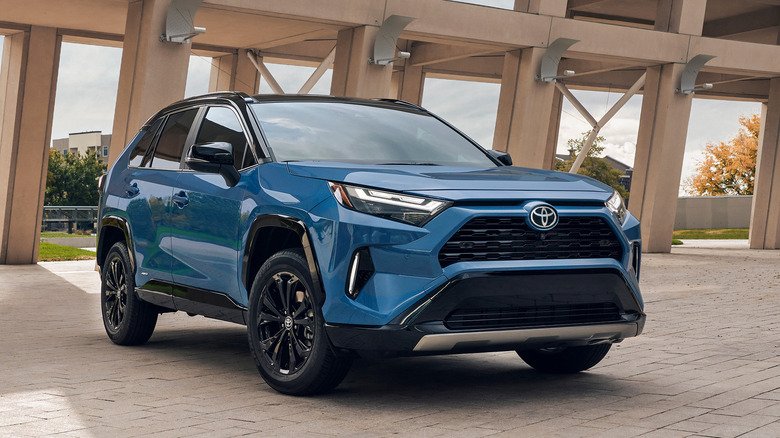
The Toyota RAV4 tends to depreciate slowly, meaning the car holds its value well. This puts some owners in a great position, especially if they're planning to sell or trade-in their vehicle for a newer model, but it can make it more difficult for those shopping for a used model. In fact, according to U.S. News & World Report, Toyota holds six of the top 10 cars with the slowest depreciation in 2026, a list that includes the RAV4.
CarEdge reports that after two years, the RAV4 retains more than 83% of its original value. By year five, this Toyota typically depreciates only about 27%. By the decade mark, a RAV4 is still worth almost 50% of its original price! How does this translate into real-world numbers? If you're hoping to buy a lightly-used RAV4 from the 2024 model year, which originally sold for about $28,600 for the base trim, buyers should expect to pay almost $24,000. If you're looking for an older used RAV4, even a 2016 model could still cost over $12,000, based on its original starting price of $24,350 and this data.
Of course, other factors affect the value of a used car, including condition and mileage. If you plan to buy new, the RAV4's slow depreciation is most certainly a positive, but it may prove to be a barrier if you want a used model.
All-wheel drive isn't standard
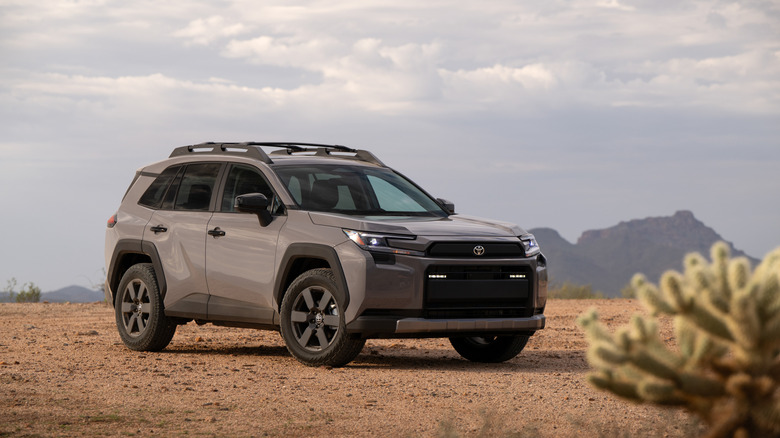
The 2026 Toyota RAV4 is available in six hybrid trims, but if you want all-wheel drive, be prepared to pay extra. Not only does the base LE trim come standard with front-wheel drive, so do the SE and even the XLE Premium trims. Adding AWD on any of these trims adds an additional $1,400 to the price, putting the base LE model with all-wheel drive at $33,300.
Several RAV4 competitors offer standard all-wheel drive, including the Subaru Forester, which starts at $29,995, or more than $3,300 less than the all-wheel drive LE model of the RAV4, and Subaru's symmetrical all-wheel drive is standard on all models. The Mazda CX-50, another compact SUV, also has standard all-wheel drive and a starting price well under the RAV4's. If a hybrid is your preferred choice, you may want to check out the 2026 Hyundai Tucson Hybrid, which has standard all-wheel drive and a starting price almost $1,000 less than the RAV4 LE with all-wheel drive.
The RAV4 boasts what U.S. News & World Report calls "adequate acceleration." All-wheel drive models have 236 horsepower, while front-wheel drive trims make 226 horsepower. If horsepower is a priority, the Mazda CX-50 Turbo, for example, has 256 horsepower when you use 93 octane gas. That being said, this trim starts at $37,900, so you'll definitely pay for that extra oomph.