

Tabless Vs. Traditional Power Tool Batteries: What's The Actual Difference?
Modern cordless power tools might not have touchscreens, but they still borrow plenty of "smart" features from smartphones. Contemporary power tools are powered by brushless motors driven by a 32-bit microcontroller that leverages embedded sensors to optimize the seemingly simple tasks of drilling and cutting. Advancements in battery technology have been equally pivotal in meeting the ever-increasing power draw of brushless power tools. And this is primarily achieved by improving the energy density of the battery cells, which also makes modern cordless power tools lighter and more compact.
This pursuit for power and efficiency has led to an arms race between major power tool brands to adopt tabless batteries over the past couple of years. But this technology is fairly confusing for consumers. Neither the tabless battery packs, nor the individual lithium-ion (Li-ion) cells within appear any different from regular power tool batteries. And then there's the challenge of figuring out the real-world improvements provided by tabless technology over plain vanilla batteries amid the marketing noise surrounding the new technology.
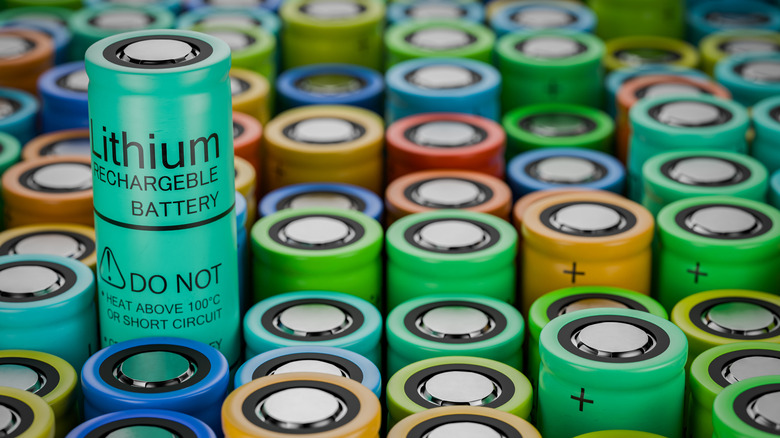
For starters, tabless batteries have nothing to do with the shape or size of the individual cells. These tabless cells come in the same Li-ion sizes, such as the standard 18650 or the larger 21700 varieties. The shape of the positive terminal or the anode—be it "button top" or "flat top"—isn't a matter of distinction either. In fact, tabless batteries and their individual cells do not physically differ from regular Li-ion batteries at all. Because the magic lies inside the individual Li-ion cells themselves, let's delve deeper to understand how tabless battery technology improves power tools.
Understanding tabless battery technology
A lithium-ion cell is an expensive chemical sandwich comprised of a toxic electrolyte (brimming with lithium salts) trapped between a graphite anode and a cathode fashioned out of various lithium metal oxides. The anode and cathode are layered alternately into thin, flat sheets. When these electrode pairs are rolled into a cylinder, you get cylindrical Li-ion cells. Whereas pouch cells involve the same electrodes being laid out into flatter sheets. Additionally, there's the all-important separator, which is a porous insulating sheet (fashioned out of ceramic or polymers) facilitating ion exchange between the layered anode and cathode sheets. It also stops the electrons from jumping between the electrodes and causing house fires.
This setup ensures that the migration of lithium ions between the electrodes forces the electrons to move from the anode to the connected load (EV, drone, vape, etc.) and back through the cathode. In standard cylindrical Li-ion cells, these electrode pairs are connected to external positive (anode) and negative (cathode) terminals located at the opposite ends by thin strips of metals also known as tabs. These tabs create a bottleneck of sorts by forcing electrons, generated by lithium ions migrating between the entire length and breadth of the electrode sheets, through a thin and narrow sheet of metal.
If you remember Ohm's law, reducing the cross-sectional area of a conductor increases resistance, impedes current flow, and generates excessive heat. A tabless cell removes this bottleneck by allowing the electrons to be transported to their respective battery terminals along the entire edge of the electrode sheets. Think of tabbed cells as forcing vehicles on a six-lane freeway to zipper merge into two lanes. A tabless cell basically allows the freeway traffic to move uninterrupted by eliminating the bottleneck.
Higher discharge rates, better cooling, and faster charging
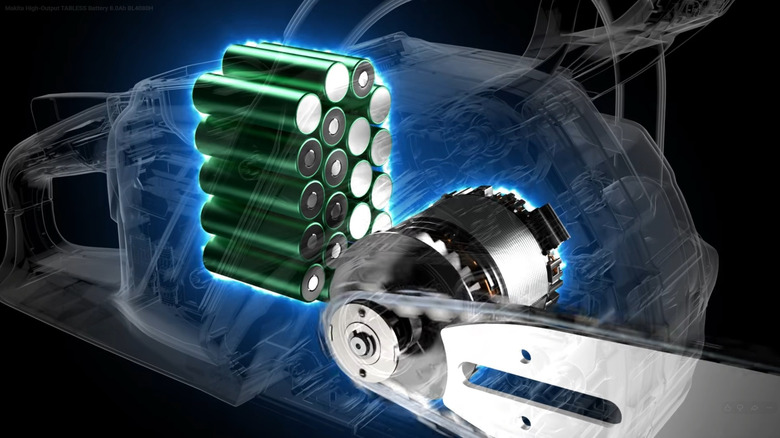
The most obvious benefit of tabless battery technology comes from its significantly high discharge rates over its standard cylindrical Li-ion counterpart. The ability to dump more amps into a cordless power tool makes tabless batteries perfect for heavy-duty drilling, cutting, and demolition tasks. These roles are usually restricted to expensive batteries employing pouch cells, which offer lower internal resistance and faster heat dissipation. Tabless cylindrical Li-ion batteries might not offer the same energy density of batteries employing stacked pouch cells, but the former can still compete with pouch cell technology in terms of internal resistance, discharge rates, and thermal stability.
In fact, the improved thermal performance of tabless batteries isn't restricted to longer service life, but it is quite important for job sites where battery uptime matters. The same technology that delivers high discharge rates in tabless cells also allows them to recharge quicker. Because tabless batteries stay cooler under heavy loads, they can be charged immediately after use. This isn't true for tabbed Li-ion power tool batteries, which have a significant cooldown period enforced by the charging unit's inbuilt protection circuitry. A busy worksite benefits from improved productivity when batteries charge quicker and can therefore be cycled on and off power tools more efficiently.
And it's not just about pure performance either. The increased current output of tabless batteries also makes it possible to match the performance of larger traditional Li-ion battery packs. In other words, you have the choice between maximizing power, or improving ergonomics and lowering operator fatigue with a lighter power tool.