

4 Of The Most Practical Pickups Americans Can Buy In 2026

Pickup trucks are an important part of the automobile culture in America. Drive through any neighborhood, pull into any hardware store parking lot, or glance out at any highway, and you'll spot them; they are usually hard to miss. But here's the thing, most of those trucks spend the majority of their time doing ordinary things. Commuting to work, running to the lumberyard, towing a trailer on the weekend, etc. Even when they are used to haul gear, the truck's actual limits are rarely tested.
Now, that gap between what a truck can do and what most owners actually ask of it is exactly where the idea of practicality becomes so important. For example, if you're hardly going to be using the features that give a particular truck its premium tag, why not go for a cheaper but still reliable option? A truck that has high towing ratings but consumes fuel outrageously isn't practical. Nor is it one that rides so rough you dread the commute or costs so much upfront that it takes years just to break even. Practical means the truck works hard and works smart without constantly reminding you what it costs.
That's the standard we used to put this list together. Whether you're in the market for something brand new or open to a used model that still has plenty of life left in it, these four pickups represent some of the best real-world value you can find right now, and they also rank among the most reliable pickup trucks of all time. To give you flexibility, this list covers a range of sizes, price points, and use cases. So there's something here for you, regardless of what your taste is
Ford Maverick Hybrid
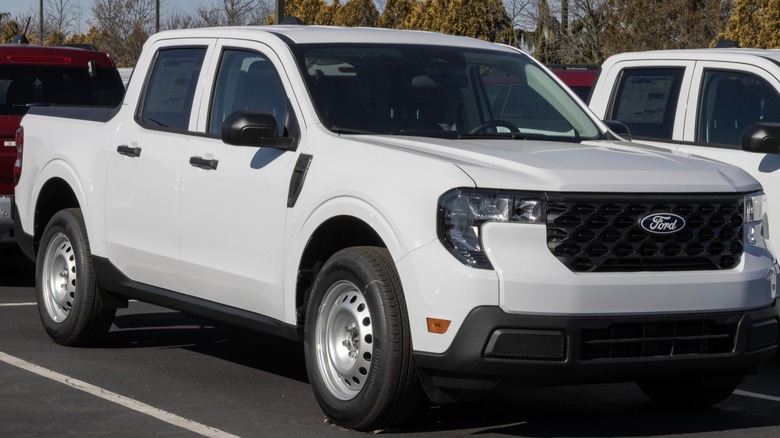
If you're in the market for an entry-level small pickup, then you should consider the Ford Maverick Hybrid. This is a compact truck that manages to drive like a crossover, work like a truck, and sip fuel like neither. Under the hood, the hybrid setup pairs a 2.5-liter four-cylinder engine with an electric motor and a continuously variable transmission, giving you a combined 191 horsepower and 155 lb-ft of torque. These aren't headline-grabbing numbers, but they're enough for everyday driving. Around town, the hybrid system drives smoothly. The only real drawback is the noise; the hybrid powertrain can sound a bit harsh and unrefined under acceleration. If that bothers you, the available 2.0L EcoBoost four-cylinder is the alternative, but that will drop you back to around 25 MPG combined.
And the hybrid's fuel economy numbers really are the headline here. The EPA rates the front-wheel-drive Maverick Hybrid at 42 MPG city and 35 MPG highway, for a 38 MPG combined figure. Even when you add all-wheel drive, it only dips to 37 MPG combined. In real-world testing, reviewers regularly averaged 36 MPG or better, making it one of the most fuel-efficient trucks you can buy at any price. In terms of capability, the truck's towing and payload numbers are honestly average. The hybrid can pull up to 4,000 pounds, while payload capacity tops out at 1,500 pounds.
Where the Maverick Hybrid does attract criticism is in its interior quality. You can easily tell the materials used were on budget. In comparison, the Hyundai Santa Cruz offers a nicer interior experience for comparable money. None of that changes the fundamental value of what the Maverick offers, though. It starts at $26,771, while still being one of the pickup trucks with good resale value.
Honda Ridgeline
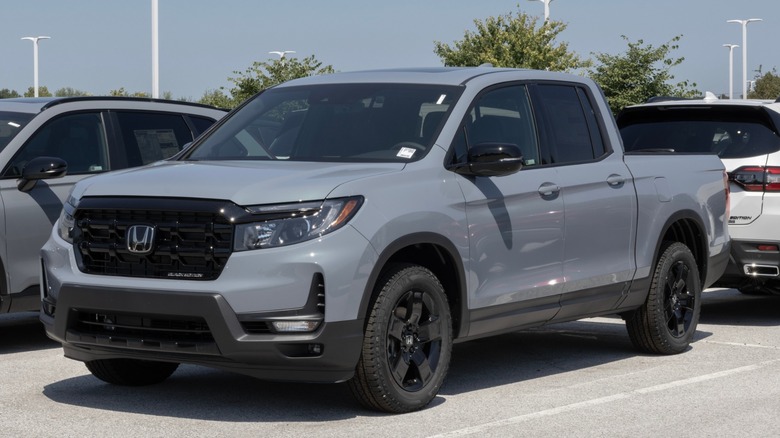
The Ridgeline is Honda's only pickup truck for the North American market, and it has always done things differently. Rather than the traditional body-on-frame construction used by most trucks, it's built on a unibody platform. That decision shapes everything about how this truck drives and feels. Its construction gives this truck a unique, car-like driving experience that you hardly find among pickup trucks.
Powering this truck is a 3.5-liter V6 producing 280 horsepower and 262 lb-ft of torque, yet this engine rarely sounds or feels strained. Its power delivery is smooth, and the nine-speed automatic transmission shifts without drama. When independently tested by a reviewer, the Ridgeline went from zero to 60 MPH in around 6.2 seconds, which is quick for a midsize truck. Fuel economy, sits at a modest 21 MPG combined, though owners report real-world figures closer to 24 MPG, which is noticeably better than the official estimate. For a V6-powered all-wheel-drive truck, you can't complain.
On the capability side, the Ridgeline tows up to 5,000 pounds and carries a payload of up to 1,583 pounds in base trim. While these numbers are okay, traditional midsize trucks offer way more, with ratings closer to 7,500 pounds. It's also worth acknowledging that this truck has been in its current generation since 2017, and the age is starting to show. The exterior and interior designs feel dated, and some of the driver-assist technology lags noticeably behind newer rivals. That being said, the safety credentials are solid, and for its price tag of $42,000, it provides value for money and is one of the best pickup trucks for families out there.
Ford F-150
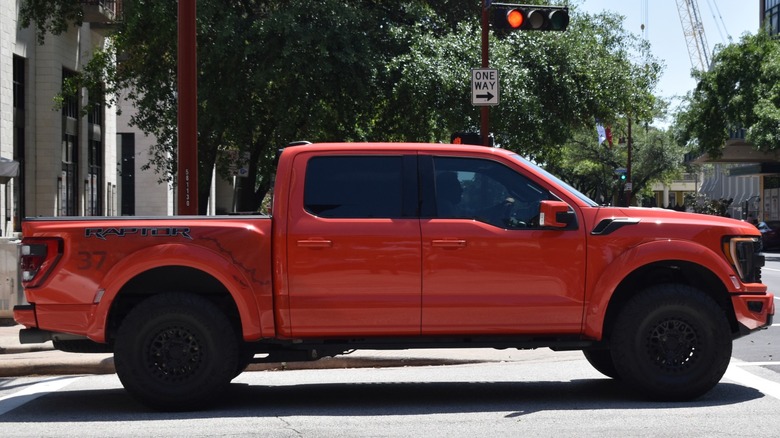
There's a reason the Ford F-150 has been America's best-selling vehicle for decades. This truck genuinely does more things, in more configurations, for more types of buyers than anything else in its class. For starters, this truck is available in nine trim levels, ranging from the work-grade XL, which costs around $39,330, to the high-performance Raptor R, which will set you back over $110,000. That breadth of choice can feel overwhelming for a first-time buyer, but it also means there's an F-150 built around almost any use case you can think of.
In terms of engineering, each model comes with different specifics. Using the PowerBoost Hybrid as a case study, it runs on a 3.5-liter twin-turbo V6 paired with an electric motor producing a combined 420 horsepower and 570 lb-ft of torque. When tested, that powertrain gets this truck from zero to 60 MPH in around 5.5 seconds, which is genuinely impressive for a vehicle of this size. It also tows up to 13,500 pounds, with the payload capacity across the F-150 lineup reaching as high as 2,440 pounds, figures that you'll rarely see on a heavy-duty truck.
On the road, the F-150 handles itself well for a truck of its size. The steering is direct and responsive, which makes the truck feel manageable. One criticism is that the F-150 uses leaf springs at the rear, and with an empty bed, it can feel noticeably bouncy. It's not a deal-breaker, but it's worth knowing before you commit.
Fuel economy is mostly average across the F-150 models. The PowerBoost Hybrid is rated at 23 MPG combined, which, for a truck capable of towing over 13,000 pounds, is pretty cool. Nonetheless, this vehicle still ranks comfortably among the best pickup trucks of 2026.
2026 GMC Sierra EV
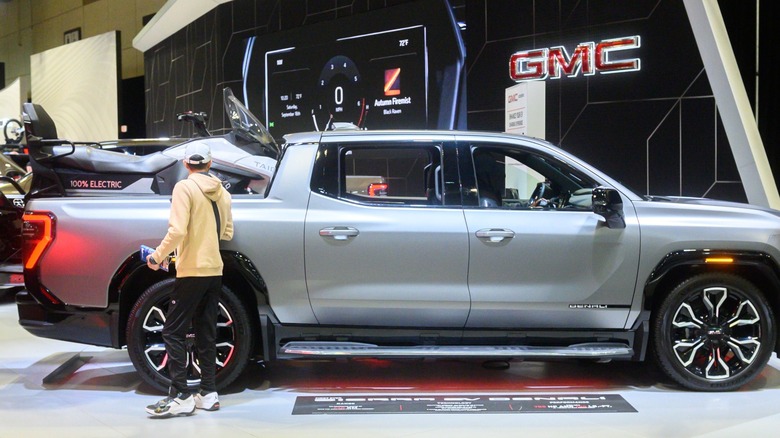
Electric pickup trucks are not particularly popular among truck enthusiasts, especially the traditional truckheads. Concerns around range anxiety and towing limitations have limited the appeal of these EVs in the market. While the 2026 GMC Sierra EV doesn't erase every one of those concerns, it makes a pretty strong argument.
It helps to start with the numbers, because they're impressive. The Sierra EV can tow up to 12,500 pounds in its top configurations, way more than its contemporaries. Payload capacity reaches 2,250 pounds on the Elevation and Denali models. Those figures put it in conversation with gas-powered full-size trucks on the market. Range, which tends to be the first question any EV buyer asks, is equally convincing. When equipped with the optional 205-kWh Max Range battery pack, the Sierra EV delivers an EPA-estimated 478 miles on a full charge, which is more than decent. It also charges quite well. When connected to a 350-kW DC fast charger, the Max Range pack can add approximately 116 miles in as little as 10 minutes.
Powering the Sierra EV is a dual-motor four-wheel-drive setup with outputs ranging from 605 to 760 horsepower, depending on the configuration. The AT4 trim, for example, gives you 625 horsepower and 775 lb-ft of torque. That translates** to a zero-to-60 MPH time of just 4.5 seconds.
However, this vehicle has drawbacks, which are not surprising. Significantly, it is a heavy vehicle, weighing over 9000 pounds, which you'll find out** when you're trying to steer under hard acceleration. Also, it seems GMC overpromised on the AT4's off-road capabilities. Those caveats aside, this EV's base price, which has been significantly reduced to $62,400 for 2026, makes it quite compelling if you're looking for an electric pickup truck.
How we compiled this list

Picking the most practical trucks on the market isn't as straightforward as it sounds. "Practical" means different things to different people, so we started by asking a simple question: what do most ordinary truck owners actually use their vehicles for? The answer, more often than not, is daily commuting, weekend hauling, towing a trailer, and getting through a workday while minimizing fuel usage. That became our benchmark.
From there, we looked across a range of sizes, price points, and powertrain types; from a compact hybrid pickup to a full-size electric truck, because practicality doesn't look the same for every buyer. We also leaned on data from Consumer Reports and J.D. Power studies, both of which survey real owners and give an honest picture of long-term satisfaction that spec sheets simply can't replicate.
We also consulted driver forums, which gave us an additional layer of candid, real-world perspective from people living with these trucks day to day. Finally, we cross-referenced our findings with established automotive sources to make sure everything held up.