

These New Sensors Could Drastically Change How Self-Driving Car Tech Works
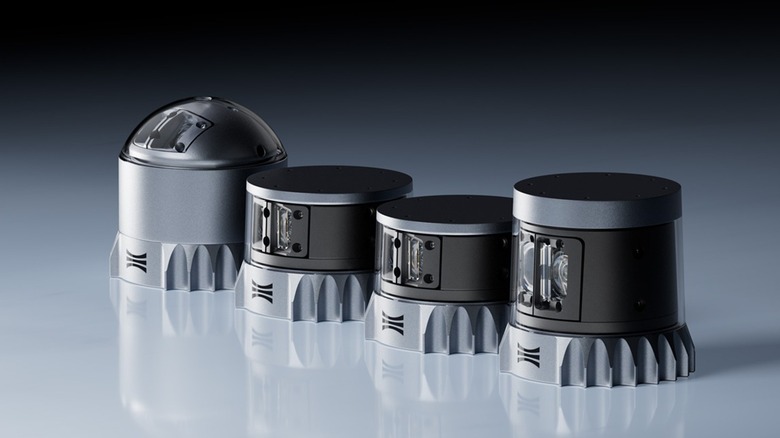
Self-driving cars are becoming more common on the roads, with several U.S. cities now making them a part of their public transportation. This technology is far from perfect, however, with some recent missteps involving self-driving cars cruising down light rails, passing through wet cement, or crashing into a firetruck. As such, tech companies continue to look for ways to improve their capabilities and safety.
One company, Outster, is working on a new lineup of sensors called "Rev8" that it claims could enhance safety for self-driving vehicles. Generally, a self-driving car has multiple cameras placed all around the vehicle to capture a 360-degree view of its surroundings. Radar and lidar complement these cameras, as the former works in low-visibility conditions and the latter can help the vehicle measure distances and create a 3D map.
The Rev8 sensor, also known as a "native color lidar," would serve as both a lidar and a camera, capturing imagery and three-dimensional landscapes simultaneously. This could essentially help self-driving systems operate more efficiently, according to the company. The Rev8 platform includes the OS1 Max, a 256-channel sensor that measures 500 meters in all directions, but Outster says there are other sensors built on this platform as well.
How these radars could help advance self-driving technology
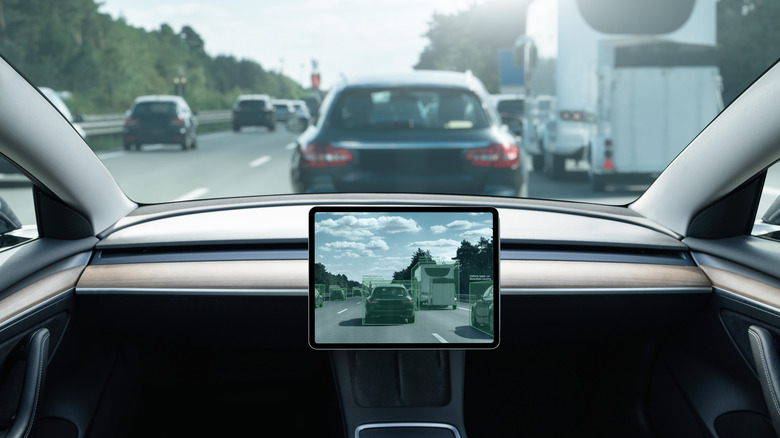
There are six different levels of autonomous driving capabilities, ranging numerically from 0 to 5. Robotaxis from companies like Waymo generally operate on Level 4, whereas vehicles with driving assistance features involving breaking, acceleration, and steering are classified at a Level 2. For Level 3, vehicles have self-driving capabilities but must still be monitored actively by a human driver, who can intervene when necessary. In order to be classified as Level 3 or higher, self-driving cars must have camera sensors, radar, and lidar. Color lidar sensors could help automakers advance their driving systems, and possibly improve autonomous driving technologies like robotaxis.
Outster is not the only company working on color lidar. It's competing against China's Hesai Group, which has revealed the "6D ETX full-color platform" that can detect color, reflectivity, and velocity of surrounding objects as well. In South Korea, another company called bitsensing recently revealed a similar sensor for self-driving cars called AIR4D that works as both a camera and a radar. As more carmakers rush to develop more advanced systems, these new lidar sensors could allow self-driving cars to work more efficiently and accurately.