

5 More Terrible Places To Store Lithium-Ion Batteries

Power tool safety is as much about what you do with them when they aren't in use as when they are. With so many of the devices we use every day having rechargeable batteries now, it's easy not to really give them a second thought. However, we do this at our peril, because they can be incredibly dangerous if they aren't stored correctly.
If you're a home improvement veteran, you may well have accrued quite a collection of power tools, and that might mean a lot of different types of batteries to care for. Even if you're only an occasional user, though, it's just as important, because this would tend to mean that your tools are in storage a lot of the time. If they're not being checked on or maintained regularly, they could be a potential danger.
There are a lot of places that you absolutely shouldn't store your DeWalt batteries, for instance. Fortunately, as expected with such items, other manufacturers and suppliers like Harbor Freight have also created a huge range of materials for each product regarding safe usage and storage. At the same time, it's important to note that, with the ubiquity of Li-ion, it's not just about power tools. Here, then, are some more places that you absolutely shouldn't store lithium-ion batteries, whether they're powering the most formidable of power tools or something a little more low-key.
Connected to a charger

So many of us are guilty of charging devices overnight even when advised against it. The feeling of waking up with a cell phone at 100% battery ready to start the day is an enticing one, for certain, but there's a good reason why we shouldn't charge overnight: This is an unattended charging lithium-ion battery, after all, and that can be a no-no.
The first thing to consider is the type of battery in question. Harbor Freight's user manual for the 190 Watt Power Source Battery Inverter warns that chargers aren't interchangeable with all battery packs, and they may even burst into flame if mixed up. Also, this is not a license to keep a device plugged into the correct charger indefinitely.
Though many modern batteries are designed in a way that prevents overcharging, it is still safest to ensure that a given device fully charges and then is removed from power promptly. As the National Fire Protection Association puts it: "Do not keep charging a device or the device battery after it is fully charged."
Even if the battery is only going to be stored briefly, take care to check that it's unplugged and remove its charger from power. During a charging cycle, it can get very hot, and the same sort of safety measures apply: Keep it on a flat, safe, non-flammable surface before even plugging it in.
In critical home evacuation spots in case of an emergency

A major concern with so many different electronics is the importance of keeping them dry. For this reason, you should typically avoid storing them in places such as basements. There's much more to think about in addition, however, if you live in an area that's prone to flooding.
The National Fire Protection Association notes that, if there's a possibility of flooding in your area, lithium-ion batteries should be kept as far away from the danger as possible. On top of that, it warns, "do not attempt to charge a lithium-ion battery that has been submerged in water or shows signs of damage; do not try to open or repair a submerged or damaged battery."
In the panic and rush to minimize damage, it's easy to over-fill the safest spots in your home with the essential property you're protecting. In doing so, though, it's also important to remember that you might be creating another danger for yourself. The NFPA adds, "don't store batteries near evacuation pathways, windows, doors, or sleeping areas."
Should the worst happen with compromised, damaged, or faulty batteries, doing so could potentially make a disaster far more difficult to control or escape from. As a result, it's essential to consider every aspect of an environment for the storage of such batteries. Temperature and moisture are huge factors, of course, but the physical space taken up in a home, and the areas that could be damaged if a compromised battery causes a fire, for instance, must be taken into account too.
Too close to other batteries of varying power levels
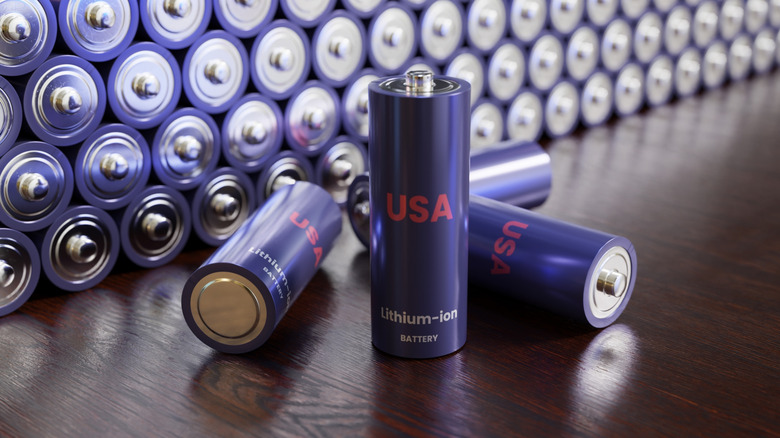
Some arrange their toolshed, garage or workshop by meticulously arranging and labeling every item within. You may think that you're doing exactly the right thing by carefully placing your batteries all together, then, but take particular care if they're of all different levels of charge and if they're in close contact.
The reason for this is that batteries have terminals, and while in storage, they can be very dangerous if touching inadvertently. Rogue Disposal & Recycling Inc. notes that if batteries' terminals inadvertently touch, it can cause a short that can spark a fire. As such, lithium-ion batteries that can be removed from their device are recommended to be kept packaged separately, or with a special tape protecting the terminals, while in storage or when transported for recycling.
When batteries are stored together, it's not just a matter of proximity to each other. The condition of the batteries, as well as their charge level, is another factor that can exacerbate the danger. A battery that's a bit old might find itself placed on an out-of-the-way shelf, and it can be difficult to tell at a glance whether it has damage that could be or become dangerous. It may degrade further over time, safely out of sight and out of mind.
Outdoor storage areas without sufficient protection from the elements

In our rundown of important mistakes to avoid when storing tires, we noted that outdoor locations without sufficient protection from the elements are to be used for temporary storage at most. Batteries are no different. DeWalt's vice president of product management, Sara Godding, told BobVila.com in 2025 that "cold air reduces the battery's capacity and efficiency, leading to shorter run times and potentially causing the battery to not charge properly."
The outlet goes on to note that temperatures between 35 and 105 degrees can be considered a good rule of thumb for devices with rechargeable batteries more broadly, but it's still essential to know whether your specific tool or accessory has a type of battery that is particularly vulnerable to temperature or the weather.
In the user guide for Harbor Freight's 20V Lithium-Ion Cordless Compact Jobsite Blower, the outlet reminds users that the blower is absolutely not to be used in inclement weather. Even if it's not actively raining at the time, these conditions can strike unexpectedly, so secure, indoor storage of your battery-powered devices is essential. These are the keys to preventing fires when storing lithium-ion tool batteries.
In your refrigerator

Allowing lithium-ion batteries to overheat or get too cold are common mistakes. With regards to the latter, there's a curious habit to address: As the Environmental Protection Agency puts it, "there is no need to place them in the refrigerator."
It might sound a little odd if you aren't familiar with the practice, but storing batteries in a refrigerator has been common. This is believed to be a means of slowing the rate of self-discharge, a process through which batteries slowly lose capacity over time when idle due to continuing chemical reactions within them. This applies to all different types of batteries, from alkaline AAs to lithium-ions. The process is very slow with lithium-ion batteries, which drain by up to about 2% every month when stored, but it's a habit that some just can't shake.
With today's improvements in battery technology, it's also essentially useless, if not outright harmful to the battery. As Panasonic Energy Corp. of America's Tom Van Hoy put it to USA Today, "That's a long-held myth [...] we recommend a dry storage environment. You build up condensation in a refrigerator." Condensation can be devastating to batteries, potentially leading to corrosion or a negative impact on the electrolytes that lithium-ion models need to function efficiently.