

5 Used Motorcycles That Make Great Weekend Track Bikes
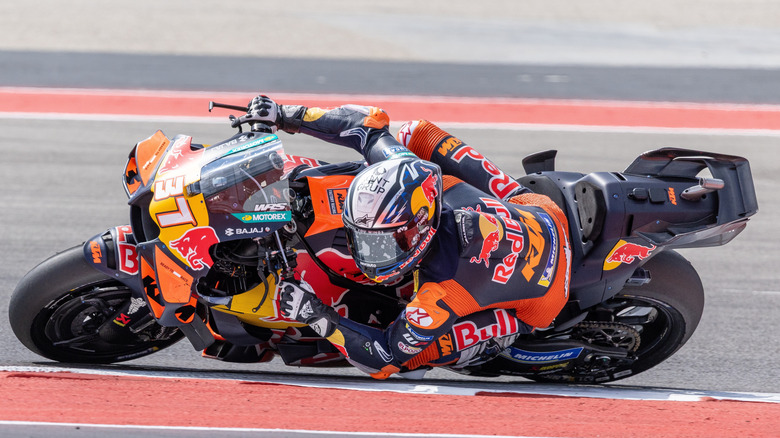
Taking modern motorcycles to their limits is virtually impossible on the street. Performance machines with a power-to-weight ratio that often outstrip supercars, there just isn't a way to stretch the full legs of even a small-displacement motorcycle without breaking a number of laws (not to mention endangering yourself and others in the process).
Fortunately for those of us with daydreams of being Valentino Rossi, track days reduce the impact of traffic and the likelihood of a ticket. Of course, the danger of physical harm remains. If you want to get low in the corners and open the throttle on the straights, picking up a track bike is a great way to do it.
The nice thing (if you're inclined to wrench) is that finding a worn-out or used street bike and converting it into your track-attack dream can be a budget-friendly option for motorcycling. People tend to whip the heck out of their sport bikes — probably not something you'd want to see in your daily commuter, but a track bike that you expect to change out parts and abuse yourself is something else entirely.
The used market is rife with clapped-out (and otherwise) motorcycles aching for a second life on the track. We run down some of the models of yesteryear you may be able to pick up for a song to play on the weekends.
Yamaha YZF-R1
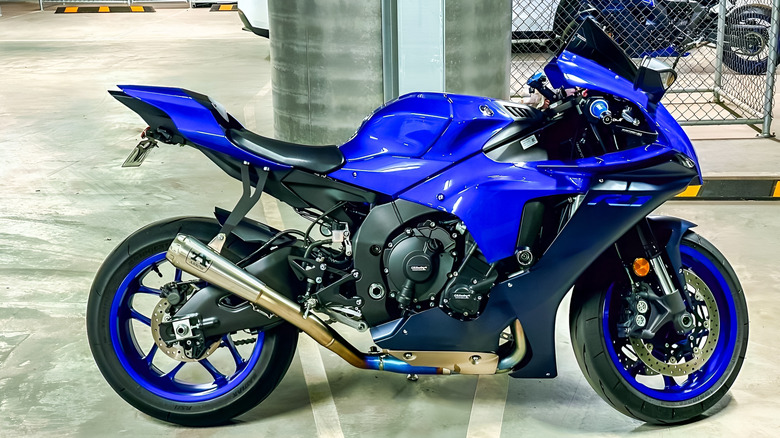
The R1 is a long-running champion that needs little introduction. First fielded by Yamaha in 1998, this four-cylinder superbike has been running strong for 28 years. It delivers on the absolute classic formula of a liter of displacement spread between four inline cylinders.
The YZF-R1M reigns atop the 2026 Yamaha lineup with an MSRP of nearly $28,000. The base models come in nearly $10,000 cheaper — still a pretty penny. The good news is that nearly three decades of used R1s are available for you to choose from for your new track weapon. From the factory, they range from 150 to 200 horsepower with a wet weight of 420 to 450 pounds.
Even the most seasoned knee dragger would be hard-pressed to wring out the R1's full potential — regardless of model year. It's no novice bike, that's for sure. But if you're a vet who wants to get a full-sized superbike between your knees on the track, the R1 may be for you. For such legendary motorcycles, old models are surprisingly affordable. J.D. Power estimates a 2004 R1 in excellent condition is valued at $6,735. Those searching for a beater to bring back to life could pay even less, with the publication listing an asking price of $2,185 for the same bike in fair condition.
Honda CBR 600RR
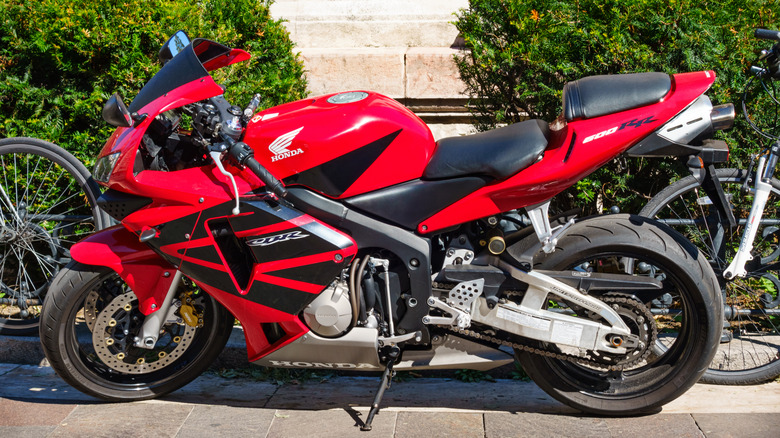
Honda has been a major player in the performance bike scene since virtually inventing the superbike with the 1969 Honda CB750. Since then, it has produced a wide range of middleweight sportbikes bearing the CBR name, beginning with the 1989 Hurricane CBR600. There have been multiple iterations and displacements of CBR sportbikes, including the F2, F3, F4, Fireblade, and RR models.
We enter the sweet spot of used trackable motorcycles with the 2003 introduction of the Honda CBR600RR. Born from Honda's RC211V MotoGP champion, the 600RR eschews its exotic five-cylinder V engine configuration for a more traditional inline-four setup. The 2003 edition boasted 117 horsepower against a wet weight of 434 pounds. The latest and greatest 2026 model makes 121 horsepower and weighs 425 pounds. That's not a huge difference in specs over the course of 23 years, which means there's a glut of used CBR600RRs out there that make like-new power without the brand-new pricing.
Reaching back just a few years to the 2022 model-year CBR600RR, KBB estimates a unit in good condition with typical mileage is worth $7,670. One from 2003 in the same state of repair demands about $4,130. But one of the things about a bike you expect to track (and thus work on) is that it doesn't need to be in a perfect state of repair when you get it.
Suzuki GSX-R750
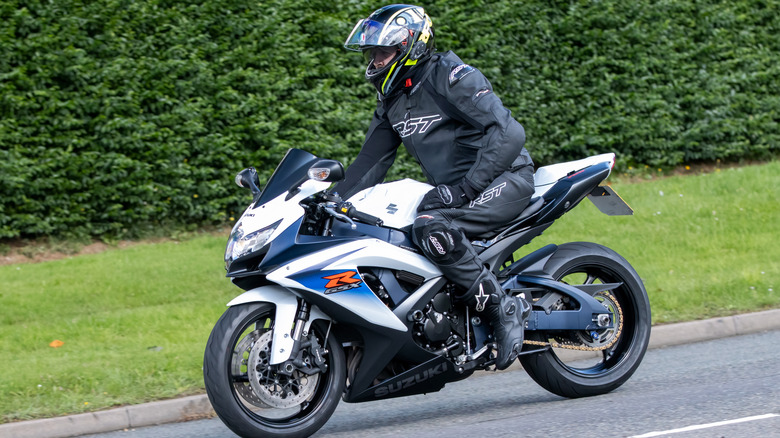
A veteran of the performance wars of the 2000s, the GSXR-750 represented a rare middle ground between 600cc and 1000cc racing motorcycles. Essentially a 750cc inline-four engine stuffed into a 600cc chassis, the Gixxer was road royalty and a track terror during its prime, and it has the power to satisfy a vet and the flickability to excite the most knee-down riders out there.
The first GSXR-750 appeared in 1985. While reaching back that far will likely not yield a competitive, track-ready motorcycle, it means there is a rich, lengthy 40-year legacy from which to choose your next machine. Given that time span, you can expect the oldest models to be relatively underpowered. The inaugural edition produced 92 horsepower and weighed 408 pounds wet. Today, those numbers are 148 hp and 418 pounds. A wider power range than we've seen so far, giving used buyers the opportunity to pick up one that most closely reflects their needs.
The neat thing about the GSX-R750 is its distinct aesthetic eras. Bikes like the Yamaha R1 and Honda CBR600R have maintained the planes-and-angles supersports have worn for years. The GSX-R features some unique designs ranging from the distinct bubble-fairing era of the '90s to the sharp-edged appearance of more recent bikes. According to KBB, a 2022 model is worth $7,800 in good condition, while J.D. Power reports the 1999 model as having a good-condition value under $2,000.
Suzuki SV650
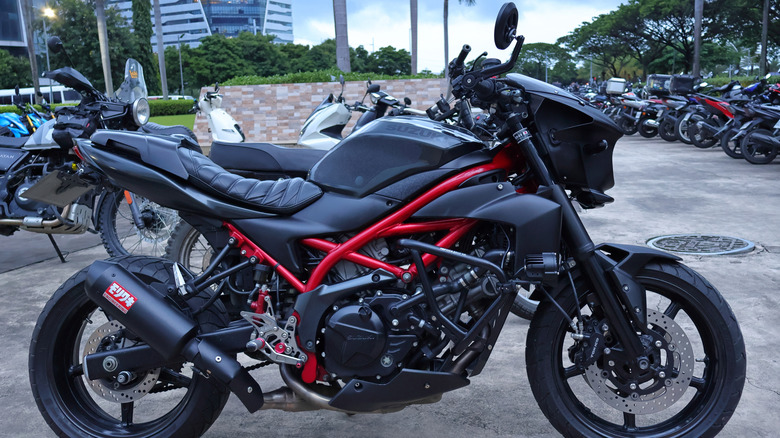
Screaming four-cylinder engines are the heart of MotoGP, but not everyone likes the way they deliver power. They tend to rev extraordinarily high, with power coming on strongest with the engine screaming in the upper RPM range. Alternatively, V-twins tend to provide more torque on the way to lower top speeds, making for an entirely different experience.
Suzuki has been building the SV650 since 1999 (though no longer in Europe). Originally a naked streetfighter, Suzuki has, in the intervening years, put out a number of SVs, including the larger-displacement SV1000. The SV was designed to compete with Ducati. As such, its V-twin engine configuration is technically an L-twin, as the angle between the cylinders is 90 degrees — much like many of Ducati's signature bikes.
If that floats your boat, consider that the 1999 SV650 makes 72 horsepower and weighs 386 pounds, and J.D. Power believes you can snap one up in very good condition for just $3,340. If a more modern edition is for you, the 2023 edition produces 75 horsepower and weighs 440 pounds, and KBB estimates a value of $6,293. The cool thing about the SV is how rideable it is in traffic. While many supersports are uncomfortable, the SV would be a great choice for the commuter-turned-weekend-track-hero.
KTM RC 390
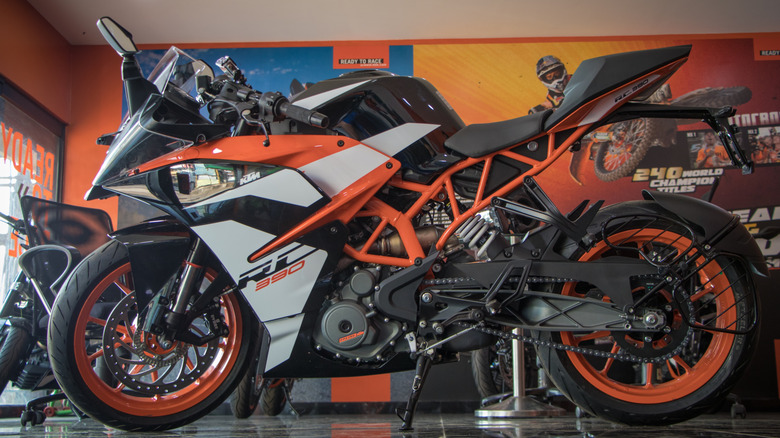
Motorcycle racing is about speed, but that speed doesn't have to be blisteringly high. Mastering the racing line is a lifelong ambition, and the KTM RC 390 is a great platform for some riders. While other motorcycles on this list tend to be large-displacement race bikes, the RC 390 is a different breed.
The RC 390 first emerged from the Austrian motorcycle producer KTM in 2014. More famous for off-road motorcycles, KTM's vision is for a street-legal racing motorcycle. The RC line has been around since 2008, so it's not precisely as if the RC 390 is a fresh effort. KTM took what it learned from building larger-displacement road bikes and applied it to its new effort, with great effect.
The KTM RC 390 is a single-cylinder four-stroke that produces about 44 horsepower and weighs 364 pounds dry in its 2026 iteration. Going back a decade to the inaugural model doesn't lose much power, as it debuted with a 43-horsepower rating against a 324-pound dry weight. Don't let those comparably low power numbers fool you. The RC 390's raison d'etre is to carve the apex. As a lighter and smaller motorcycle, some may think it's suitable for beginners, and they'd be right. Smaller riders will also likely prefer it over something like the R1. But rest assured, even track veterans with years of experience under their belt can get a thrill on KTM's supersport.
A brand-new KTM RC 390 will run you about $6,000 in 2026, while KBB suggests a 2015 model year in good condition can be had for $2,290.
Methodology
We selected performance-oriented motorcycles to cover a wide range of displacements, from beginner-friendly to expert-level. Each bike had to have a 10-year production span to ensure the availability of used models and aftermarket performance and replacement parts. Information is also based on the author's experience of over 20 years of motorcycling, including experience with several of these motorcycles.