

Route 66 Is 100 Years Old In 2026 - But How Much Of It Is Still Drivable?
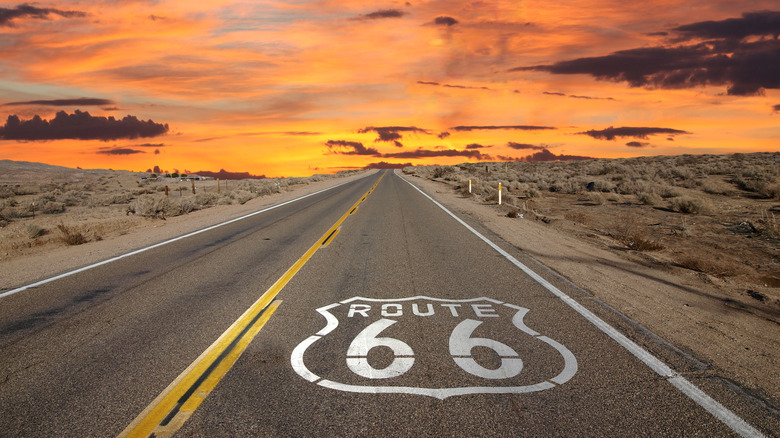
With the automobile revolution in full swing by the 1920s, the American Association of State Highway Officials proposed a brand-new system of major interstate highways that would connect the United States in a way not seen since the completion of the transcontinental railroad in 1869. Initially, 12 odd-numbered routes ran north and south, and 10 even-numbered ones that wound their way east and west. The U.S. Secretary of Agriculture accepted the proposal in November 1925, but the final version didn't receive approval until November of the following year.
U.S. Route 66 was officially designated on April 30, 1926, making it 100 years old in 2026. The original route stretched 2,448 miles from Chicago, Illinois, to Los Angeles, California, but changes made over the years shortened it to around 2,238 miles by the 1960s. It was built in segments, with only 800 miles of paved road when it opened. The majority was left as graded dirt, gravel, bricks, or wood planks until 1938, when it became the first completely paved U.S. highway.
Although it was decertified as a U.S. Highway on June 27, 1985, you can still drive a good 85% of the original route. For nearly half a century, the "Main Street of America" was one of the country's major thoroughfares. Heavily advertised as the most scenic and direct route from Chicago to Los Angeles, it soon became a major tourist attraction. Innumerable family-owned and operated roadside businesses and attractions sprouted up to provide road trippers with a way to truly get their kicks, all of which ultimately helped it become one of the world's most essential bucket-list road trips.
You can still get your kicks on Route 66
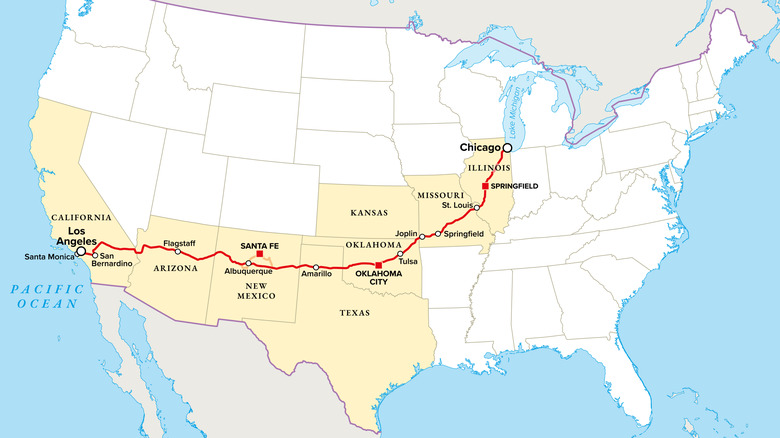
Route 66 runs through eight states: Illinois, Missouri, Kansas, Oklahoma, Texas, New Mexico, Arizona, and California. At 487 miles, New Mexico had the longest stretch, while Kansas had just 13 miles. The road has played a major role in American culture and history. In the 1930s, the Great Depression forced hundreds of thousands of families to pack up their belongings and flee the Dust Bowl, taking Route 66 westward to California in search of new job opportunities.
John Steinbeck's seminal 1939 novel "The Grapes of Wrath" tells the story of the Joad family as they travel Route 66 from Oklahoma to California during this time. Steinbeck refers to Route 66 as "The Mother Road," indelibly cementing the famous stretch of highway into pop culture forever. It's since been featured in films ("Easy Rider"), songs ("Get Your Kicks on Route 66"), and television (the "Route 66" series that ran between 1960 and 1964).
The signing of the Federal-Aid Highway Act of 1956 marked the beginning of Route 66's slow decline. As it became more obsolete, its famous roadside attractions withered away and died. Five new interstates — I-55, I-44, I-40, I-15, and I-10 (but oddly, no I-50 or I-60) — eventually replaced U.S. Route 66 over the next 30 years. In 1999, President Bill Clinton signed the Route 66 Corridor Preservation Act, authorizing $10 million in cost-share grants to restore sites along the highway.
Get in your car and drive!
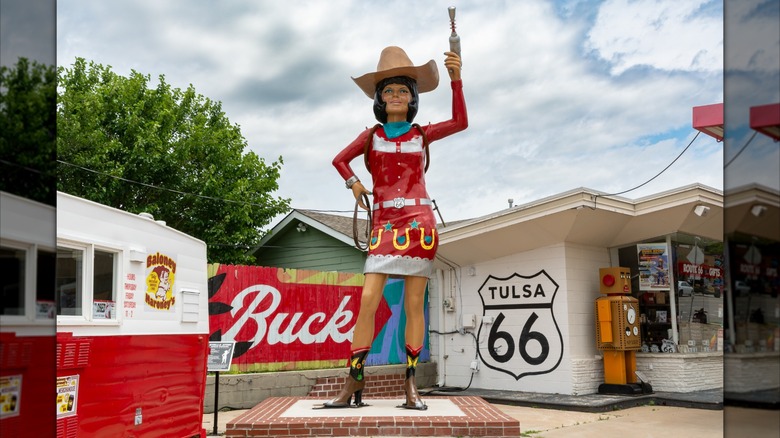
In 2008, the World Monuments Fund placed Route 66 onto its Watch List of 100 Most Endangered Sites, and several sections have since been designated as National Scenic Byways or as "Historic Route 66." Much of the original route lies off the beaten path, going from state or county highways to freeway frontage roads or small streets that meander through even smaller burgs. Some are even dirt roads (like Jericho Gap in Texas and the stretch from Glenrio to Bard in New Mexico). A section in Lexington, Illinois, still has the original paved road you can drive, but others (like a portion south of Salt Creek in Lincoln, Illinois) are permanently closed.
A solid week will only let you hit highlights; two will give you a better experience, but you'll still have to be picky about stops. Three weeks (or more) is recommended, giving ample time to stay in neon-bedecked motels, enjoy meals at roadside diners, and stroll through the many museums and other attractions like the Cucamonga Service Station in California. Technically, you could complete the trek in about 30 hours, stopping only for bathroom breaks and to fill the gas tank, but you'd completely miss out on what made Route 66 what it is.
In 2020, Congress passed the Route 66 Centennial Commission Act. It brought together representatives from each of the eight states it passes through to create special events and tours to celebrate the highway's 100th year. There's even an Official Route 66 Centennial Commission website where you can kick-start plans for the ultimate nostalgic trip down memory lane.