

The Difference Between Leaf Blower CFM And MPH (And Which Is More Important)
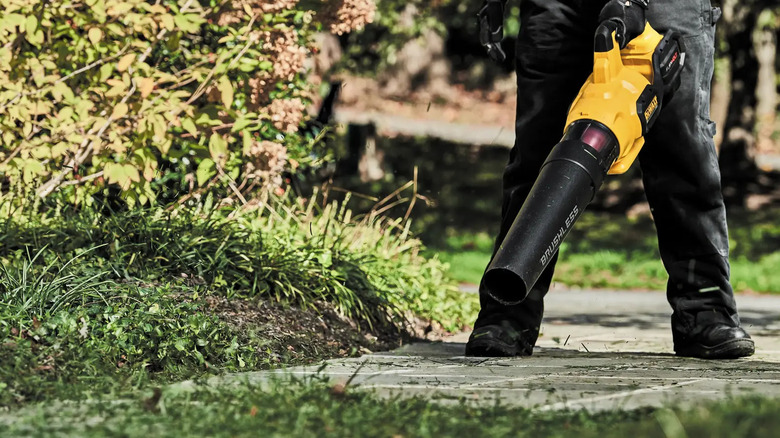
We get it, power tool stats can be confusing. Power or energy, watts or watt-hours, BPM or RPM... there's a lot of assumed knowledge in these words, and not all of it is something you'll have learned about in school. However, as is often the case with these scary acronyms, the meanings of CFM and MPH on leaf blower boxes are not as complicated as they might seem.
Let's start with MPH; You already know what that means, after all. That's right, the speed at which a leaf blower moves air through its nozzle is measured in miles per hour. It may seem like high MPH is what you always need, and speed is certainly one of the marks of a good leaf blower, but by itself, it doesn't say nearly enough. Since MPH depends on factors like the size of the nozzle, it is not a reliable metric on its own.
Imagine that, instead of moving air through a leaf blower, we're watering a garden. You need to reach a tree that's far away, but the hose is short, so you have to make the water move faster and fly farther. The easiest way to do this is to use the "jet" function on a nozzle, which shrinks the hose's exit point. This forces the water through a smaller passage, speeding it up in the process. Even though you're moving water faster, you're moving more or less the same amount of water. The same is true for air blowers: High speeds (MPH) do not always mean a lot of air being moved. For that, you want a high CFM value.
What does CFM stand for?
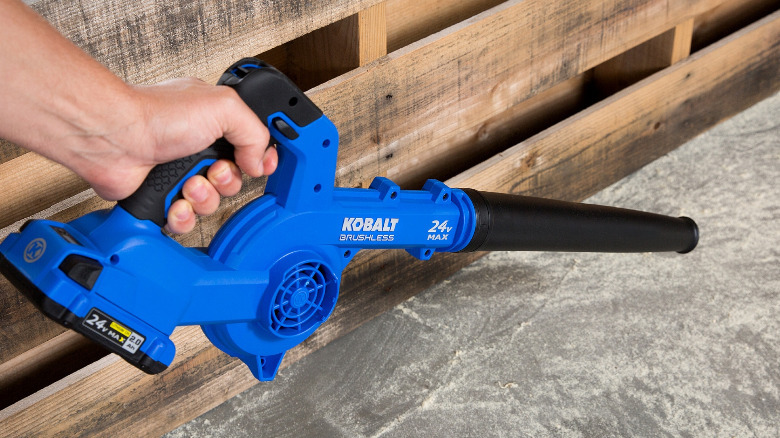
CFM means "cubic feet per minute," a unit of measure for volume (cubic feet) moved per time (minutes). The higher the CFM, the more air is moved by the blower. A blower with high CFM and average MPH will be able to hit a large surface and make short work of a big pile of dry leaves, but it might not be able to move a mid-sized scrap of wood or a few wet leaves out of your shop. This means that you want a lot of CFM for large work areas, while you should optimize MPH for precise and tough jobs.
That said, good leaf blowers for yards and gardens move high volumes of air but don't completely ignore speed — they're usually north of 400 CFM and 100 MPH — since fewer MPH would make the airflow too weak to move anything but the lightest debris. Meanwhile, workshop and jobsite blowers can reach speeds of 180 MPH and above while barely getting to 100 CFM. Of course they do: Cleaning debris off a shop's floor requires short, powerful bursts of well-aimed air, making the amount of air moved less important. Plus, there's a lot more you can do with a blower like this, like clearing snow or cleaning vacuum filters. That's why we recommend jobsite blowers as a must-have for your home garage.