

5 Cheaper Alternatives To The Shelby Cobra
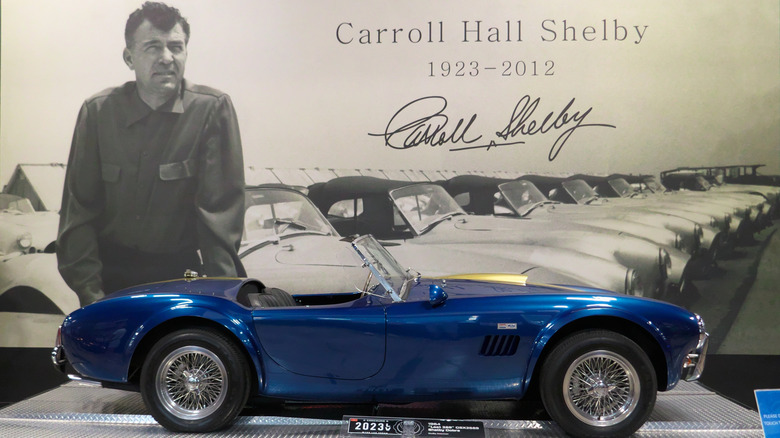
The Shelby Cobra was a legendary sports car that represented the realization of Carroll Shelby's dream of building a car that would carry his name. Shelby had been a notable racing driver who had won the prestigious 1959 24 Hours of Le Mans race behind the wheel of an Aston Martin. Although a heart condition forced him to retire from racing the following year, he continued to follow his passion for high-performance automobiles.
In 1961, Shelby had heard that AC Cars in England planned to cease production of the Ace roadster because the Bristol engines they used would no longer be made. Shelby thought that the Ace body would be ideal for an American-made V8 engine that made plenty of power. That first engine was a Ford 260 cubic-inch V8, which was incorporated into the first Shelby Cobra in 1962. Over the years, as Shelby evolved into an automotive icon, the engine size would increase first to 289, then to 427 cubic inches for the Shelby Cobra 427, which ended up being a totally different car, thanks to the demands of its monster 450-horsepower engine.
Ultimately, around 1,000 original Shelby Cobras were produced, according to Hemmings. This has made the originals extremely valuable, with recently sold cars on Classic.com going for prices ranging from over one million dollars to a high of over three million for some 427 examples. So let's now look at some "cheaper" alternatives to the Shelby Cobra, which we will define as British-made roadsters outfitted with V8 engines.
1. Sunbeam Tiger
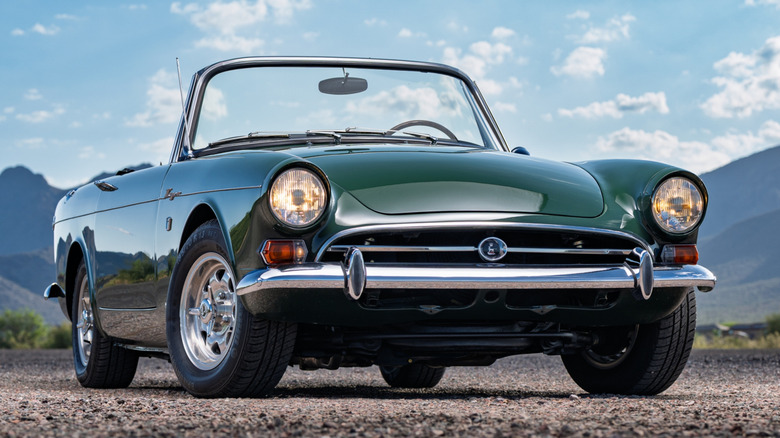
The Sunbeam Tiger had a similar origin story to the Shelby Cobra and occurred just after Shelby started production of the 260 cubic-inch Cobra. The Rootes Group, which had been making the Sunbeam Alpine since 1959, had a West Coast Sales Manager who lived near the Shelby plant. He met with Shelby and had a prototype put together as proof of concept. Next came a production-ready version, approved by Lord Rootes himself. Rootes ordered 3,000 Ford 260 V8s for the first batch of these vehicles, which would become European cars with American muscle car engines.
Production of the Sunbeam Tiger began in June 1964. Aside from the V8, some visible differences from the Alpine version on which they were based included a wood dash, a wood steering wheel, and dual exhausts. The Tiger's V8 engine produced 164 horsepower breathing through a two-barrel carburetor, while a Road and Track performance test of a 1964 Tiger recorded a 0-60 mph time of 7.8 seconds, with a quarter-mile time of 16.0 seconds at 84 mph. By the time that production ended in 1967, a total of 7,085 Sunbeam Tigers had been built, comprising three different series: the Mark I, the Mark IA, and the final 536 Mark II Tigers, which had the larger 289 Ford V8.
Today, according to recently sold original examples on Classic.com, Mark I and IA versions have ranged from $46,000 to $129,250, while Mark IIs start higher, selling from $77,500 up to $100,000. A lot less than a Cobra, despite sharing a similar history.
2. Morgan Plus 8
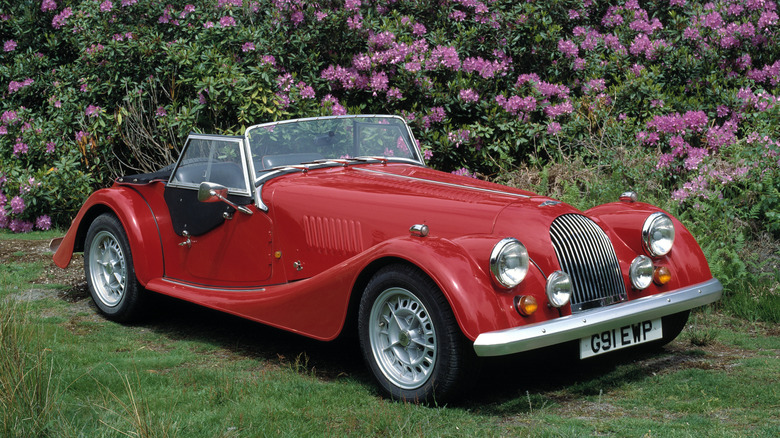
The Morgan Plus 8 also has an American connection to the V8 engine that ended up under its bonnet. While the Morgan's 3.5-liter, 168-horsepower V8 engine was sourced from Rover, this engine started out as a Buick-designed mill originally made in the U.S. This represented a healthy upgrade over the Morgan Plus 4's 2.2-liter, 100-horsepower Triumph-based four-cylinder engine. An Autocar Magazine road test from September 1968 showed that the Morgan Plus 8 did the 0-60 mph run in 6.7 seconds, with a quarter-mile time of 15.1 seconds at 92 mph and a top speed of 124 mph. Despite the added horses, the Plus 8 still kept the Plus 4's ancient sliding-pillar front suspension and a live rear axle supported by semi-elliptic leaf springs.
The Morgan Plus 8 with the Rover V8 evolved considerably over its long lifespan, which started in 1968 and continued until 2004. Some of these changes included an alloy body option in 1969, a five-speed gearbox in 1977, electronic fuel injection in 1983, Lockheed brakes in 1993, plus airbags and a 220-horsepower engine option in 1997.
To see what a Morgan Plus 8 will cost you today, recent Classic.com auction data for original-condition vehicles shows sold cars ranging from $20,000 to $70,000, with most settling between $38,000 and $57,000.
3. Triumph TR8 Convertible
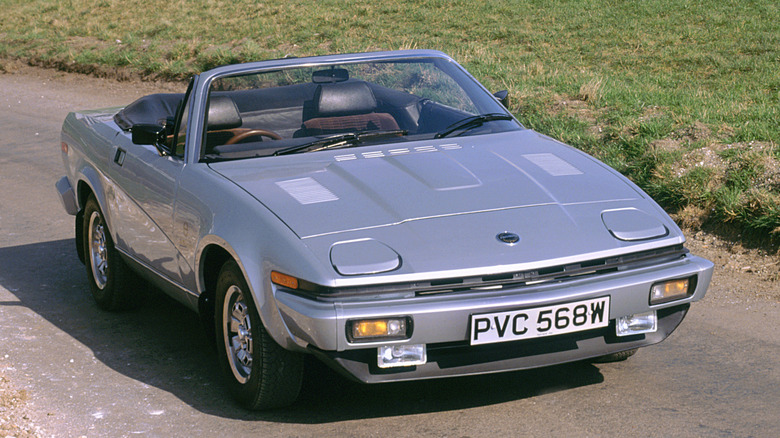
The Triumph TR8 Convertible, unexpectedly powered by a V8 engine, is yet another British top-down car that got a Buick-based, Rover 3.5-liter aluminum V8 engine transplant to cure the poor performance of its four-cylinder TR7 model. Made from 1980 to 1982, the TR8 Convertible was made primarily for the U.S. and Canadian markets, where the vast majority were shipped. The TR8's engine had two outputs, with the 49-state carbureted version producing 133 horsepower and the California-only fuel-injected version making a few more, at 137. Ultimately, only around 2,750 were produced, making them somewhat rare. There were numerous differences between the TR7 and TR8, with the TR8 receiving dual exhausts, alloy wheels, upgraded suspension and brakes, and a five-speed manual Rover transmission. An automatic transmission and air conditioning were options, but nearly every TR8 Convertible had A/C.
Performance of the Triumph TR8 Convertible saw it clear the 0-60 mph sprint in 8.1 seconds, while top speed was between 125 and 130 mph. Road and Track recorded a quarter-mile time of 16.3 seconds at 85.5 mph.
According to Classic.com, the Triumph TR8 Convertible is another great deal on a used V8 sports car, especially compared to a Shelby Cobra. For cars in original condition sold in the past year, prices range from $8,000 to $19,500, making the TR8 Convertible an even better deal than any of the others listed so far.
4. Daimler SP250
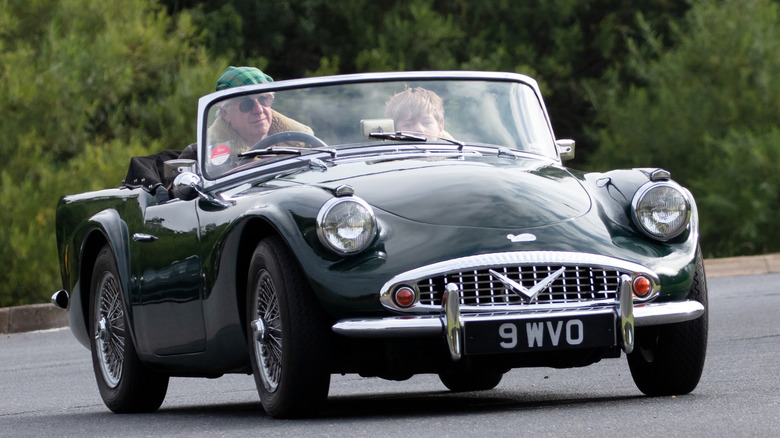
The Daimler SP250 is yet another British sports car with a V8 engine, but this V8 owed nothing to Detroit. The Daimler SP250 originally debuted at the 1959 New York Auto Show as the Daimler Dart. After Chrysler complained that "Dart" had already been registered as one of its Dodge model names, Daimler renamed it the SP250. The Daimler SP250 was somewhat of an odd duck, being a fiberglass-bodied sports car made by a carmaker that primarily sold limousines to the British royalty, who own some very rare cars, and other upper-class denizens. It was made from 1960 to 1964.
The V8 that sat beneath the fiberglass hood of the Daimler SP250 was actually a Hemi, with a 2.5-liter capacity and a conservatively rated 140-horsepower output. The SP250's chassis was supposedly copied from that of the Triumph TR2, with its independent front suspension and semi-elliptic 'cart springs' holding up the rear. Four-wheel Girling disc brakes were standard. Transmission options included a four-speed manual or a three-speed automatic. Motor Sport magazine recorded the SP250's performance, with 0-60 mph in 9.0 seconds, 0-80 mph in 15.4 seconds, and a quarter-mile time of 17 seconds — quite good for the early 1960s.
A total of 2,648 Daimler SP250s were produced, with around 40% sold in North America. Current values, based on selling prices for originals sold here over the past year on Classic.com, show that you can pick up an SP250 for between $17,100 and $48,250. It's another great buy, compared to what a Shelby Cobra costs these days.
5. Triumph Stag
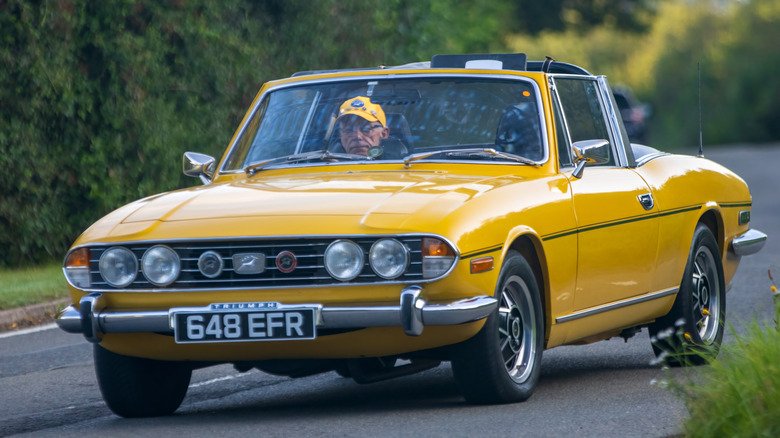
The Triumph Stag, a car powered by a V8 engine, is a cautionary tale that played out amid major financial problems stemming from the British Leyland merger. Other factors intervened as well, including labor unrest, poor quality control that ultimately led to engine failures, and the Middle East oil crisis.
The Triumph Stag was a four-seat convertible designed by Michelotti of Turin, Italy. It was intended to compete with the Mercedes-Benz SL roadster in the U.S. market. The T-top style roof was actually added to prevent the cowl from shaking while the car was in motion. The production Stag was advanced for its day, having fully independent suspension, power steering and brakes, a four-speed manual transmission with optional overdrive, and a three-speed automatic for those owners who preferred it. The 3.0-liter, overhead cam V8 engine that Triumph created in-house produced 145 SAE net horsepower in U.S. trim and did 0-60 mph in 10.0 seconds, with a quarter-mile time of 17.4 seconds at 80 mph, according to Road Test magazine. While the Stag was produced from 1970 to 1978 in most parts of the world, its U.S. run was only from 1971 through 1973, with fewer than 2,900 of the roughly 26,000 total Stags sold in the U.S.
Thanks to the work of dedicated Triumph Stag clubs around the world, the car has been supported, and the problems eventually overcome. Based on figures from Classic.com, Triumph Stags sold in the U.S. over the past year ranged from $9,276 to $20,000. Not a bad deal.