

New Porsche Patent Reveals Racing Stripes When You Switch Into Sport Mode
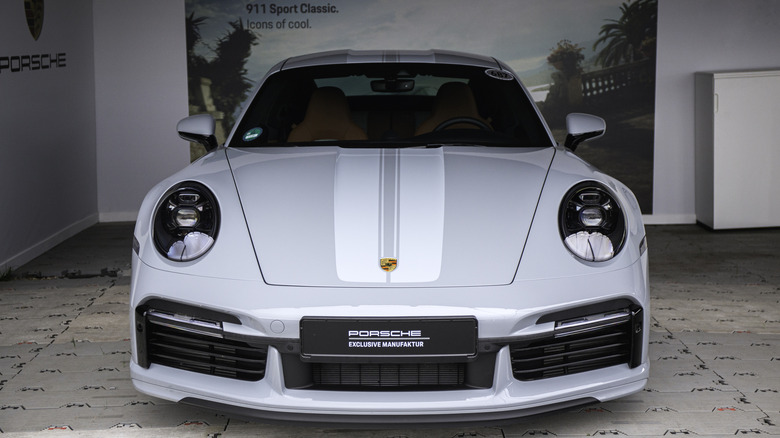
One of the most time-honored traditions of enthusiast motoring is aesthetic personalization, and Porsche has been around long enough to know the drill by now. The German firm was always a bit flashier than many when it came to colors, especially accent colors. This trend goes way back as well; take the classic Carrera RS 2.7, for instance, with its characteristic "Carrera" side stripe in one of several colors — Porsche did stuff like this with virtually every 911 generation to the modern day. And now, the automaker is apparently set to up the ante once again with its patented color-changing, disappearing racing stripes.
In short, the patent relates to the automotive application of a polychromatic paint that can change color on demand, not the actual paint itself. Technical drawings reveal the top-down silhouette of the flagship Porsche 911, boasting racing stripes using this paint. The actual wording is, "Motor vehicle having a motor vehicle body comprising an actively controllable, optically variable coating."
What does this mean, though? In simple terms, it means you flip a switch and suddenly the racing stripes change color. As per the drawings, Porsche is suggesting some sort of synchronization with the Sport Mode functionality — among other functions. All it says is that the company desires to use the paint to provide some sort of external indicator to other drivers as to the state of the Porsche — meaning go-fast stripes are now to be taken far more literally. Let's dive in and explore how the technology works and its potential applications, according to the patent.
The secret behind color-changing paint
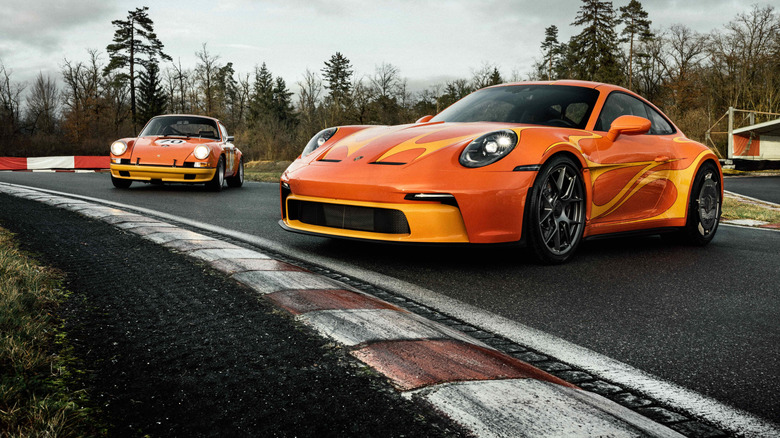
No, this has nothing to do with light, intricate shading, or iridescent paintwork — the paint Porsche is purporting to utilize will genuinely change to whatever color you wish, theoretically. It's all done by electrical impulses monitored by a control unit; the patent claims that the driver's inputs into one of various control surfaces will affect the paint. It's a relatively basic, if clever system, one which mimics the company's earlier patent from 2025 where you could control the whole car's color from inside. It works by having voltage applied to a special coating, which then reacts and changes color based on the electrical input it receives. Theoretically, if you want to mimic a cool color from a new car in 2026, you could with the flip of a switch.
Much like the color-changing full-body paintwork that Porsche patented, these racing stripes get their chameleon properties from a film. The patent states, translated from German: "In a particularly preferred embodiment, the optically changeable coating is a film. The advantages of a film lie particularly in its cost-effective production and high flexibility in application, control, and replacement." Those benefits become far more apparent when you consider something like repairing such an advanced paint if it gets chipped, for instance.
Alternatively, the patent suggests that the paint could come in the form of some type of lacquer. In this case, the lacquer's particle structure is altered by the electric current, and the differing arrangements produce different colors on demand. This coating only works with two colors, however, such as white to black (and all shades of gray in between). The patent extrapolates that more colors could become available, theoretically opening the door for an RGB rainbow or something to that effect.
The potential applications for this paintwork
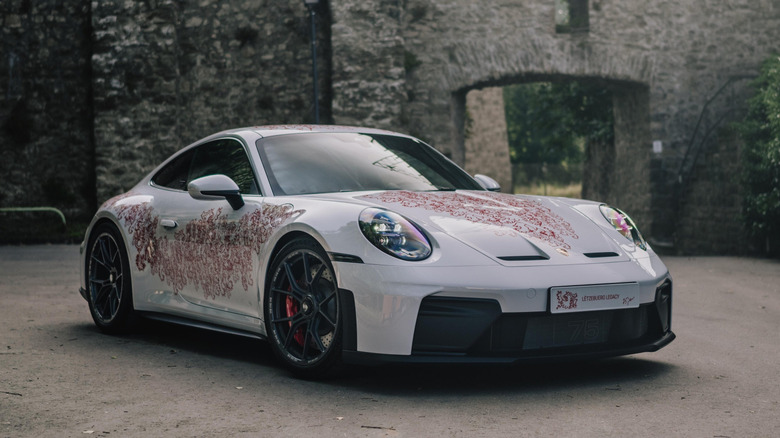
The first and most obvious application, as outlined by the patent, is that you'll have racing stripes on your Porsche whenever you want. And, provided the technology develops, or certain films are used, those racing stripes could theoretically be whatever color you want — maybe even specific patterns, if you have a grid with varying levels of electrical output. The patent states a that it ideally won't need electrical output to maintain the color, just to change it. So a driver could, in that case, create a pattern and just leave it as-is, or make multiple states depending on the driving mode.
However, the patent also suggests other uses for such technology. For example, the paintwork could display the car's state of charge; let's say you were charging up an electric car and wanted to know just at a cursory glance from inside a building. The stripes could change color by the amount it's charged, a nice little bonus. Such an indicator is also particularly useful in motorsports. As a spectator, you'll be looking at cars flying by and would like to keep track of who has more energy. Porsche suggests the color-changing paint could indicate this, like an external fuel gauge.
This effectively marks Porsche's next step in the continuous evolution of the 911 formula. All in all, aesthetic beauty aside, this innovation actually has a wider range of practical benefits than one might think. From assessing which car in a fleet is the most and least charged to tracking your favorite driver's fuel level, the possibilities — like the color combinations themselves — are infinite.