

What Happens When A Pilot Ejects Behind Enemy Lines
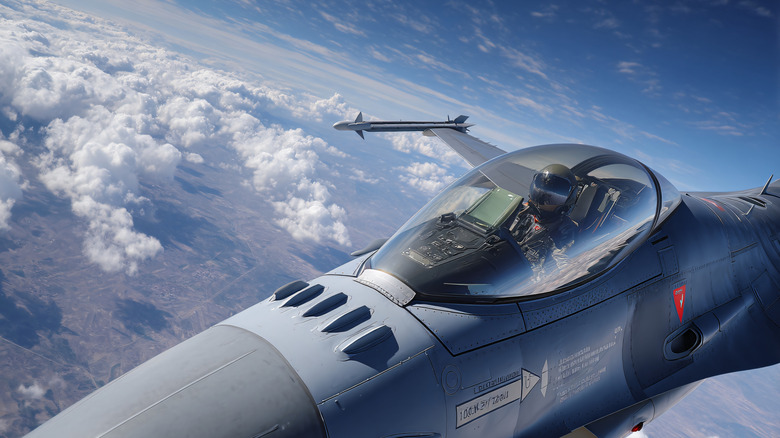
Air Force aircraft must sometimes operate within enemy territory. Whether to strike targets, support allies, or transport essential personnel or supplies where they'll be most effective, it can be an inevitability. Needless to say, opposing forces will be doing all they can to disrupt such operations, through their own aircraft and anti-air defenses. In such contested skies, there's a very real risk that pilots can be shot down.
Bailing out of a compromised aircraft will surely be a harrowing experience in itself, and with the great speed that military aircraft can be flying at and the potential force and unpredictability of a strike, the personnel operating them must act quickly and decisively through their shock. As reported by Newsweek, former U.S. Air Force Brigadier General Houston Cantwell described the initial feeling for the pilot of a critically damaged aircraft as, "you're like, 'Oh my God, I was in a fighter jet two minutes ago, flying 500 miles an hour, and a missile just exploded, literally 15 feet from your head.'"
The pilot then has two vital concerns. Firstly, ejecting from the aircraft, assessing a potential landing site in just a brief moment and successfully making it back down to solid ground (or into the water or whatever the case may have to be). On doing so, the priority then becomes treating any injuries they sustained during the attempt, before beginning the task of sustaining themselves while awaiting rescue but preparing as best as possible for the worst alternatives, such as capture. Here's how an Air Force pilot's extensive training helps ensure they're ready for each of these steps.
The dangerous process of ejecting from a stricken aircraft
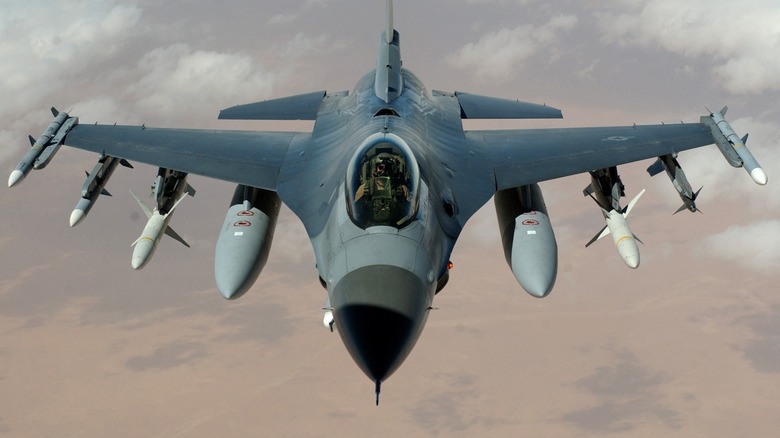
We've already taken an in-depth look at how military ejector seats typically work, via a lever the pilot can pull in emergency situations which sees the canopy of the aircraft divide and a small charge send the pilot up and out of the aircraft while still in the seat. There are various factors that complicate the dangerous journey back to ground level, though, including the fact that pilots can never predict the altitude at which they'll have to do so and the enormous forces acting on them if they eject from greater heights.
Shawn Walsh, former U.S. Air Force fighter pilot who flew an F-16 Fighting Falcon for two decades, outlines exactly what's at stake when a pilot ejects in a YouTube video. On the subject of high-altitude ejection, he notes that "there is an oxygen bottle that is attached to the seat and through to your mask," addressing the fact that a pilot's first concern after a bail-out is being able to breathe in an environment where oxygen is low. When performing this feat from greater heights, the pilot will not detach from the seat until at the right altitude for the parachute to engage.
As explained by the ICRC, Additional Protocol I of the Geneva Conventions includes a section that codifies an earlier-established "prohibition on attacking persons parachuting from an aircraft in distress during their descent," but they're still at huge risk of injuries from the force of ejecting itself. "Any ejection above 400 knots is considered moderate risk," Walsh goes on, explaining that "flailing" injuries (from loose limbs) are particularly frequent. Once the pilot makes it back to Earth behind enemy lines, the situation changes entirely and a different type of specialized training comes into play.
The critical SERE training that could save a stranded pilot's life
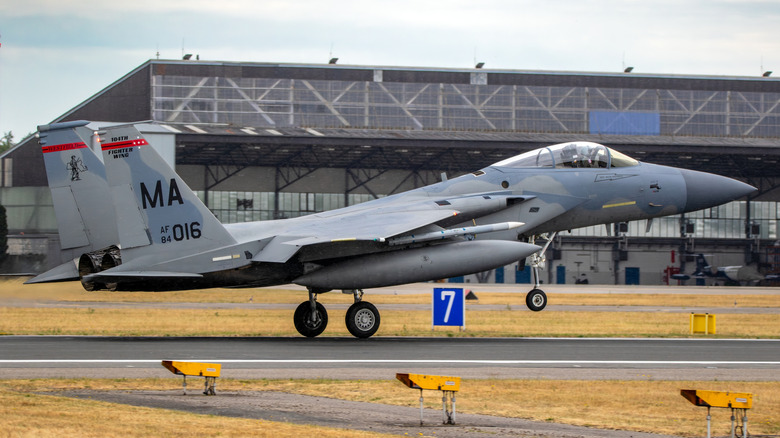
America has wielded some of the deadliest aircraft in the history of aerial warfare, but no aircraft is untouchable. As such, a pilot is trained not only to expertly fly the aircraft they work with, but to also be able to utilize the survival skills they'll need if the worst happens and they're shot down. This type of training is known as SERE, as it encompasses vital Survival, Evasion, Resistance, and Escape skills.
Ex-Brigadier General Houston Cantwell notes, Newsweek reports, that this all begins with the pilot taking stock of their physical state on landing, determining where they are and what threats are in the vicinity, and seeing to immediate needs like food and water as best as they possibly can. Any location information that can be provided to friendly forces will be of tremendous value to extraction efforts, but this is of course challenging in the unpredictable terrain pilots may find themselves in. For instance, a heavily-forested area may provide valuable cover, but would be very difficult for helicopters to negotiate in order to rescue the pilot. Fortunately, there is handheld tech that can help keep downed pilots alive.
It's a traumatic process from start to finish. The incredible speed at which ejections occur put enormous pressure on the body. In fact, ex U.S. Air Force serviceman Aaron Love reported to ABC that "There is huge spinal compression [...] There have been reports of pilots that had spinal compression that actually made them a little bit shorter." The act and its aftermath can have profound impacts on the body and mind of pilots, which is why SERE training is so comprehensive and muti-faceted, including elements like mock interrogation sessions, covering ground stealthily, and navigation.