

Never Pressure Wash Your Engine Bay Without Doing These 5 Things First
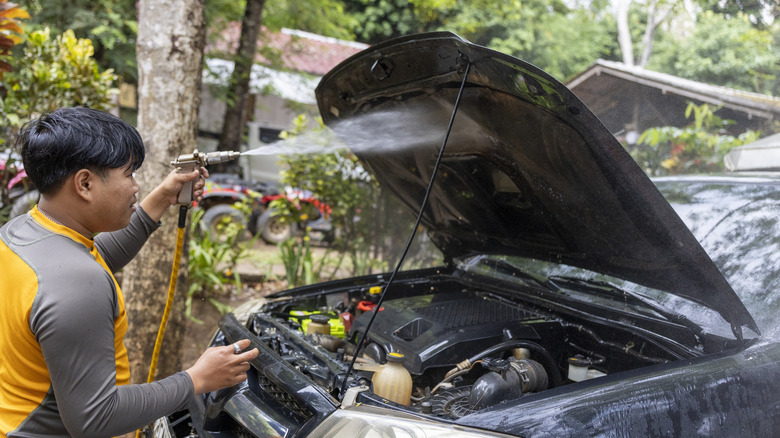
Car engines have become quite complicated over the years. Like every other machine, they need to be serviced and cleaned relatively frequently to keep them working properly. This leads many people to consider pressure washing the engine bay, which is a fairly logical assumption — if a good pressure washing can clean the outside of the car, then it'll probably do wonders for components under the hood, right?
When it comes to pressure washing a car engine, people fall into one of two camps. First are those who insist it's perfectly safe if done properly. On the other side of the equation, there are those who think it's mechanical suicide. The truth sits somewhere between; it's true that pressure washing an engine bay can indeed clean years of accumulated grime, oil residue, and road debris. However, we'll be honest — in our experience, pressure washing a car after taking the required precautions is perfectly safe, but it is a bit unnecessary and time-consuming. With all the prepping and care that goes into pressure washing an engine bay and the time it takes, many people will find that other methods are more suitable for their vehicle.
For instance, a quality degreasing agent used during a deep steam clean will also work, and without running the risk of damaging sensitive electrical bits, cracking plastic tubing via thermal shock, or forcing water where it should not go. Sure, the engine won't have that new-car sparkle that pressure washing gives, but it's easier, quicker, and carries less risk. With that said, here are five things to do before pressure washing your engine.
Let the engine cool before pressure washing it
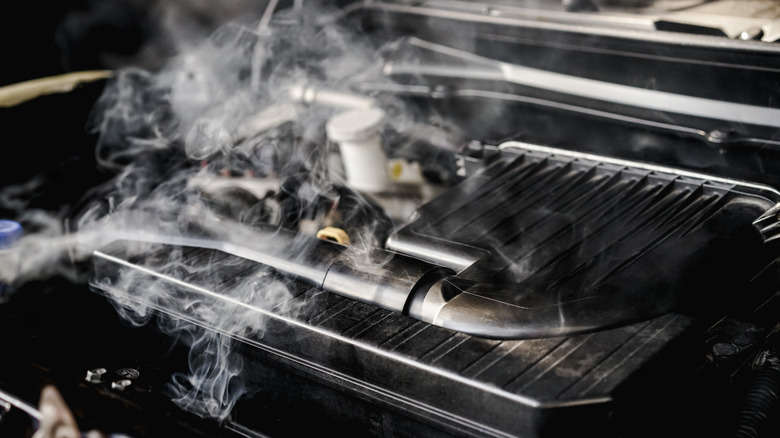
A car's engine goes through a pretty extreme (but normal) temperature change every time it is taken out for a drive, even a short one. When cold, a car's engine is usually within a few degrees of the ambient air temperature, but the normal operating temp of an engine is usually about 200 degrees Fahrenheit. Now, there's a very-well documented physical phenomenon that is known as thermal expansion and contraction — while it affects a lot of materials, we want to talk about plastic. When plastic is heated, it expands, and when it cools down, it contracts.
This process, coupled with the fact that weather also affects the engine, causes plastic bits to weaken and eventually even fracture over time. Now, modern cars have a lot of plastic in the engine bay; many critical components are now being made out of the stuff, including things like piping, coolant housings, liquid reservoirs, covers, and seals.
These components are usually made up to a standard where they can handle this thermal stress properly, but that heat is meant to dissipate over time. If you pressure wash your engine bay just after driving the car, i.e., while the engine is still hot, then the cold water contacting with the hot plastic could cause premature cracking in extreme cases. Things could get especially problematic if the damage isn't noticed right away — if a reservoir for coolant develops a slight crack, for example, you could end up being unaware as it continues to leak coolant until your check engine light comes on the next day while on the interstate.
Disconnect the battery
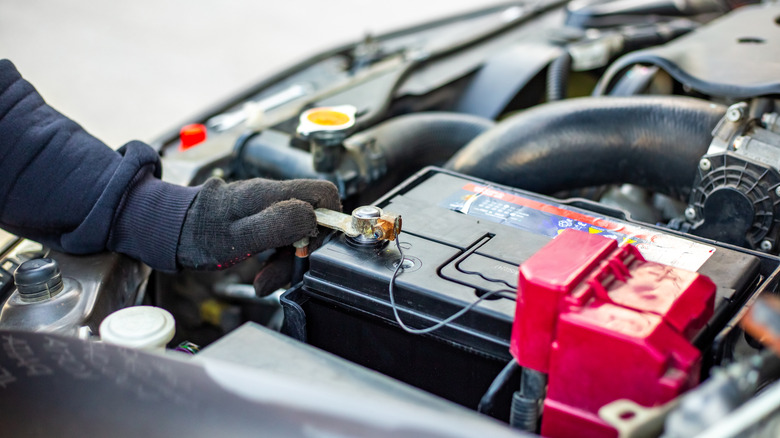
For obvious reasons, water and car batteries really don't mix well; you should do your best to avoid that happening. Ideally, if your battery isn't screwed down into the housing, removing it entirely might be the safest option available. If this is the case, take the battery out and put it to one side, far enough that there will be no chance of any water getting near it. You also want to absolutely avoid any form of closed circuit forming, i.e. some way for electricity to go from the positive terminal to the negative terminal of the battery. If there is water between the connections, that can happen.
If removing it entirely is not possible, then it's better to disconnect the battery. There's a specific way to do that safely. First, you should make sure that there is no metal contacting the terminal and wire end at any point. Then, you should first remove the negative wire, which is usually black in color, and place it carefully to one side, again being careful not to let the connection head touch any metal. Next, follow the same process for the positive wire, which is usually red. Also, make sure that these two wires do not come into contact with each other at any point in the process. When reattaching the cables (after the engine bay is dry!), repeat the process, but in reverse — do the red positive wire first, and then the black negative.
Cover the engine's air filter and exposed intakes
Engines work by mixing small amounts of fuel with large amounts of air and then compressing this mixture to create energy. In other words, air is pretty important for an engine's operation. However, water behaves very differently from air in terms of compression. Specifically, water does not pressurize the way that air can, so even a small amount of water getting into the engine can cause complete failure.
Your engine's connecting rods (so called because they connect the pistons to the crankshaft) will bear the brunt of the force if water gets into the compression chamber. In many cases, the connecting rods will bend because of the water, causing a complete engine failure known as hydrolock, which is very expensive proposition to repair. Even a small amount of water is enough to hydrolock a big V8 engine, so it's crucial to exercise high levels of caution here.
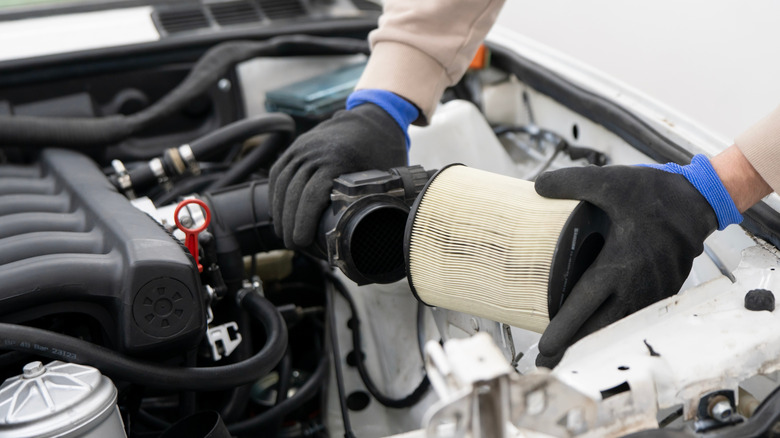
Now, the only way (ideally) for air to get into the compression chamber is through the air intake — every combustion vehicle has one. So, if we block off the air intake properly, there will be no way for water to get inside the engine. To that end, you must locate your air intake, cover it with a thick plastic bag, and use elastic bands to keep the bag in place. While you're doing that, also look for any exposed wires and cover them the same way. For wires, using dielectric grease, a waterproof protectant for engine components, to cover the exposed areas can also work fine.
Cover all your engine's other important bits
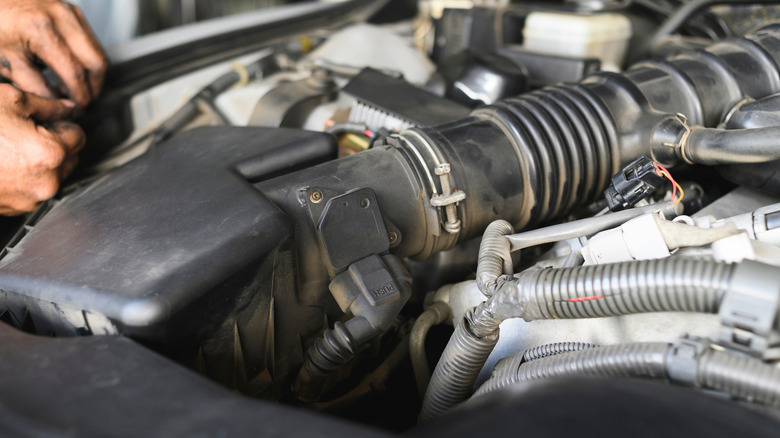
Once the initial prep is done, it's time to make sure that water doesn't get into other places it's not supposed to go. First, start by locating your vehicle's fuse box, which can usually be found either near the driver's side or the front passenger's side dashboards. From there, follow the wiring and look for relay harnesses that can sometimes be found in the engine bay. If you find any, cover these bundles of wiring with a plastic bag to protect them from water intrusion. You can tie the bag into a knot, or seal it with an elastic band — either approach works. Next, you want to do the same with the car's ECU, or engine control module.
This thing can be thought of as the "brain" of the car, and you really don't want it getting wet. Some cars can have an exposed MAF, or mass air flow sensor, so look up the location for your model, and if it's in the engine bay, cover it too. The last thing to seal completely before actually starting your pressure wash will be the alternator system. Furthermore, just because you've covered these parts with plastic bags doesn't mean that you can hammer around them with the pressure washing hose. In fact, for that extra peace of mind and to reduce your risk, actively work to avoid these areas when washing them.
What not to do while pressure washing your engine bay
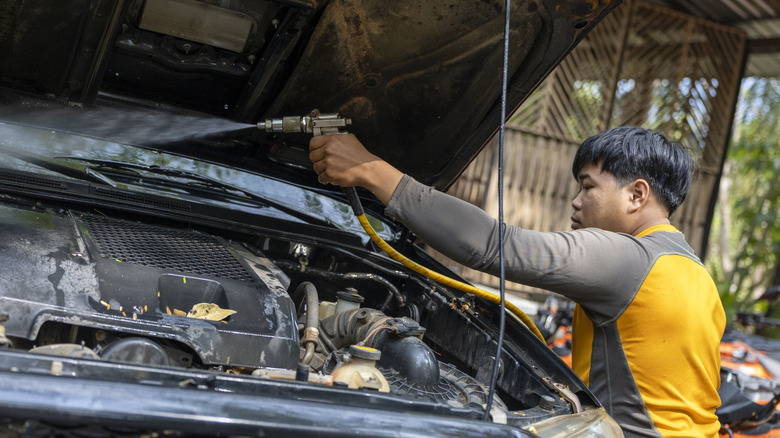
Now that all the prep is done, let's talk a little about how to go about the actual cleaning. The first thing to avoid doing is maxing out the power on your pressure washer. While many units can go beyond 1,500 PSI, you should opt for a lower setting, perhaps around the 1,000-1,200 PSI mark. Higher-pressure streams of water can possibly cut right through the rubber gaskets and seals that protect various parts of the engine, which is an undesirable outcome to say the least. While these seals are designed to keep water out, they were made with things like moderate rainstorms in mind; they're not intended to keep out high-pressure jets. Blasting these seals with over a thousand PSI of pressure will no doubt be a risky move.
Another thing to avoid doing is to use the thinnest nozzle, as this channels water at a faster speed — science says that fluid can speed up when being pushed through a smaller opening. Also, avoid getting right up against the engine when pressure washing it; stay about 18 inches to 2 feet away at all times. Lastly, in addition to avoiding all the areas that we sealed with plastic bags, also avoid directly spraying water onto any coils as well as the spark plug wells. If you follow all these instructions, then your engine bay pressure washing experience will likely go off smoothly. However, there's always a risk of something not going according to plan, even if you follow all these precautions to the letter. That's why we said the lower-risk option (with less hassle) is to pay a professional mechanic's garage to steam clean your engine bay and use a degreasing agent while they're at it.