

4 Semi Truck Brands You Didn't Know Were Owned By Volvo
It's common for multiple auto manufacturers to be owned by the same parent company, such as how Stellantis Group owns Dodge, Fiat, Maserati, and countless others. It's the same in the commercial vehicle world as well; Volvo Group has several badges under its aegis as well. Obviously, the best-known of these is the company's namesake Volvo Trucks, which is a car brand that makes semi trucks, along with construction equipment, buses, and autonomous driving solutions.
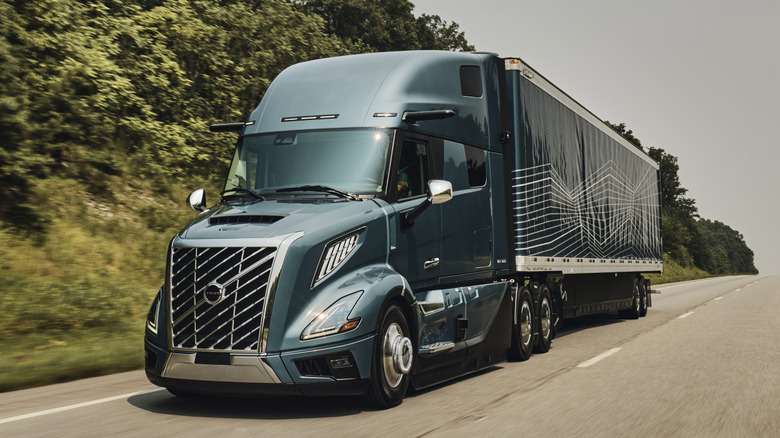
For the U.S. market, Volvo offers six different variations on the traditional over-the-road style truck with a hood over the engine and the cab behind it. These include the aerodynamic VNL (shown above);' the profitable, agile, and efficient VNR; the VNR Electric with up to 275 miles per charge; the VNX, stronger and built for heavier loads; the VHD that is ideal for garbage collection, concrete mixing, or firefighting applications; and the VAH, a specialized version designed for transporting automobiles.
Production on the Volvo Trucks' VNL started at the company's Dublin, Virginia factory toward the end of 2024. Since then, around 15,000 of Volvo's VNL trucks have been put into service on the roads and highways spanning Canada and the United States. One more feather in the VNL's cap is its winning of the the 2025 Red Dot Design Award for Product Design in the category of commercial vehicles. Yet the automaker owns several other semi truck brands that are arguably just as successful, both in the Americas and around the world. You might just be surprised by these next four.
Renault Trucks
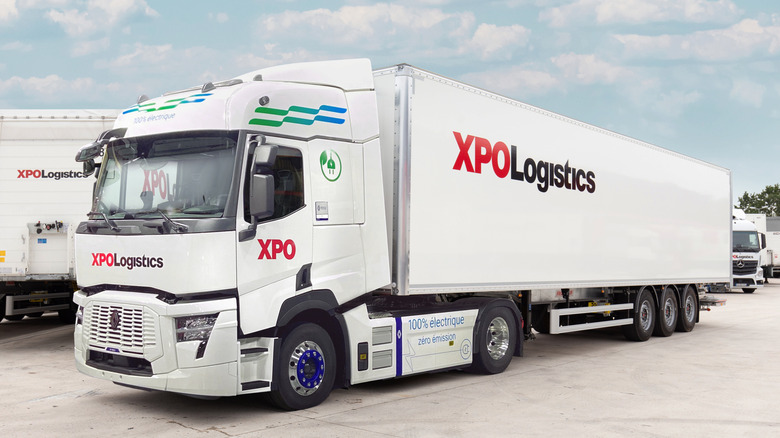
Renault Trucks is a semi truck brand that's been owned by Volvo for more than 25 years. The badge offers many types of commercial vehicles that range from light trucks up to heavy-duty trucks that are designed for long-haul trucking. Renault Trucks sold 25,000 vehicles in 2025 and employs 10,000 people. The automaker in its current form is actually the result of an ongoing series of mergers within the group of French commercial vehicle manufacturers. By 1978, these mergers had consolidated all of the remaining French truckmakers into a single company known as Renault Véhicules Industriels. The new company went on to acquire the Dodge Europe brand in 1983 as well as the well-known American Mack Truck brand in 1990 (more on that in a bit). Then, in 2001, Renault Trucks emerged after Renault Véhicules Industriels, later renamed Renault V.I., became a part of the Volvo Group.
Renault Trucks produces all of its trucks, and most of the parts that go into them, in France. Some locations in the Middle East and Africa use production partners that assemble Renault imported as a collection of parts and then assembled. While Renault Trucks does not have a presence in the U.S. or Canada, it is well-established in Central and South America, as well as Europe, Africa, Asia, and the Middle East.
Renault Trucks has been in the forefront of semi truck electrification. The company announced in February 2024 that XPO Logistics of France had placed an order for 165 of the company's electric trucks, 105 of which would be semi tractors. These electric-powered trucks are slated to replace diesel trucks on regional and suburban delivery routes.
Mack Trucks
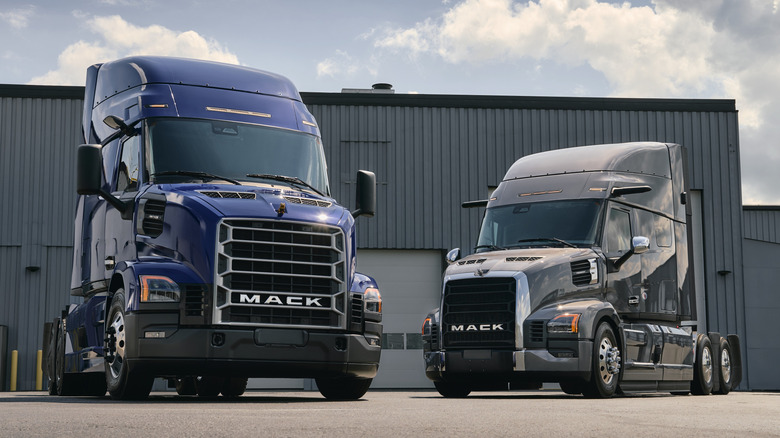
Mack Trucks became a part of the Volvo Group as a result of Volvo's acquisition of Renault V.I. in 2001. The semi truck manufacturer's current offerings for the U.S. market include the Anthem, Keystone, and Pioneer, all newer models. In addition to semi trucks, Mack also has a wide variety of rigid-chassis trucks that can serve as waste collection vehicles or other vocational purposes like fire trucks and concrete mixers. These trucks vehicles include the Granite, LR, LR Electric, MD, MD Electric, and the TerraPro. Mack Truck power sources include not just the company's proprietary diesel engines but also natural gas engines sourced from Cummins and battery-powered electric drive systems.
The all-new Anthem semi truck, shown above on the left, began production in January 2026 at Mack Trucks' Macungie, PA plant, where Mack's Class 8 heavy trucks for both North America and export markets are built. An advantage built into the Mack Anthem is its shorter length of just 113.5 inches as measured from its bumper to the back of its cab, making it better suited to getting through the smaller spaces found in the urban environments where the Anthem will be operating. The Anthem's hood was also designed for optimal driver visibility, which is important while operating in these tighter confines.
Standard safety features found on the Mack Anthem include forward collision warning and a front airbag for the driver. Optional equipment consists of blind spot warning on driver and passenger sides, lane keep assist, side curtain airbags, and a digital mirror system.
Eicher Trucks (joint venture)
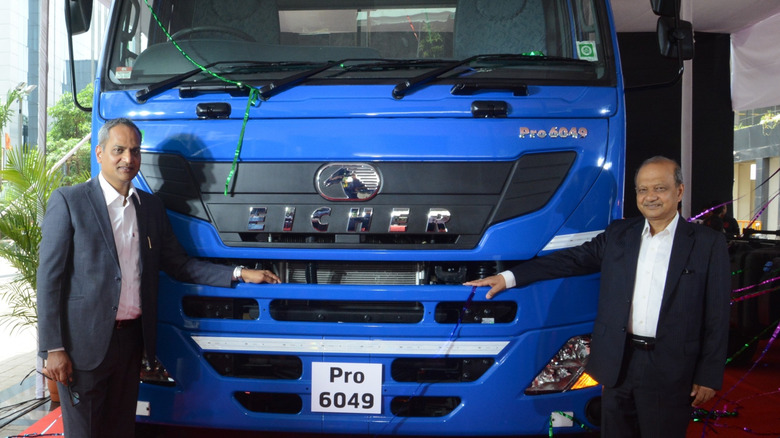
In 2008, the Volvo Group and India's Eicher Motors formed a 50/50 joint venture, which continues to the present day. The joint company is known as VECV, or Volvo Eicher Commercial Vehicles. The JV consists of five different businesses: Eicher Trucks and Buses, Volvo Trucks India, Eicher Engineering Components, VE Powertrain, and VECV Engines. Interestingly, Eicher also owns and makes the motorcycle brand Royal Enfield in India, in an operation that is completely separate from the Volvo JV.
The Eicher brand began back in 1948 as the Goodearth nameplate, which was created to import and sell tractors in India. The Eicher Tractor Corporation then became India's first indigenous tractor manufacturer in 1959-60. In 1982, Eicher entered into a joint venture with Mitsubishi Motors of Japan to produce light commercial vehicles. Eicher expanded into medium-duty commercial vehicles in 1994, followed by its entry into heavy-duty commercial vehicles in 2002. Then came the Volvo Group joint venture in 2008.
Today, Eicher makes a full line of heavy-duty semi trucks for the Indian and Asian markets. These include tractor-trailers like the Pro 6040 rated at 39.5 tons, the Pro 6046 rated at 45.5 tons, and three models, the Pro 8055, the Pro 6055XP, and the Pro 6055XP (4x2), all rated at 55 tons. While the entry-level Pro 6040 is equipped with a 5.1-liter engine, the tractor-trailers above it have a 7.7-liter engine with additional horsepower, which varies with the specific truck.
Dongfeng Trucks (joint venture)
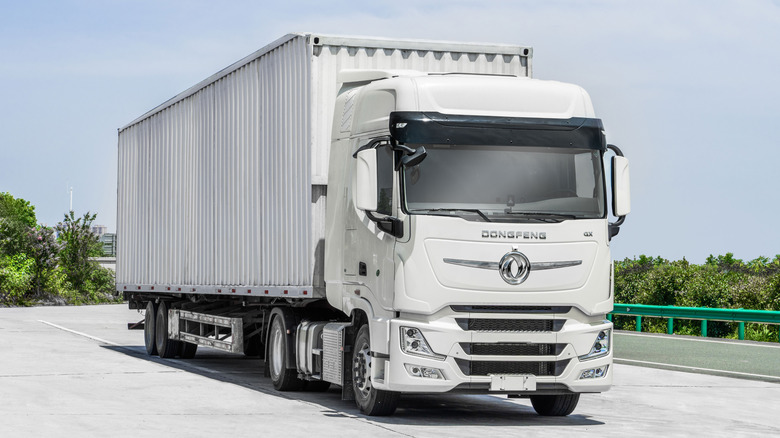
The Volvo Group also has a joint venture with Dongfeng Commercial Vehicles Co., Ltd, of China, also known as DFCV. Volvo acquired 45% of DFCV in January of 2015, giving it a solid foothold in the Chinese medium-duty and heavy-duty truck markets. The objective of this joint venture, according to then-Volvo CEO Olof Persson, is to provide the company "with the opportunity to become involved in growing DFCV's international business in a manner that will benefit us and our Chinese partner."
Dongfeng started out back in 1969 as the Second Automobile Works, located in Shiyan in Hubei province. Its original mission was to produce military vehicles for the People's Liberation Army while developing China's local vehicle manufacturing capabilities. Dongfeng later transitioned to commercial vehicles and eventually went into passenger cars with its 1992 production of the Fukang sedan.
In terms of heavy-duty semi trucks, the Volvo/Dongfeng joint venture currently has four different models available in the Chinese market. These are the GX Tractor, the KX Tractor, the KL Tractor, and the VL Tractor. The GX, shown above, is specialized for logistics and comes with a 13.5-liter, six-cylinder, 520-horsepower Cummins diesel engine. The KX, meanwhile, is available in several different configurations, with power outputs ranging from 480 to 560 horsepower. The KL, designed with reliability and classic aesthetics in mind, comes with engines producing either 420 or 465 horsepower. The VL has a choice of 420-horsepower or 450-horsepower engines.