

'Battle Lab' Is The US Air Force's Newest Defense Against Small Drones
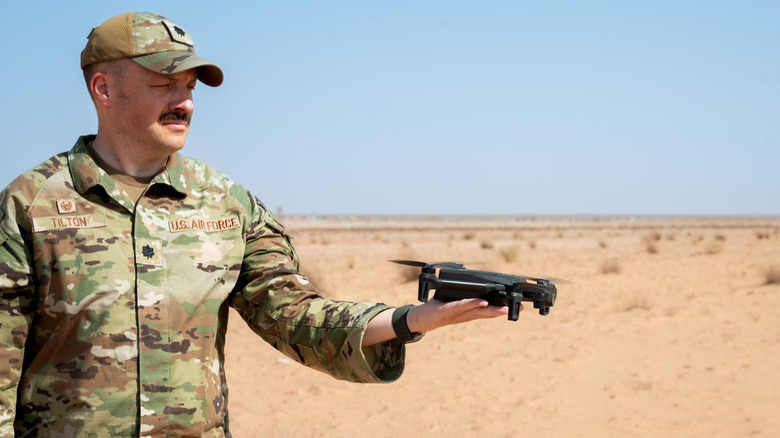
The U.S. military is certainly no stranger to drones. Some of the biggest and deadliest unmanned vehicles in the world are fielded by the United States, including the formidable MQ-9 Reaper. In fact, the U.S. military faces the looming problem of having too many drones, both in terms of the logistical challenges of fielding so many of its own and defending against unfriendly ones.
The Point Defense Battle Lab is being created as a way to respond to the latter threat, as drones have been discovered loitering in military bases more and more in recent years. It can be particularly difficult for U.S. military bases to detect drones because of their small size and erratic movements. In some cases, it's not the big, heavily-armed models like the Reaper that are the danger, but the smaller ones.
That's why the military has enlisted this force, which combines the expertise of the 184th Wing of Kansas' Air National Guard and the 319th Reconnaissance Wing, in order to prepare for the increasing number of these miniature menaces. Grand Forks Air Force Base was chosen as the headquarters for the initiative in October 2025. Let's take a look at some things the projects has planned and the expertise it's drawing in from other sources in order to execute them.
The innovative work of this USAF Battle Lab
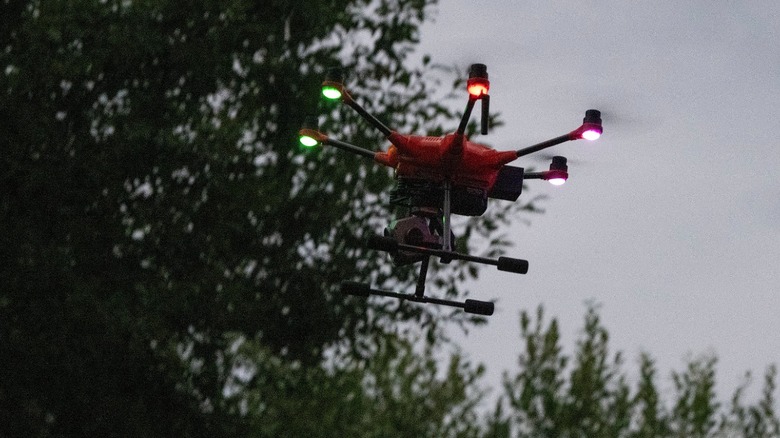
The Battle Lab will be part of the USAF's Air Combat Command Point Defense Task Force. Essentially, the lab will devise scenarios and training exercises for other bases to test their anti-drone defenses. Every month or so, a new exercise will take place, focusing on different challenges posed by small UAS (unmanned aerial systems). This could be training exercises designed to improve the way bases can track down drowns or physically destroy them.
Col. Alfred Rosales of the 319th Reconnaissance Wing explained to Defense Scoop that these would also be exercises that manufacturers and anti-drone technology vendors would sometimes be invited to. Some potential innovations on display could well lead to the reveal of the latest and greatest tools against drones. New technologies that more quickly differentiate between small drones and similarly-sized objects, as well as a laser weapon of up to around 20kW strength, are some of the tools that the lab has invited vendors to demonstrate at the trials.
The work being undertaken by the Battle Lab is truly a collaborative effort, and not only because vendors across the industry will be given the opportunity to partake and demonstrate what their equipment can do. Grand Forks Air Force Base is also taking applications from people interested in working with the lab. According to the Battle Lab's site, military personnel can even submit their own ideas for "Counter-Small Unmanned Aircraft Systems, passive defense, point defense, or installation defense from aerial threats."