

All-Terrain Vs Mud-Terrain Vs Rugged-Terrain Tires: What's The Difference?
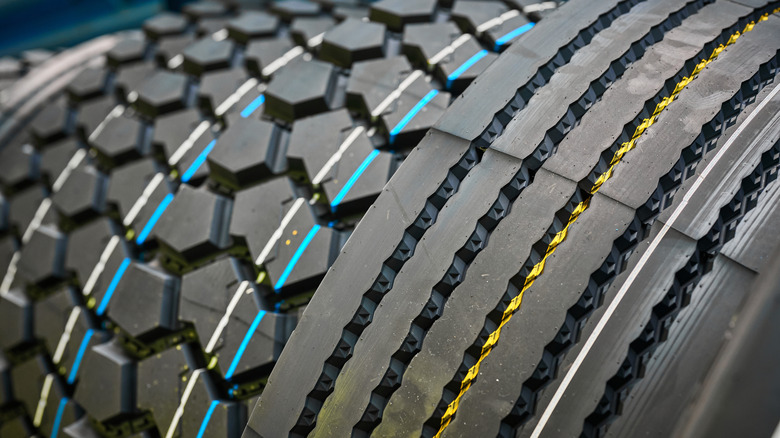
Tires might not receive the respect they deserve because they run with little to no tech, but they are among the most crucial components of your vehicle. They are your only direct link between the road and your car, which means they can determine how your car responds to acceleration, braking, and overall control. Given that most SUV and truck tires are designed to handle heavy loads and traverse harsh conditions with ease, you might assume that they are created equal, but they are not. There are several major brands that make the best off-road tires, and each offers different types designed for diverse driving conditions, with the three most common being all-terrain, mud-terrain, and rugged-terrain.
Each of these tire styles features different tread patterns and materials, and you'll want to carefully choose the right tire for your driving style and vehicle. It may not seem like a big deal because they all fall under almost the same category of off-road tires, but they have significant differences that can make or break your driving experience. Choose the wrong type, and you will negatively impact your car's fuel consumption rate and, even worse, increase the risk of accidents. Fortunately, we can help. Ahead, we will assist you in understanding the differences between all-terrain, mud-terrain, and rugged-terrain tires so you can make an informed decision and get the best tires for your car.
All-terrain tires are perfect for both paved roads and off-road environments
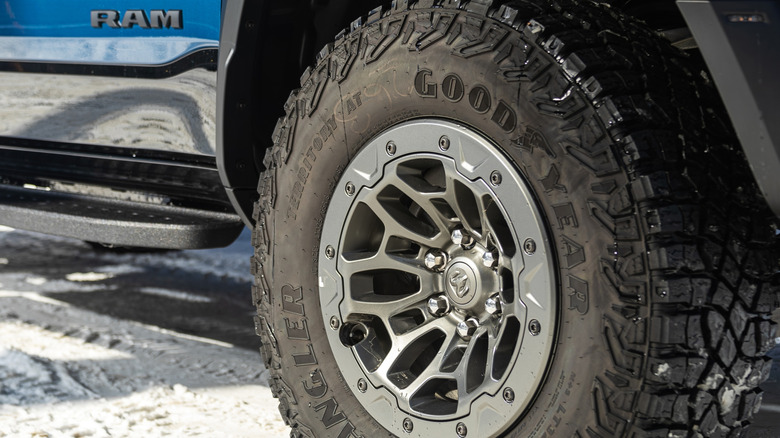
Of all these options, all-terrain tires (A/T) are the most widely-used option by a large margin. Regarded as a jack-of-all-trades, A/T tires compromise on both ends of on-road comfort and off-road capability.
Tackling harsh trails, whether rugged mountains, snowy paths, or sandy beaches, requires an AWD or 4WD vehicle equipped with tires purpose-built for the challenge. A/T tires, like all off-road tires, feature a more aggressive, open-block tread pattern, making them ideal for such tasks. In addition to that, although the treads are wide to repel rocks, they're still compact enough to keep the tire stable on pavement. The treads are also quite deep to maximize traction, support heavy loads, and effectively disperse water — a trait that reduces the likelihood of hydroplaning and makes A/T tires the perfect choice for those who regularly experience light snowy conditions.
A/T tires are also built with firmer rubber compounds, and as a result, when it comes to off-road tires, they're considered the longest-lasting car tires, with an average lifespan of 50,000 to 65,000 miles. If you're a daily driver, however, you might want to think twice about using all-terrain tires for highway driving because all these traits come at a cost. Compared to mud-terrain and rugged-terrain tires, A/T tires might offer a much quieter ride, but if you want to save money at the pumps, you'll be interested to know that A/T tires will reduce your MPG by about 3%.
Choose mud-terrain tires if you spend much of your time on mud, dirt, or rocks
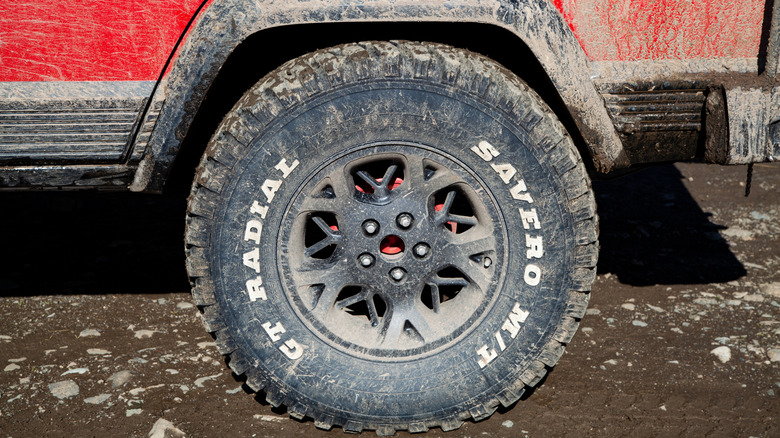
All-terrain tires like the Toyo Open Country A/T III and BF Goodrich All-Terrain T/A KO2 might get you off-roading in no time. If you're a full-time adventurer, however, it's wise that you go for mud-terrain (M/T) tires. These tires are purpose-built for handling mud and other serious off-road conditions like jagged rock paths and loose soil. Compared to all-terrain tires, M/T tires feature more aggressive tread patterns that offer significantly more traction in challenging conditions.
The tread blocks are not only chunky but also deeper and widely spaced, and this helps the tires bite into deep mud and snow without slipping. The larger voids along the shoulders also shed away caked mud, rocks, and debris as you spin, keeping grip consistent. When it comes to construction, mud-terrain tires are often built with softer, high-grip rubber compounds that are often reinforced. This makes them more resistant to chips, cuts, and trail damage. On top of that, these tires have extended shoulder lugs, which offer additional traction and protection from sharp rocks.
M/T tires might offer great grip across various challenging conditions, but they're not meant for highway driving or severe icy conditions. On the highway, their aggressive look makes them hungrier for fuel and creates additional road noise that is noticeably louder than A/T tires. They're also quite expensive, and you'll have to replace them more often as they have a shorter lifespan compared to their off-road cousins.
Rugged-terrain tires are built to bridge the gap between A/T tires and M/T Tires.
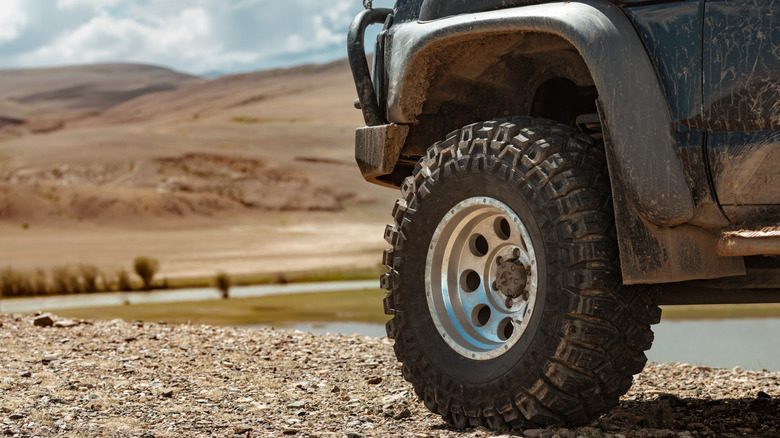
If you want to transform your truck or SUV into a legend of the trails without compromising on-road performance, chances are you'll need rugged-terrain (or R/T) tires. These tires borrow traits from both A/T and M/T tires, blending them into one do-it-all package that's built to offer superior off-road traction and reinforced durability for untamed wilderness.
Like M/T tires, R/T tires feature much more aggressive tread patterns than A/T tires, with wider and deeper voids that help them grip loose surfaces like sand, rocky terrain, and also mud. Unlike M/T tires, however, R/T tires have siped tread blocks (small slits in the tread lugs), which protect the car from skidding when you tackle wet and icy conditions. Additionally, these tires have knobby sidewall treads to survive brutal, muddy terrain and closed-off gaps between inner tread patterns that make them quieter than their chunky M/T cousins.
They also have more prominent shoulder lugs than A/T tires, which enhance their appearance and protect the tires from abrasion and punctures. These tires also feature a 2-ply or 3-ply sidewall construction, which makes the sidewall rigid enough to tackle challenging conditions or carry heavy loads, and comfortable enough for smoother rides. Beyond the design, many R/T tires are rated with the three-peak mountain snowflake symbol, while others have the M+S mud and snow symbol. This means that they've met the standards for street use as well as for severe mud and snow conditions.