

Not Just Any Tire Can Be Used For Towing - Here's What You Should Look For
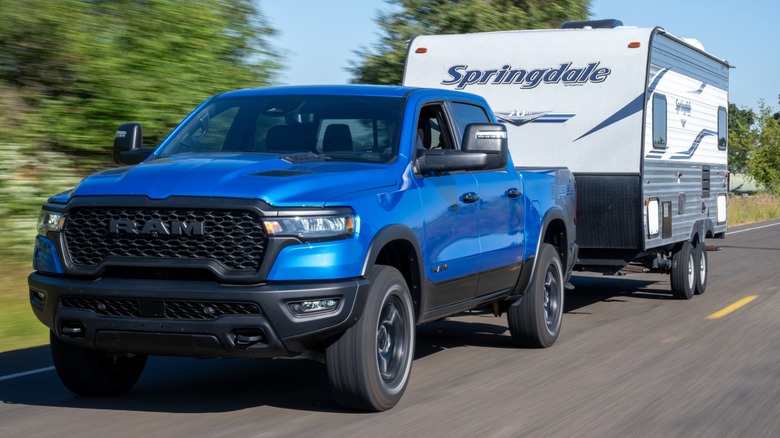
If you bring up the subject of towing safety around a group of people who frequently tow heavy loads, you'll get a lot of opinions and numbers thrown at you involving the differences between towing capacity and maximum tongue weight and their roles in towing safely. While those facts and figures are among the most important considerations when choosing a trailer and a vehicle for towing, choosing the right tire is just as important.
The calculations automakers use to determine the towing capacity of their cars are based on a variety of factors, including tires adhering to prescribed specifications. Choosing the wrong tire for your tow vehicle, or your trailer, can have devastating consequences.
Having suitable tires installed on your car or truck before towing a trailer ensures the vehicle will provide an acceptable level of handling, braking, and stability. Tires with higher ply counts (load range) and load indexes offer more carrying capacity and vehicle stability due to their thicker, stronger sidewalls and robust construction. Using tires that do not meet the specifications for your tow vehicle can lead to tire blowouts and loss of driver control which can result in a crash.
What to look for on a tire for towing
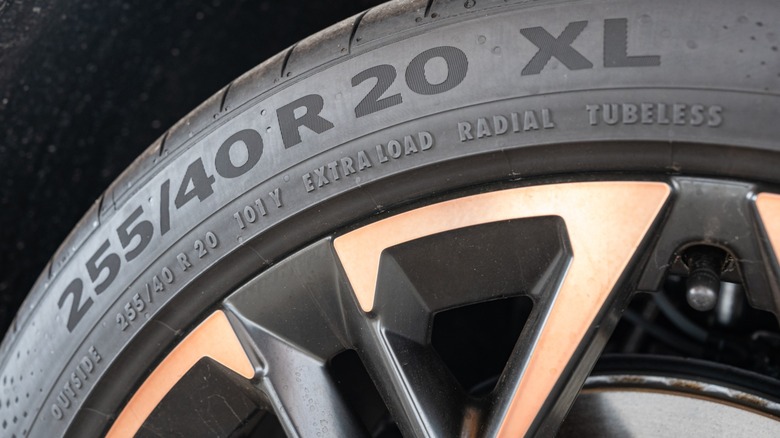
The first consideration when buying tires for any vehicle is to ensure they are the correct type and size. Sometimes the type, passenger car (P), light truck (LT), or standard trailer (ST), will be on the sidewall, but usually, the type is listed only in the tire specs. The size is embossed on the sidewall, 255/40R20 in the example above. The 255/40 is the tire's width in millimeters, and the 40 is the sidewall height as a percentage of its width, known as the aspect ratio. The R signifies it's a radial tire, and 20 is the wheel diameter in inches.
In our example the size is repeated closer to the rim, followed by 101Y. The 101 is the load index with the tire inflated to its maximum psi, and it requires a chart, like this one from Les Schwab, to decipher. The letter Y is the top speed rating of the tire, and it requires its own chart to decode.
From the load index chart, we see that the tire above has a maximum capacity of 1,819 pounds. Four of those have a max carrying capacity of 7,276 pounds. Sometimes tires capable of mounting in dual-rear-wheel configurations list two load indexes, like 121/118, the higher number is for single-rear-wheel, while the lower number is for duallys.
Load range is another code to look for on the tire's sidewall. Our example is an XL (extra load), which represents a 4-ply tire. Load range replaced the antiquated ply rating system for tires when manufacturers developed tires with fewer, yet stronger, plies. You'll still see and hear ply ratings, such as 10-ply (E) and 12-ply (F) used frequently, but the actual ply count of those tires is lower.
Other tire considerations when towing

Considering all the information from the tire example above doesn't mean you can tow 7,276 pounds with those tires, it's simply one factor automotive engineers use to determine the vehicle's gross carrying capacity. It's also important to remember that you can't increase the towing capacity of your vehicle by installing tires with a higher load index or load range. You do need to ensure the tires on your tow vehicle and trailer meet or exceed the recommendations of the manufacturer.
Whether you're buying new or used tires, or you're buying a new or used tow vehicle or trailer, it's a good idea to thoroughly inspect the tires before making the deal. Another thing to look for, especially when buying used, is the date code. It's also a good idea to check the date code on your spare tire, because they do expire, and they need to be replaced even if they're not showing any signs of wear.
On tires produced after 2000, the date code is a four-digit number, representing the week and year the tire was produced, and it usually stands apart from other tire sidewall markings. It's often located in a stamped oval and may be preceded by the letters DOT (Department of Transportation). The first two numbers, 01 through 52 are the weeks of the year — 01 would be the first week in January and 52 would be the last week of December. The last two numbers, 00 through 99, represent the year it was made. For example, aire produced near the end of March 2026 could have a date code of 1226.