

Nissan Torture-Tested This Engine For 100 Hours And The Results Are Impressive

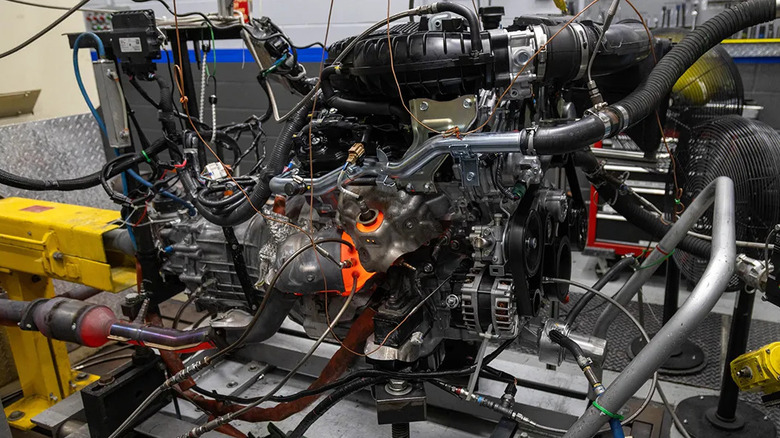
What does it mean for an engine to be durable? If one were to ask the engineers at Nissan's Decherd Powertrain Assembly Plant, they would likely say a durable engine can withstand a level of punishment so severe that components begin to glow with heat — and keep working. That's something of a bold statement coming from Nissan, a corporation struggling with average reliability across its mid-2020s lineup, including a massive engine recall affecting 480,000 SUVs in August 2025 – one of the worst engine recalls of the year.
Nissan's powertrain engineers hope to buck that trend by putting engines through a punishing trial. More specifically, the naturally-aspirated VQ38 3.8-liter V6 that powers the third-generation Nissan Frontier, which is mated to a 9-speed auto transmission. The test itself involves running the engine at full throttle for 100 hours straight under maximum load, basically four 24 Hours of Le Mans races (and then some) run back-to-back without a single break, well beyond what owners are likely to do. The Frontier is a work truck that aims to compete with midsize offerings like the Toyota Tacoma and Jeep Gladiator, and it seems Nissan is attempting to double down on durability.
Decherd analyzes the test results using X-ray imaging, sort of like an MRI for the engine, taking photos in "slices" to peer inside without going invasive. This lets the team further refine the design, finding stress points without disturbing the engine's configuration by tearing it down and cutting metal. Let's take a closer look at the process and why such tests are important.
Nissan's testing process
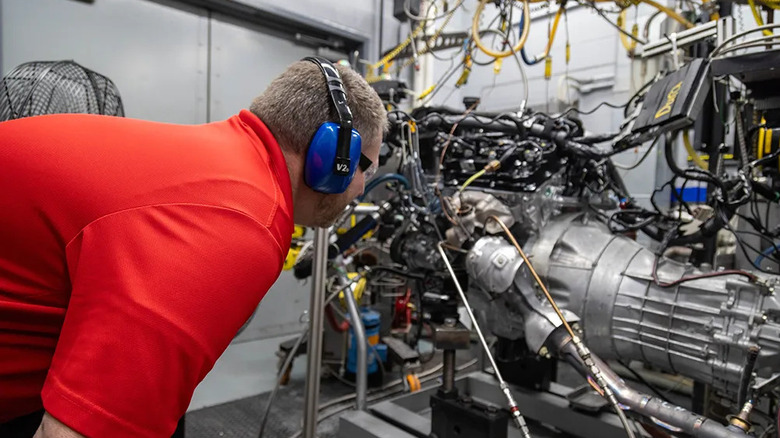
The test involves setting up the engine on a dynamometer, a device that measures various specifications of an engine, such as peak horsepower and torque, its power curve, and its stress points. It involves mounting a standalone powertrain to a test stand and running it through specific tests, in this case focusing on a powertrain's endurance under heavy load. While Nissan doesn't go into specific details in its press release, this sort of test typically involves running the engine under a set load for a specified timeframe; in this case, from several hours to 300 hours.
These test cycles determine the longevity of specific parts by heating metal components well beyond what one would reasonably expect, effectively putting 130,000 miles on these engines within a couple of weeks, by Nissan's estimates. The grueling 100-hour stress test is one component of this larger battery of examinations. For a real-world comparison, imagine driving a Frontier hauling a fully-loaded two-car trailer up a mountain, at full throttle, for four straight days.
Nissan selects engines straight from the production line, checking roughly one of every 100 engine blocks produced, to the tune of several engines per day. If one were to go off sales figures, the facility would've tested around 6,500 engines for model year 2025. These engines are then examined for defects using the aforementioned X-ray scans, with the 100-hour test offering insight into factors like heat buildup and internal metallurgy.
Why these tests are important
These trucks are nothing without their utility, and the beating heart is, of course, the engine. Without a reliable, powerful engine, businesses would have little use for a pickup. However, while every manufacturer presumably keeps this in mind when building pickup trucks, not all get it right: Toyota, for example, has had recalls related to engine manufacturing defects in its pickups and SUVs. Procedures like those outlined in Nissan's press release will, at least in principle, help prevent such incidents from happening by detecting longevity issues before they arise on the road.
Engines are incredibly violent places, especially in high-stress, high-power situations. Stressing metal components to the point that they're glowing hot can push them quite literally to the breaking point, but Nissan's engineers are confident that its engines will pass muster every time.
In practical terms, this means that the owner can expect the engines to hold up under various conditions, be they high-heat environments, high-load scenarios, or extended road trips with plenty of cargo. Will a test detect everything? Likely not, but it will certainly give engineers some insight into where to refine the designs. Nissan's engineers, for their part, are confident in the engines — provided owners get their oil changed (or change it themselves) on time.