

How Many Submarines Does Iran's Navy Have?
After the United States and Israel attacked Iran in late February 2026, it became increasingly important to determine how many warships Iran's navy has. However, militaries around the world typically keep this kind of information confidential. As a result, only estimates can gauge how many submarines Iran has in its navy.
The Nuclear Threat Initiative estimates that before Israel and U.S. forces attacked, Iran had somewhere between 28 and 30 boats, which is another name for submarines. (By comparison, the United States has around 70 subs in its fleet.) Iran's fleet is generally composed of far weaker submarines than those in the U.S. fleet, and none of them are nuclear-powered due to international sanctions. Iran has four submarine classes: the Tareq, Fateh, Nahang, and Ghadir. While a fifth class does theoretically exist, this "new" Besat/Qaem-class has been under construction since 2007 and still wasn't in service as of this writing.
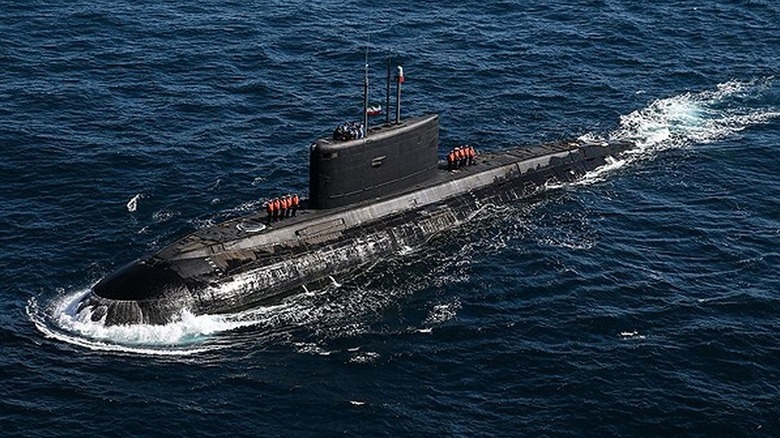
Built in Russia and based on its Kilo-class submarine, the trio of Tareq-class boats (the IRIS Taregh, Noah, and Yunes) are Iran's heaviest hitters. They're each 242 feet long with a 32-foot beam and a top speed of 17 knots (almost 20 mph). Each of these contains six 533mm tubes capable of launching 18 torpedoes and Anti-Ship Cruise Missiles (ASCMs). They can also lay up to 24 mines. Iran reportedly retrofitted these back in 2012, and they are its most advanced submarine class to date.
Iran's submarines are capable, though not as strong as the United States'
Iran's Tareq-class subs' hulls are layered with anechoic tiles made from advanced composites and synthetic materials. These tiles are so good at distorting sonar waves that Iran's Tareq-class sub has earned the nickname, "Black Hole." Additionally, they can go 45 days without refueling and have a range of over 6,000 miles, making them all the more fearsome.
Iran's three Fateh-class submarines — its most advanced original design — are 157 feet long and have a displacement of around 600 tons. Top speed estimates range from 14 to 23 knots (16 to 26 mph). They're also outfitted with six 533mm tubes and can lay mines like the Tareq. The single mini-sub in the Nahang-class lacks torpedo tubes and likely carries its mines or torpedoes externally. Its main mission is to transport and deploy special operations forces into combat.
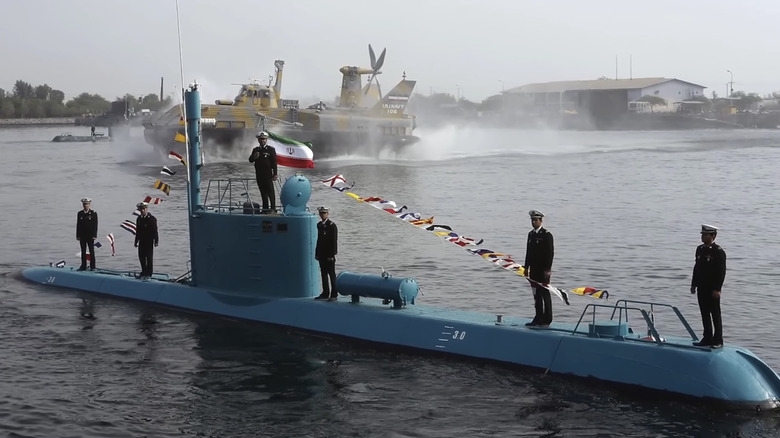
At 23 boats, Iran's stock of Ghadir-class mini-subs comprises the bulk of its fleet. These subs are truly mini, with a length of just 95 feet and a beam stretching about 9 feet. Each boat's diesel-electric drive can reach a top speed of 9 knots (10 mph), and they are equipped with two 533mm torpedo tubes that can fire Iranian Hoot high-speed supercavitating torpedoes. These boats may also carry torpedoes like North Korea's 533mm CHT-02D. This makes sense considering this class is thought to be based on North Korea's Yono-class submarine, which still operates alongside the country's tactical nuclear submarine.