

Are Boxer Engines Better Than Other Flat Engines?
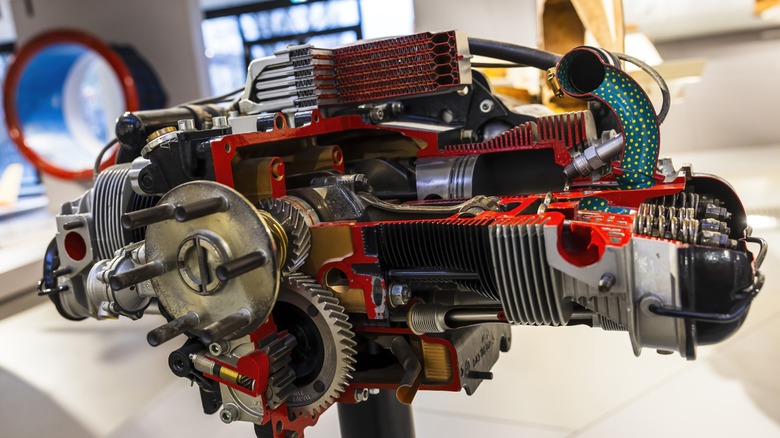
Flat engines are horizontally-opposed piston engines, and this group includes Boxer engines, but not opposed-piston engines like the Cummins 14.3L Advanced Combat Engine (ACE) designed to power tanks. We can think of flat engines in much the same way as V-engines, except with 180 degrees separating their cylinder banks, instead of the familiar 60 to 90 degree orientation. They contain even numbers of cylinders, 2, 4, 6, etc., and two cylinder heads, one for each bank.
The boxer engines used by Toyota, Subaru, and Porsche today are unique among the group of flat engines. While all boxer engines are flat engines, not all flat engines are boxers. The defining characteristic for a boxer engine is the way each set of horizontally-opposed pistons move in relation to each other.
Boxer engines are often considered superior to other flat engines due to their balanced operation. Other flat engine designs require the use of counter weighted crankshafts that add considerable weight to their rotating mass. Boxer engines can forgo much of the additional balancing weight, although they can benefit from minor internal balancing.
What makes boxer engines different?
Subaru is fond enough of its four-cylinder boxer engine to trademark the Subaru Boxer name, but Porsche loves its flat-six engine too. While the Porsche engine doesn't proclaim its boxer design in its title like the Subaru Boxer, it still uses what is known as the contra engine design developed by Carl Benz in 1896. Yes, the same Carl Benz behind the first car ever invented.
Flat engines that are not boxers have each pair of opposed pistons connected to the crankshaft on the same eccentric rod journal. This connection pushes one of the pistons away from the engine's centerline, while the other moves toward centerline, either pulled by the crankshaft on the intake stroke or pushed by the combusting fuel during the power stroke.
Boxer engines employ separate eccentric rod journals set 180 degrees apart for each piston connecting rod. This means that, for each opposing piston pair, both pistons move outward and inward together. To visualize the process, place one of your fists at each shoulder, right to right and left to left. Now, punch both fists simultaneously outward then pull them in together. Tada, you're a boxer engine.