

Before Stealth Jets And Missiles, Lockheed And Martin Built These Planes First
Before the American defense and aerospace manufacturer Lockheed Martin (maker of the F-35 Lightning II) existed, there were brave men with sky-high aspirations. On August 16, 1912, Glenn L. Martin started his self-named company in Los Angeles, California. Just four months later (December 19), the brothers Lockheed (originally spelled "Loughead") – Allan and Malcolm — founded the Alco Hydro-Aeroplane Company (later becoming the Lockheed Aircraft Company) in a garage in San Francisco, California.
The first type of plane the Lockheed's built is right there in the company name. It wasn't a fighter, bomber, stealth jet, or missle, but a "hydro-aeroplane," which is simply an old-timey term for a seaplane, complete with a pontoon. Lockheed Martin Corporation didn't come about until Martin Marietta and Lockheed merged in 1995 – a full 83 years after they both separately started.
The Lockheed brothers and Martin were only 400 miles apart, a distance covered by car in about six hours today. Back then, though, taking the train was much faster (about 13 hours) as roads weren't reliable or direct. Still, this group of men all possessed a love of flight and were innately mechanical enough to teach themselves to build and fly airplanes in an era when, generally speaking, only daredevils experimented and made stuff up on the fly. After all, the Wright brothers had only made flight a reality at Kitty Hawk in December 1903. Interestingly enough, Orville Wright himself encouraged Martin to build his first airplane.
Martin was as instrumental as the Lockheeds
Glenn Martin first tried to take to the air in July 1907 aboard a single-wing aircraft he'd designed and built in a rented church. When it stalled during the inaugural flight, he tried restarting it himself. Upon spinning the propeller, the entire airplane jumped forward; Martin avoided certain death by the narrowest of margins. The plane, however, did not survive. He finally managed to get into the air in August 1909, and by 1911 was considered a leading pioneer in American flight.
The following year, he strapped a single pontoon to the bottom of his Martin Model 12 biplane, converting it into a seaplane. Martin flew the 34 miles from California to Catalina Island and back, setting two world records: longest hydroplane flight and longest round-trip flight over water. Oh, and he delivered mail to the island (also a first) in the process.
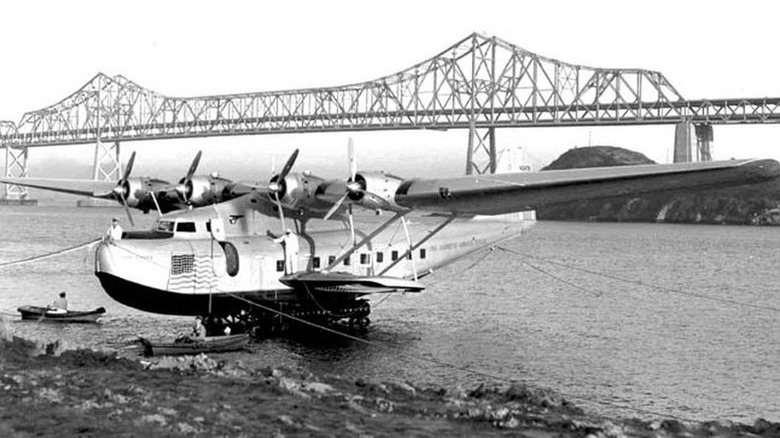
Martin purchased 1,260 acres outside Baltimore, Maryland, in 1929, and subsequently built a massive manufacturing facility. In 1932, Pan American Airways (Pan Am) issued an RFP (request for proposals) seeking "flying boats" capable of crossing the Pacific Ocean. Only two companies replied: Martin and Sikorsky Aircraft Companies. Martin won the contract with the M-130, and Pan Am put the China Clipper, Philippine Clipper, and Hawaii Clipper into service in 1935. At the height of World War II, the plant employed more than 50,000 people and produced more than 11,000 planes. In 1962, the first U.S. multistage ICBM (Intercontinental Ballistic Missile) — the M-68A/HGM-25A Titan I — went online, built by none other than Martin Marietta.
The Lockheeds led the seaplane surge
Meanwhile, the Lockheed brothers were on a similar seaworthy trajectory of their own. Allan got his first taste of flying in 1910 when he hopped aboard a Curtiss pusher biplane (the same model involved in the first aerial "dogfight" in 1913) powered by a 30-horsepower engine. He'd never flown before, but somehow managed not to kill anyone (himself included) who had gathered on that cold December day at a baseball field in Chicago to see him soar into the sky.
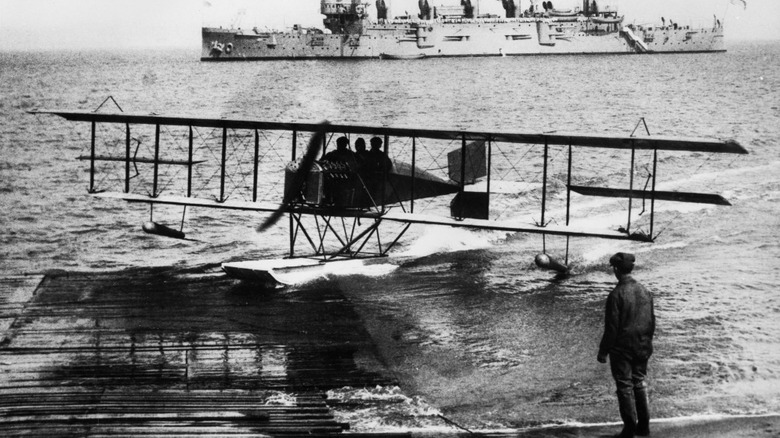
Along with his brother Malcom, the two immediately began designing seaplanes from a modest garage near San Francisco's waterfront. Finally, on their 7th iteration — formally designated as Model G — they hit upon what they felt was the best of the bunch (concepts A through F got tossed into the waste bin). With money provided by the Alco Cab Company (remember, their first business name was the Alco Hydro-Aeroplane Company), Allan flew the completed biplane equipped with a lone sled-shaped pontoon (and two passenger seats) on a test flight out across San Francisco Bay on June 15, 1913. It was a success. They made two additional 20-minute flights that day, reaching speeds of 50 mph at an altitude of 300 feet.
Two years later, they showed off the Model G at the 1915 Panama–Pacific International Exposition, a world's fair-style exhibition that drew more than 18 million attendees. They flew approximately 600 passengers during the event, each paying $10 for a 10-minute ride. With $4,000, in profits they formed the Lockheed Aircraft Manufacturing Company, and went on to build the largest seaplane of its kind in the country. The rest, as they say ... is history.