

5 Gaming Consoles More Powerful Than Nintendo Switch 2
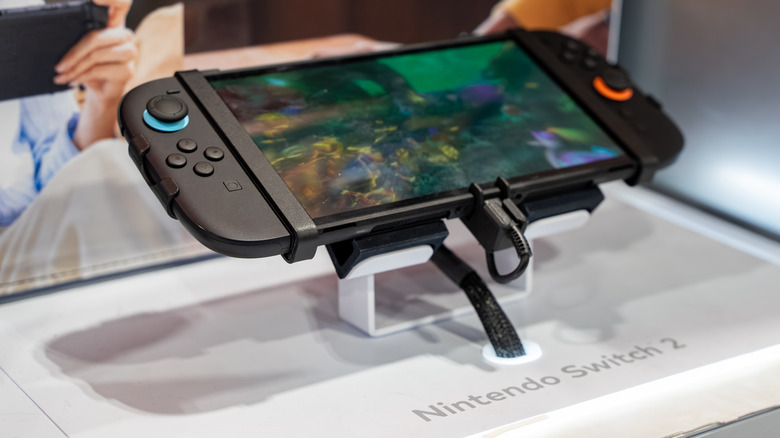
Since its launch in June of 2025, the Nintendo Switch 2 has sold over 17 million units by the end of that year. The system is Nintendo's follow-up to the massively popular Switch, which itself has sold over 155 million units since its 2017 debut. The Switch 2 continues its predecessor's main gimmick of being a hybrid console; it can be played either in handheld mode, like the classic Game Boy of ages past, or you can slide it into a dock plugged into a television for a more traditional console experience.
The Switch 2 is significantly more powerful than the original Switch, which often struggled with infamous ports of games like "Mortal Kombat 1" and "Ark: Survival Evolved." By contrast, the Switch 2 has fully featured ports of games like "Final Fantasy VII Remake", "Cyberpunk 2077", and even a day-and-date launch of "Resident Evil Requiem" alongside the PC, Xbox, and PlayStation 5 versions.
That being said, the Switch 2 isn't the most powerful system on the market. It isn't even the most powerful handheld available for purchase in 2026. Let's take a look at five gaming consoles that are more powerful than the Switch 2.
Keep in mind that "more powerful" doesn't necessarily mean "better." All the teraflops in the world don't mean a thing if the games aren't good enough, and where the Switch 2 lacks in relative horsepower, it more than makes up for it with games like "Pokémon Legends: Z-A", "Donkey Kong: Bananza", and "Mario Kart World."
PlayStation 5 Pro
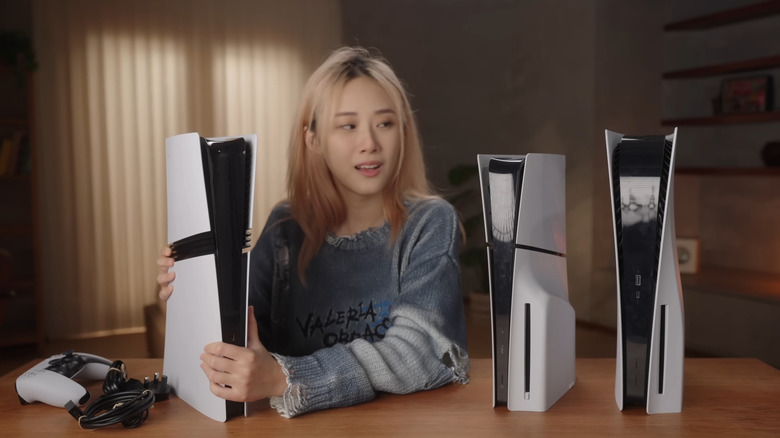
In the current console generation, the industry leader is Sony with its PlayStation 5. That system is already more powerful than the Switch 2, but it's not the most powerful PlayStation on the market. That honor goes to the PlayStation 5 Pro, which features additional hardware advancements over the base model.
The Switch 2 benefits from NVIDIA's DLSS for upscaling low-resolution images into something that's crisp and viable on the 1080p handheld screen or even a 4K television, though it's not nearly advanced as the DLSS systems that are available on other platforms. To that end, the PS5 Pro utilizes its own machine learning-based upsampling solution called PlayStation Spectral Super Resolution (PSSR). While games like "Star Wars Jedi: Survivor" and "Silent Hill F" had trouble with PSSR, the system was upgraded with the launch of "Resident Evil Requiem", and it will only get better over time as PSSR continues to improve.
On top of proprietary tech like PSSR, the PS5 Pro boasts specs that include an upgraded GPU and 16 GB of RAM with faster bandwidth over the base PS5 of 576 GB per second, as well as 2 additional GBs of DDR5 RAM specifically for back-end system processing. Meanwhile, the Switch 2 features 12GB of LPDDR5X RAM. While docked, it outputs 102 GB per second, which is reduced to 68 GB per second in handheld mode.
Xbox Series X
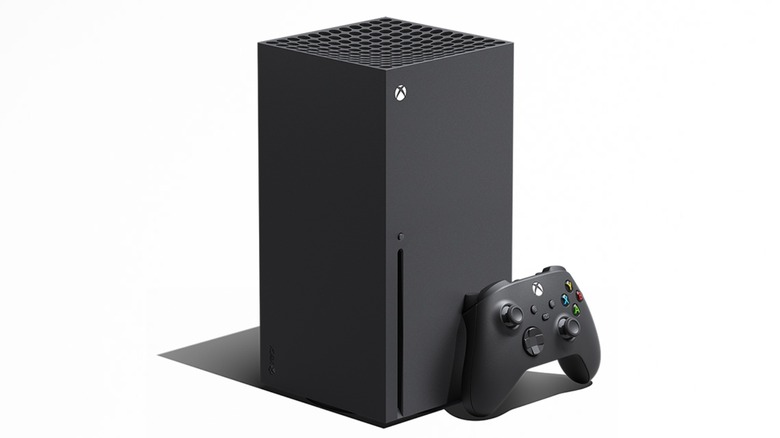
Alongside the PlayStation 5, the other big home console of the current era is the Xbox Series X. At the start of the console generation, Microsoft made the controversial decision to create two consoles: The Xbox Series X and the less-powerful "starter" system, the Xbox Series S. Both are versatile systems with a variety of functionality, but the Series X is superior in just about every way.
In early comparisons, multiplatform titles like "Cyberpunk 2077" run similarly on Switch 2 compared to Series S, with both 30 and 60 FPS modes. Then again, other games, like "Final Fantasy VII Remake", support 60 FPS on Series S but only 30 FPS on Switch 2.
While it may be a toss-up how the Switch 2 compares with the Series S, Nintendo's system lags far behind the Series X, which is much more in line with the PlayStation 5. The Series X boasts a custom RDNA 2 GPU that boasts 12 TFLOPS (trillion floating point operations per second) of processing power, more than the PS5's 10.3 TFLOPS, but behind the PS5 Pro's 16.7 TFLOPS. Meanwhile, the Switch 2 is capable of just 1.7 TFLOPS in handheld mode and a hair over 3 TFLOPS while docked to a TV. For fans of portable play, losing a few TFLOPS is a small price to pay to enjoy a 60 FPS version of "The Legend of Zelda: Tears of the Kingdom" while riding the train to work or taking a plane on a cross-country flight.
Steam Deck OLED
If the Switch 2 has one major weakness, it's the LCD screen. the original Switch was eventually upgraded to feature a superior OLED screen with excellent black levels, vibrant colors, and incredible contrast. Unfortunately, with the Switch 2, Nintendo went back to a cheap LCD display, presumably as a cost-cutting measure. The results are honestly not very good. If you play exclusively in handheld mode it might be worth hanging on to your original OLED Switch, since Switch 1 games that run on both platforms honestly look better on the OLED Switch than on Switch 2, improved framerates and resolutions notwithstanding.
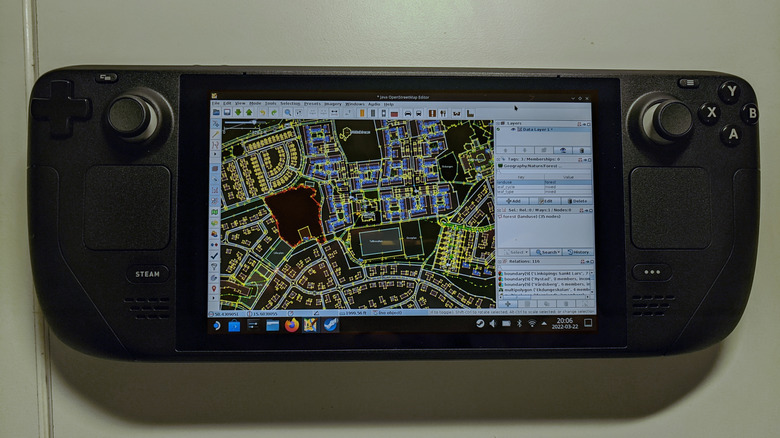
If you want a handheld gaming machine with an OLED screen, then the Steam Deck OLED is the system for you. Its 7.4 inch OLED HDR screen isn't quite as big as the 7.9 inch screen of the Switch 2, but in terms of image quality, the Steam Deck OLED has it beat by a country mile thanks to the wonders of OLED technology over LCD displays. Even with a lower screen resolution (1280x800p vs the Switch 2's 1920x1080p), the image simply looks better on the Steam Deck OLED.
The rest of the Steam Deck's specs are nothing to scoff at, either. The Steam Deck OLED features 16 GB of on-board LPDDR5 RAM; this makes for a more versatile device than the Switch 2, since it's essentially a portable PC with Linux compatibility. If you just want to play games then the Switch 2 will be more to your liking, but if you have a substantial Steam library of older, less-demanding games or want an easy and relatively inexpensive way to dive into the PC gaming space, the Steam Deck OLED is worth getting in 2026. It's a fantastic machine that takes advantage of the sheer scalability of the PC platform.
ROG Xbox Ally X
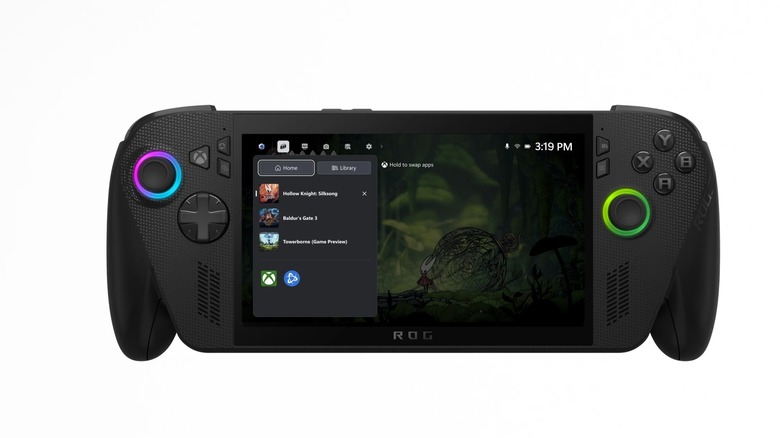
The Steam Deck isn't the only "portable PC" in town. There's also the wares of the Asus-branded Republic of Gamers, or ROG. They make phones, laptops, graphics cards, and other devices. Last year, they teamed up with Microsoft to make the device we're here to talk about right now, the ROG Xbox Ally X. It's sort of a portable Xbox Series system, but has more in common with the Steam Deck than an Xbox and is the next-generation version of the 2024 ASUS ROG Ally X.
The newer ROG Xbox Ally X has a seven-inch, 1080p LCD screen and runs on Windows, so you're not locked into the Steam ecosystem. This allows you to play games from GOG, the Epic Games Store, or any other launcher. In terms of internals, the Ally X has 24 GB of LPDDR5X RAM, double what is available on Switch 2, and uses a AMD Ryzen AI Z2 Extreme processor for maximum performance. Alas, these impressive specs come at a cost. The ROG Xbox Ally X costs $999, and you don't even get HDR or an OLED display, though at least you get 120Hz and FreeSync VRR visuals for smoother performance.
If you're interested in the idea of a ROG handheld but don't want to go all the way with the premium model, there's also the ROG Xbox Ally (without the 'X' at the end), which costs $599 MSRP but has reduced power under the hood.
Lenovo Legion Go 2
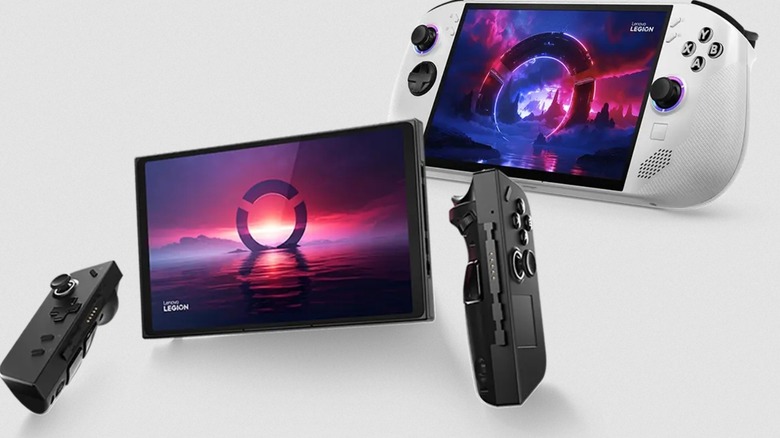
Finally, we have the Lenovo Legion Go 2, the 2025 iteration of Lenovo's flagship line of "portable PC" handhelds. The original Lenovo Legion Go launched back in 2023, and subsequent models have improved on an already strong foundation. Even more than most post-Switch handhelds, this one wears its Nintendo influence on its sleeve, right down to the detachable "TrueStrike" controllers that are effectively Lenovo's version of Nintendo's Joy-Cons.
Like most portable PC handhelds, the Legion Go 2 is tremendously expensive, with prices starting at $1,099. For that price, though, you're getting some major bang for your buck. Instead of the traditional 16:9 display, you get an 8.8 inch 16:10 screen with a resolution of 1920x1200. This screen is both HDR and OLED and has a refresh rate of 144Hz, which is a huge improvement over what's currently possible on the Switch 2. The Legion Go 2 also uses an AMD Ryzen Z2 Extreme processor to provide as top-notch portable gaming experience as possible for any game you can run on Windows.
The Legion Go 2 is set to be replaced by an updated second generation version of the system. As of this writing, there's no release date for the upcoming Go 2 Gen 2, but it will replace the current version of the Go 2. Overall, if you're wealthy enough to afford a Legion Go 2, you're better off waiting for the Gen 2 version. If you don't feel comfortable putting down well over a thousand bucks for a gaming handheld, there's also the less powerful Legion Go S line, which starts at $649 and has downgrades including an LCD screen, a smaller SSD, less RAM, a default to Steam OS, and other cost-cutting measures.