

New Bill Would Ban Bosses From Forcing Microchip Implants In Employees

In a turn of events that feels directly lifted from the pages of a science fiction thriller, a new bill in Washington State would bar bosses from forcing their employees to get microchip implants. If that sounds like a far-future fantasy, it largely is. We do not yet live in a world where cybernetic body implants are easily available outside of medical experimentation, let alone widely available. Neuralink's first human trial came and went without much in the way of expansion. If anyone's boss has fantasized about chipping employees in order to track and control them, they thankfully do not have the means to act on those wishes — yet. So, why the urgency from Washington's elected officials?
The bill, which has passed both chambers in the state's bicameral legislature, now sits on Governor Bob Ferguson's desk, waiting to be signed. If signed, it would prohibit employers from mandating or coercing those who work for them into getting microchips implanted under their skin which might personally identify them or otherwise impinge on their privacy. The law does make clear that people will be allowed to get microchip implants on the basis of personal preference and informed consent, and it also exempts both medical implants and non-implanted devices such as wearable tech (smart watches, rings, and so forth). Here's what the bill will cover if signed into law, and why it isn't as sweeping as it seems at first blush.
Washington state is proactively guarding against futuristic labor abuses
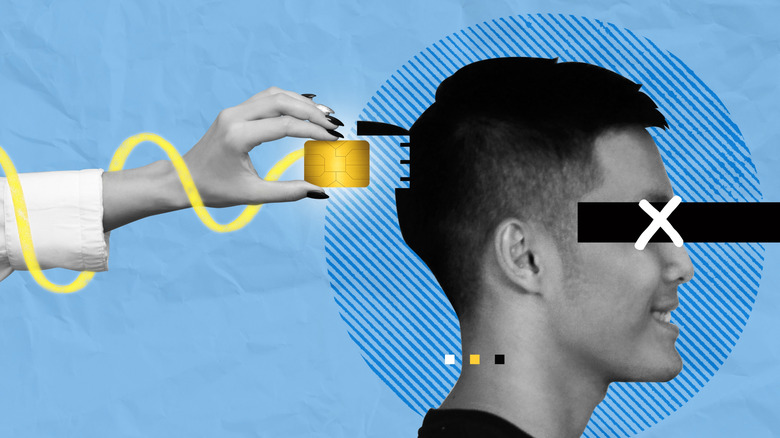
Given its futuristic ambitions, the Washington bill prohibiting mandatory microchipping of employees has a rather limited scope. The bill defines a microchip as "a product, device, or technology that is subcutaneously implanted in the body of an individual and contains a unique identification number and personal information that can be noninvasively retrieved or transmitted with an external scanning device." Under this definition, an implanted chip would need to be identifiable and to identify the person it's implanted within in order to violate the law. There is also a broad carve-out for medical devices, so long as the device is only used for medical purposes.
In other words, if you're one of the people who has electromagnets implanted in your skin for the purposes of sensing electromagnetic fields — a so-called biohacking technique that's been available for the better part of a decade — nothing in the text of this bill appears to prevent you from requiring your employees to do the same. And the law also explicitly states that it only applies to subcutaneous implants, meaning devices placed "beneath the skin," adding a carve-out for bracelets and other wearables. If your boss wants to track you via Apple Watch rather than Neuralink, that may still be their prerogative if no other law can be invoked against such a mandate. Anyone whose rights are violated by an employer's microchip mandate can bring a civil suit to secure injunctive relief, along with actual and punitive damages.
Limited functionality body implants are already available
At the time of this writing, no sophisticated microchip implants of the kind you might see in "Black Mirror" are available to the public. The closest thing might be Neuralink, the Elon Musk brainchild that has been probed for possible animal cruelty as it attempts to bridge the gap between the human mind and computer interfaces. Other programs have been tested on those with serious medical conditions such as ALS. The unifying factor is that humans who have actually augmented their natural abilities with an implant have all been participants in extremely limited trials and studies.
Even so, there are a number of less-capable implants on the market. They are sought after by a relatively small community of transhuman futurists who call themselves biohackers. Most of these chips are single-function, such as an NFC or RFID implant that acts as a house or office key, or as a tap-to-pay chip at terminals. In a profile on the biohacking community, ABC reported that these types of microchips are nominally led by a DIY community and do not have FDA approval. However, they would likely fall within the purview of Washington's anti-chipping bill, since keys and payment cards are personally identifying.
But given the pace at which other technologies have accelerated, Washington may be ahead of the curve. For decades, AI produced useful but not earth-shaking innovations. But when ChatGPT arrived, it started a Cambrian explosion in generative AI which is now transforming our society in unpredictable and often bizarre ways. With no laws to preempt unethical use cases, current AI technology is leading to some nightmarish scenarios. In time, DIY biohacking could become a multi-billion dollar industry, and Washington's residents will be more immediately sheltered from its externalities.