

4 Of The Weirdest Aircraft The US Air Force Has Ever Flown
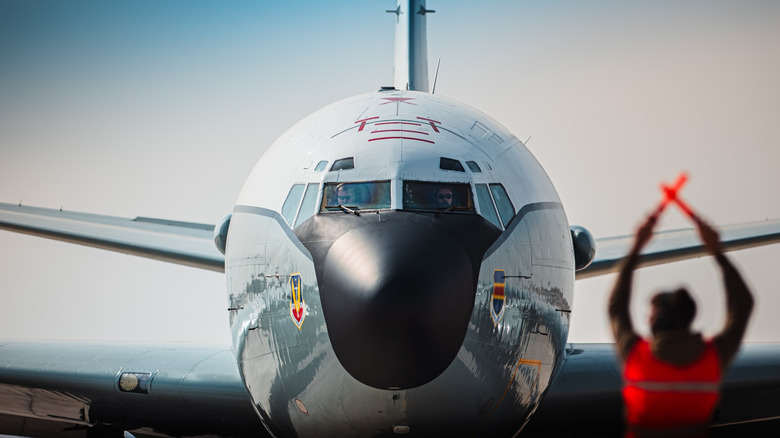
There are some aircraft that will forever be associated with the U.S. Air Force. The formidable and hugely heavy C-130 Hercules transport and the swift, deadly F-22 Raptor are both iconic examples. The planes, as dramatically different as they are, each have a critical role to play in their operations for the world's largest air force. Every model in the USAF's repertoire is a fascinating work of aviation engineering, but there have also been some rather outlandish designs that never saw mainstream adoption.
Not every aircraft ever flown by the U.S. Air Force was intended to serve in its ranks full time. Some of these were just experimental efforts that were never intended to reach production. Others were ambitious endeavors that seemed workable on paper, but as the project continued and prototypes took to the air, it proved impractical to continue. In the interests of pursuing new technology and advancing the course of aviation, more experimental models are often flown from time to time; some of them have been truly peculiar, but despite their odd designs, have had an important part to play in the overarching story of U.S. aviation.
Some of the strangest aircraft the U.S. Air Force has ever flown include a Phoenix that was built to smell for nuclear attacks, a laser-wielding Boeing, and an aircraft with a unique, seemingly wingless design. Let's take a closer look at some of these special aircraft, where they got some of their more outlandish qualities, and what ultimately happened to them. Sometimes, they were one-off curiosities that are largely forgotten, but others live on in current designs of aircraft that are still used today.
YAL-1 Airborne Laser Test Bed
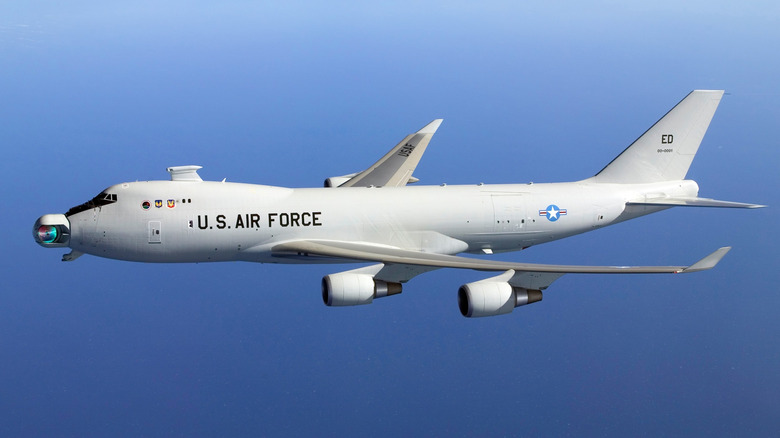
It's more jarring, perhaps, to see an aircraft that looks almost completely conventional, but which has one absolutely outlandish feature. As you'd probably guess, the YAL-1 Airborne Laser Test Bed has just that: The laser, which is unmissable there in the aircraft's nose cone. That eye-catching facial feature, according to the Air Force Test Center, is "a megawatt-class chemical oxygen iodine laser," and it's built on the platform of a Boeing 747-400F. Military-grade lasers are being explored more and more today as means of tackling threats like drones, but in the early-2000s, the U.S. Air Force had different targets in mind: Missiles.
The laser on the nose of the YAL-1 went through an extensive program of experimentation at California's Edwards Air Force Base. At the end of the testing in 2007, project manager John Kalita noted that it provided "an operationally significant range against all classes of missiles including intercontinental ballistic missiles." It's a unique approach to targeting these airborne threats, doing so in their post-launch boosting phase. Testing was performed using the laser within components of a 747 that were assembled at ground level; when operators were satisfied, the next stage was to incorporate the defensive weapon in a real, flying YAL-1A.
Though there were successes in flight tests, the program was abandoned in late 2011. Even so, the utility of laser weapons continues to be explored, with China claiming in 2025 that it had a new laser weapon that could outperform the U.S. Navy's HELIOS laser system.
Boeing WC-135R Constant Phoenix
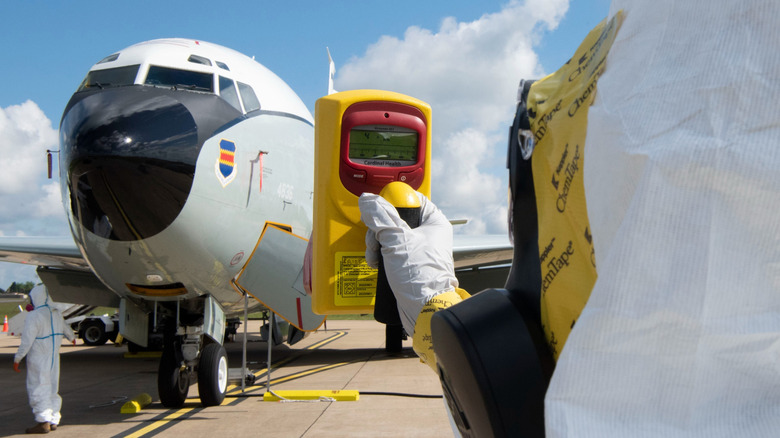
The Constant Phoenix, Boeing's WC-135R, is an adaptation of the C135b Stratolifter, a mighty U.S. Air Force transport. Its role is entirely different to those models, though. The U.S. Air Force explains that its "modifications are primarily related to its on-board atmospheric collection suite, which allows the mission crew to detect radioactive 'clouds' in real time"; the Constant Phoenix comes with the ability to collect airborne particulates, as well as holding tanks for collecting air samples, for later analysis.
Flown by the 45th Reconnaissance Squadron, this aircraft has a role that's as unique as it is crucial. Globally, it plays a part in ensuring that weapons tests are performed responsibly and accordingly to international standards. As WIOS reported when a Constant Phoenix landed in the United Kingdom in January of 2026, "the Limited Nuclear Test Ban Treaty of 1963 [...] bans above-ground nuclear tests," and so the aircraft's appearance often coincides with efforts to detect whether this has been breached — hence the aircraft's nickname of "nuke sniffer."
There are just two of these aircraft currently active, which is why it made the news when it made a rare journey across the Pacific to the UK. Due to its unique purpose, it has had a historically significant role in global crises. This includes its use during the aftermath of the Chernobyl disaster in 1986 where it was able to monitor the movement of radiation released into the atmosphere, providing crucial data to the effort to mitigate the effects of the nuclear explosion. The WC-135R variant, a modified version of the aircraft that was fitted with a quartet of CFM International turbofan engines, showcases the U.S. Air Force's continued efforts to modernize the aging airframe for future operations.
NT-43A RAT55
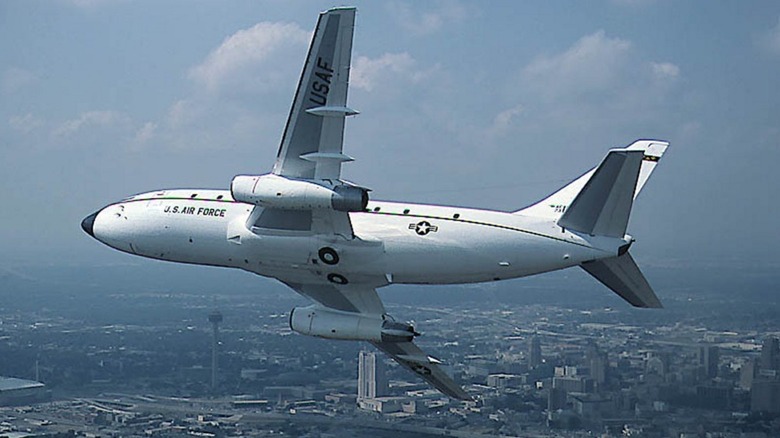
It's easy to be wowed by speedy and deadly fighters. When it comes to military aircraft, though, the mighty workhorses that keep operations running often don't get the appreciation they deserve. Support aircraft enable allies and help keep them safe, frequently becoming priority targets themselves in the effort. Elusive USAF planes like the RAT55 have their essential contributions to make too. These are modifications of the T-43A flight trainer (as shown here), fitted with all manner of advanced sensors.
Far from a small and subtle aircraft, this is actually a Boeing 737-200, one of the oldest still in service today. The RAT55 variant, though, has been extensively customized for a specific purpose. The War Zone dubs it "a grotesquely modified radar cross-section measurement platform." Its origins as one of the long-lived commercial models are clear to see, but so too are its modifications. The nose and the tail sections bulge with the radar systems placed there, which allow the aircraft to serve its role of reading the radar signatures of stealth aircraft.
This data can be very difficult to acquire from aircraft in flight through more conventional means, which is why the single RAT (Radar Airborne testbed) still in use holds such value. The more information it can glean about the movements of a stealth aircraft and the radar signatures they leave in their wake, the easier it is for aviation engineers to design aircraft that can obfuscate them further. Meanwhile, the RAT55 is all the more intriguing because so little is known about it. What is confirmed makes it an even more fascinating USAF asset, such as the fact that it has operated in the region of the Tonopah Test Range Airport near Area 51 in Nevada,.
HL-10 Lifting Body
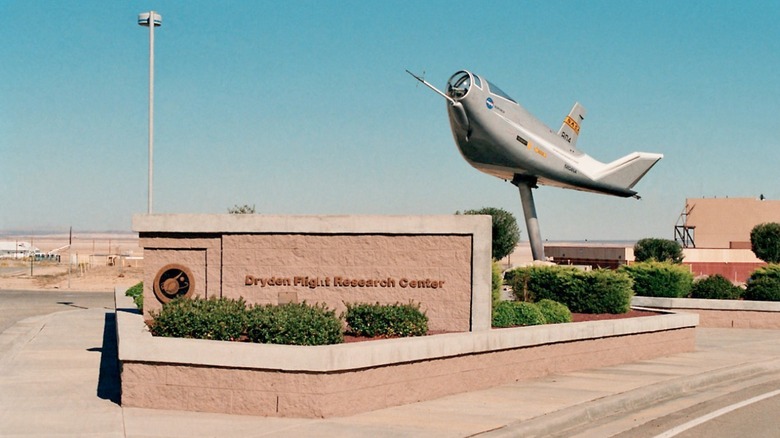
Even the most unconventional of modern aircraft have certain features that are typically all but non-negotiable, such as a pair of wings. Nonetheless, sometimes engineers defy such conventions; that's how the USAF finds itself with extraordinary machines like the conspicuously wingless HL-10 "flying bathtub" in its back catalog.
The curious design, unsurprisingly, was created for a very specific role. NASA reports that its lifting body program, which also included models such as the X-24A and M2-F2, ran for almost a decade from 1966. Its goal was "to study and validate the concept of safely maneuvering and landing a low lift-over-drag vehicle designed for reentry from space." Both NASA and USAF test pilots got behind the controls of the remarkable HL-10, which had a maximum weight of 9000 pounds, was just over 22 feet long, and was powered by a Chemical Reaction Motors Inc XLR-11 rocket engine. Flying it was surely a harrowing experience, beginning with release from a B-52 Stratofortress bomber, but it was all about testing for maneuverability and safety during a high-speed descent.
And speed was definitely on the menu. In the hands of USAF pilot Peter Hoag, the HL-10 reached velocities as high as Mach 1.86 during test flights. It would go on to have a considerable influence on the development of future craft. In "Wingless Flight: The Lifting Body Story" from NASA's History Series of publications, authors R. Dale Reed and Darlene Lister referred to the model as one of the "configurations with high volumetric efficiencies, best suited for shuttle-type missions in deploying satellites and in carrying cargo and people to and from earth orbit." In a world that reached the moon during the testing period of the HL-10, these capabilities would be important.