

5 Motorcycle Models With Legendarily Long Production Runs
It really takes a lot for a model's production to span a long time, especially in the motorcycle world, where it's normal for trends to come and fade out really fast. One year it can all be about engine type and speed, the next everyone starts reaching for tech-loaded ones. So, for a model to last for decades or even push close to a century, it means it thrived against everything the industry threw at it: emissions regulation changes, ownership shifts, the rise and fall of economies, or even the tastes of the riders. Plenty of nameplates have folded under the pressures, and the ones that stood tall didn't survive it by luck. For most, all they did was adapting, improving, and keep rolling without losing what actually made them special in the first place.
What really makes these bikes so special is how familiar they feel. Regardless of the generation, any rider can casually hop on the same nameplate and still sense that connection. That alone is what keeps its riders coming back. Apart from that, these bikes get better over time in terms of displacement, engine, and suspensions. Even the electronics and safety tech tends to gradually work its way in while the bike keeps its core identity intact. Without further ado, these are the nameplates that truly earned their long-running reputation by remaining in production across several generations.
Royal Enfield Bullet
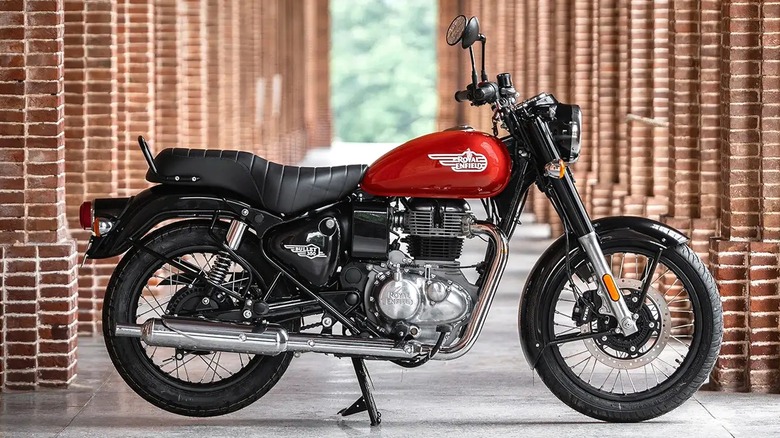
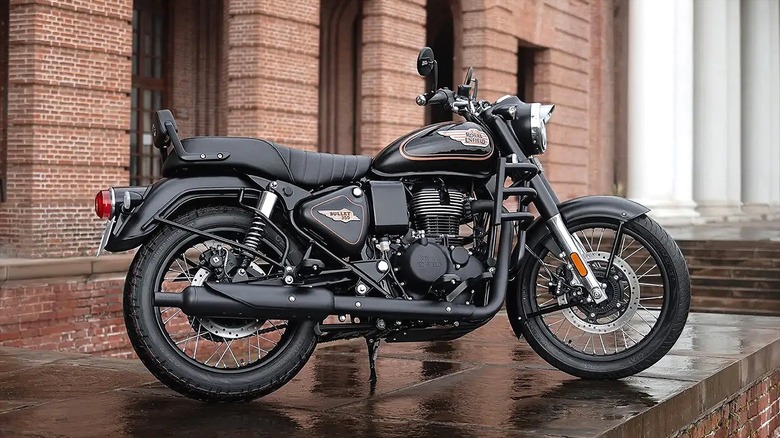
One of those bikes that has refused to bow out, even after 100 years and 15 generations, is the Royal Enfield Bullet. Its journey began back in 1932 when the brand was still cranking out bikes in Redditch, England. During those times, it was possible to get a Bullet in one of three engine options, but already in 1936, the bike stepped up its game by evolving its 500cc version into the Model JF. The same year, another package was made available: A bronze head cylinder version for riders who wanted something sportier.
Even after the Second World War, the Bullet didn't fade out, rather it came back with more updates, the biggest one being the swinging-arm rear suspension of 1948. That tweak laid the groundwork for the likes of the refreshed 350cc model that followed in 1949. To further prove itself, the Bullet battled at the Scottish Six Days Trial, which it won in 1952 and again in 1957. Around that same period, the Bullet's reputation had already caught the attention of the Indian Army, which then led to Royal Enfield teaming up with Madras Motors in the mid '50s.
From there, production moved in part to India, ensuring the Bullet never left the road. Over the decades, it picked up better brakes, refined suspension, updated electrics, and even unit-construction engines. Other variants came and went, but the lineup is still very much alive today in the form of the Bullet 350s and 650s.
Honda Super Cub
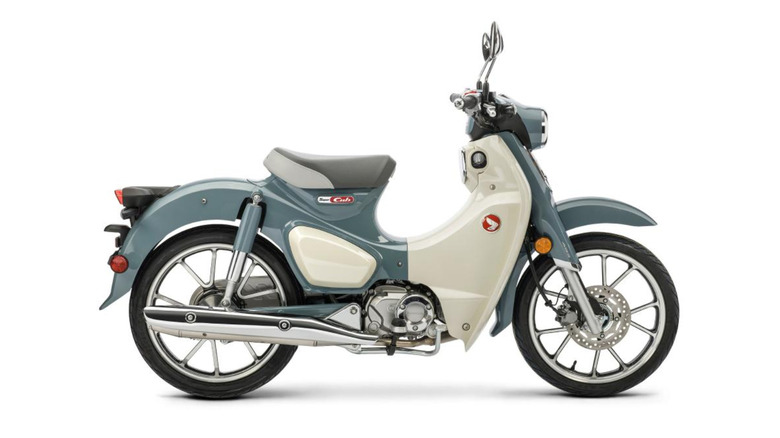
If there's a motorcycle that defines "long run," it's the Honda Super Cub. Introduced way back in 1958, this lineup is one of Honda's all-time bestsellers. Even to this day, its production still runs across 16 factories around the globe, and total production has since reached over 100 million units.
What really sealed the deal for this bike even since its very first model, the C100, was just how approachable it was. Thanks to its low chassis build and the big leg guard, you could easily ride it no matter your height or weight. That friendly vibe alone opened its doors to millions of riders, which then led to Honda's famous 1963 slogan, "You meet the nicest people on a Honda."
After that, its production numbers started to scale up. By 1967, five million Super Cubs had already rolled off the line, and by 1974, that number had increased to 10 million. That momentum didn't slow down either, with as many as three million units sold in 1982 alone. However, over the years, the Cub has evolved in different ways, whether through OHC engines, fuel injection systems, or even through spin-offs like the Cub F and Little Cub. Even though, as of today, the small Honda stepped aside from the U.S. market, models like the C125 are still sold in more than 160 markets worldwide. They now roll in with modern goodies like ABS, LED, and even larger 124cc engines.
Harley-Davidson FL Electra Glide
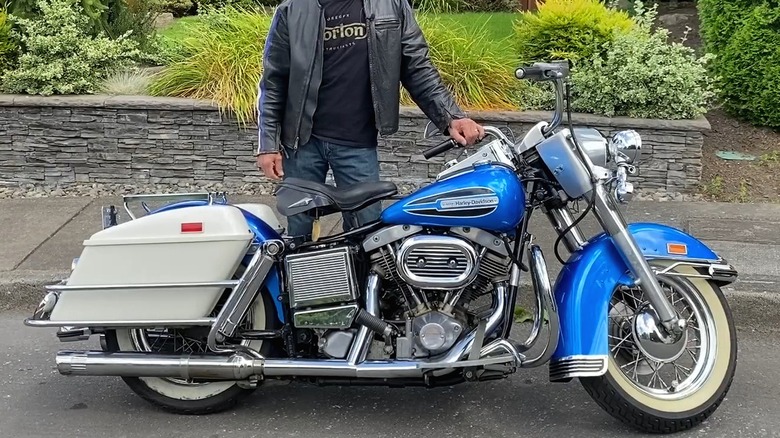
Another heavyweight that has been holding it down for decades now is the Harley-Davidson FL Electra Glide. Born in 1965 as part of Harley's FL touring family, it pretty much drew the blueprint for what a full-dress American touring bike looks like now. This bike arrived on the Big Twin FL platform back in the AMF days and wasted no time in becoming one of the brand's most popular machines during the '60s.
Those early versions came out packed with a big air-cooled V-twin, mated with a four-speed manual gearbox, and that muscle-bound character that really never left. By the late '70s and into 1980, these machines were already looking at a 1337cc V-twin making over 50 horsepower, paired with five-speed manuals. Even back then, these bikes weren't stripped cruisers. They were already rolling out with saddlebags, plenty of chrome, and ergonomics tuned more for comfort than carving corners.
By mid-'90s, the Glide's engine had already grown to 1449cc, and was capable of churning out about 67 hp. Not long after that, models like the 20007's Electra Glide Classic stepped up again, to 1584cc. That came with a six-speed gearbox and torque figures that hovered near 92 ft-lbs. More recently, the Electra Glide comes with stuff like the Milwaukee-Eight 107 engine, audio systems, cruise controls, ABS-linked brakes, and even premium finishes, all while staying true to itself.
Harley-Davidson Sportster
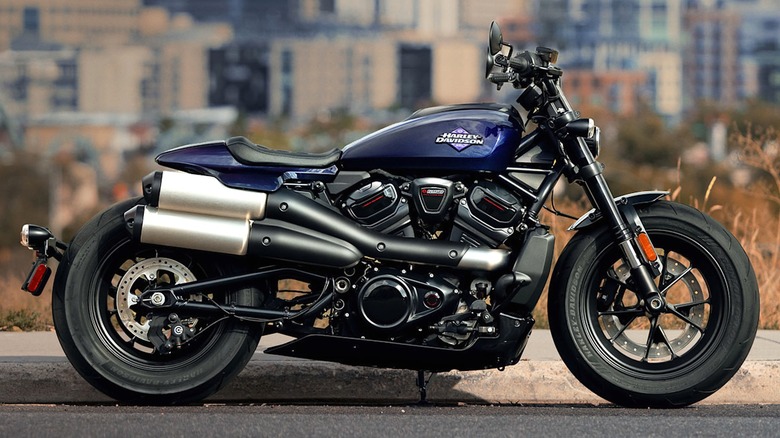
After spanning over 40 variants since its debut in 1957, it's only right for the Harley-Davidson Sportster to come up in this conversation. This bike really marked a turning point for the brand, with close to 2,000 Sportsters flying off the lot in its first year alone. Part of what really cranked things up a notch was the smart carryover of stuff like hydraulic rear shocks from the old K-series into Harley's lineup, which gave it a more modern edge. Around that same time, the Sportster also ditched the older side-valve setup for the now-famous Ironhead engine.
That Ironhead V-Twin with cylinder head became the core for all Sportsters for nearly 30 years. Although its displacement got bumped in 1972, that little extra punch churned through the four-speed gearbox is what helped generations of riders, without losing its gritty and mechanical charm. In 1986, the Ironhead stepped aside for the Evo engine, which made operations smoother and improved reliability, even before the five-speed gearbox came along in 1991. Fast-forward to now, and you can really see how far the Sportster has come. They now punch close to 121 horsepower when mated with modern muscle like Electronic Sequential Port Fuel Injection. To top that up, you also get goodies like drive mode options that can help tailor your experience however you want.
BMW R-Series
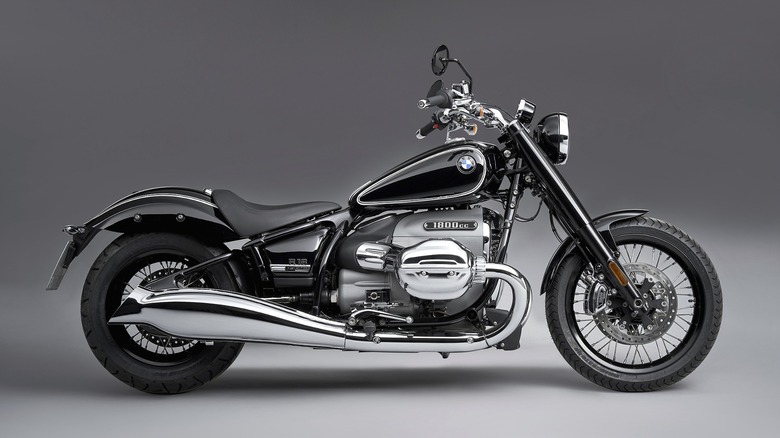
BMW's famous R-Series has been around for over 100 years, and it is easily one of the brand's success stories. The line kicked off in 1923 with the BMW R 32, the bike that introduced BMW's now-famous flat-twin boxer engine and shaft drive setup. That formula stuck, and for dozens of generations, it's been the backbone of the R badge.
Early on, bikes like the R 37 and R 16 showed that BMW could be relied upon both in durability and on the track. In 1933, the R 16 took home the 15th International Six Day Race win in Wales, while the R 37 grabbed three wins at the Solitude Race. By the '60s, models like the R 69 S were already hitting close to 109 mph, even before the fifth and sixth generations came out, with the likes of the R 75 and R 90 S. With about 67 horsepower and a max speed of 124 mph, those bikes defined sport touring in the mid-'70s. Even till now, many still regard them as BMW's best café racers of all time.
As the years rolled on, their frames stiffened, telescopic forks improved, and braking systems became modernized. Decades later, that same boxer DNA lives on in bikes like the BMW R 1300 RS. Its 1,300cc liquid-cooled boxer can now push up to 145 horsepower and around 110 lb-ft of torque, thanks to things like ShiftCam variable valve timing and its light engine design.
Methodology
Our focus with this list was on bikes that stayed in continuous or near-continuous production one way or the other for several decades. We started by cross-checking official timelines, long-term model histories, and trusted motorcycle sources. This is how we confirmed when any model started, how long it stayed in production, the number of generations, if any variant ever left and came back, and when they were upgraded.
The regular updates that were considered were things like new engines, upgraded fuel injection, and even improved suspension. In fact, those changes were expected. What really mattered was whether the bike kept its lineage intact and remained recognizable from one generation to the next. All short-lived trims, special editions, or one-off variants were also treated as potential evolutions. Any model that completely changed into something unrecognizable didn't make the cut.