

Toyota's 2026 bZ Woodland Is All The Electric Off-Roader Most People Need
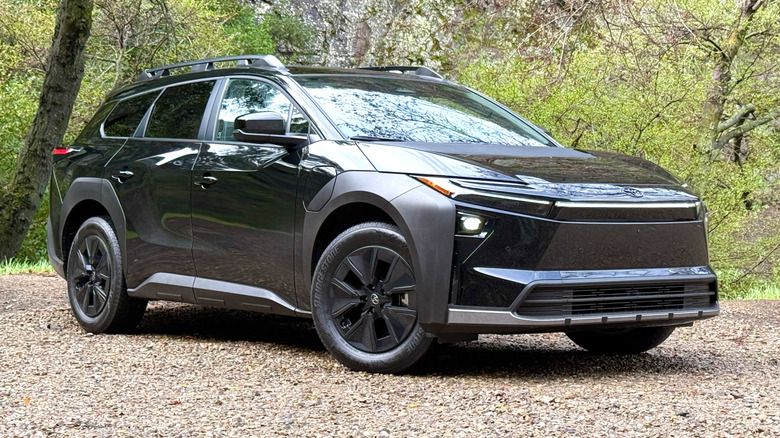
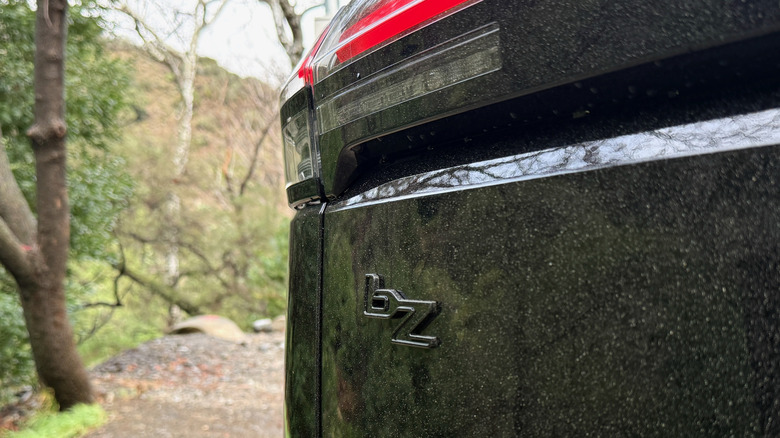
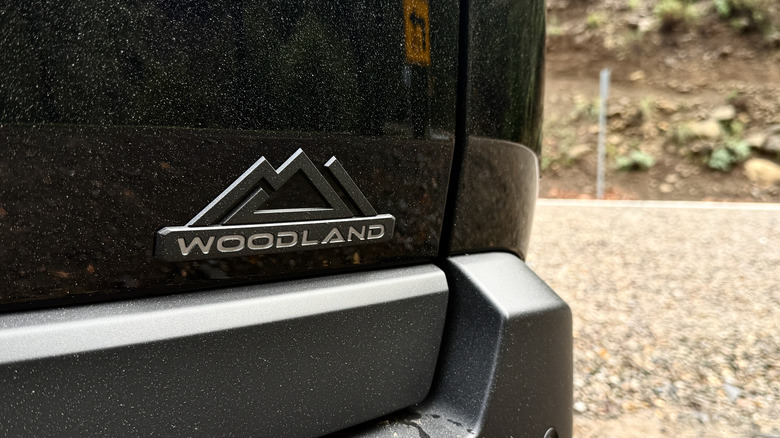
The 2026 bZ Woodland is an all-electric SUV from Toyota that's all new — sort of. Technically, the full name is new; there's never been a bZ Woodland model before. But the bZ Woodland is really just a variant of Toyota's bZ model, which was previously known by the name bZ4X. The bZ4X was thoroughly updated for 2026, at the same time it was given the shorter name of bZ, and the bZ Woodland was added to the lineup.
I hadn't driven a bZ4X in some time, so when Toyota offered to host me for the first drive of the Woodland, I was happy to say yes to the invitation and see whether it was just the name that had changed or if there was more to this EV.
 Travis Langness/SlashGear
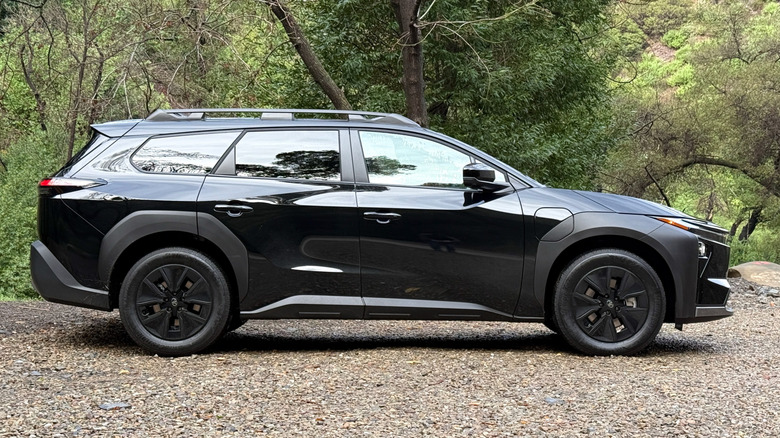
The bZ and the bZ Woodland are part of a big, happy, EV family. They share their construction and underpinnings with the Subaru Trailseeker and the Toyota C-HR. So the bZ Woodland isn't exactly a shining example of individuality, but it gets some rugged cladding and available all-terrain tires (just like the Trailseeker) to give it unique appeal. And casting aside all the stuff it shares with its platform siblings, the bZ Woodland is a wagon-shaped EV SUV with a practical approach to driving. It has impressive power ratings, an outdoorsy look, and a suite of modern features that should keep modern SUV shoppers happy.
The important range and power numbers
There are two trim levels for the bZ Woodland: the standard model and the Premium. Power for both is provided by a 74.7 kWh battery and — depending on which tires you go with — the bZ Woodland has an estimated range of 260 miles or 281 miles. Neither range estimate is class leading, but should be enough to handle most regular commutes and road trips between public chargers.
The latter is done via an NACS charging port and with a maximum charging input of 150 kW, the bZ Woodland should be able to go from 10 to 80% charge in about 30 minutes.
 Travis Langness/SlashGear
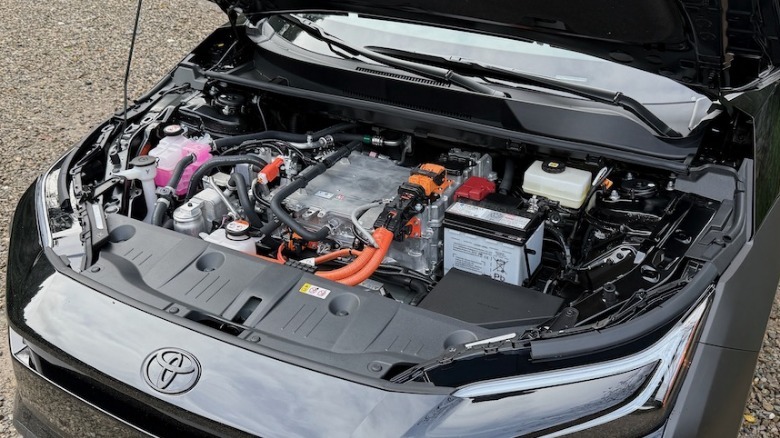
The standard and Premium models both get two electric motors, one front and one rear, which means that all-wheel drive is standard. According to Toyota's spec sheets, both trim levels put out an impressive 375 horsepower which is enough to take the Woodland from zero to 60 mph in just 4.4 seconds — a time that's closer to the sports-cars of old than the typical eco-friendly EVs you might think would be Toyota's bread and butter. In practice, the 375 horses are more than enough to send the Woodland rushing towards the horizon, and even enough to engage traction control in pretty surprising scenarios.
Driving it through the mountains
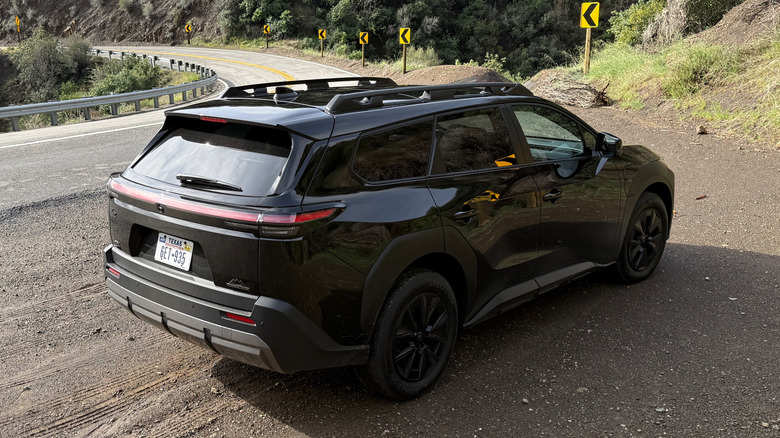
Toyota's launch event for the bZ Woodland was held in Ojai, California, just a short drive from Los Angeles. The evening before I drove the Woodland, however, there was quite a bit of rain in Ojai, so the roads were muddy, slippery in places, and speckled with scattered rocks that kept me on high alert. It wouldn't have surprised me if traction control kicked in on wet corners or slippery sections of the road, but the Woodland was cutting power in even mild, dry bends.
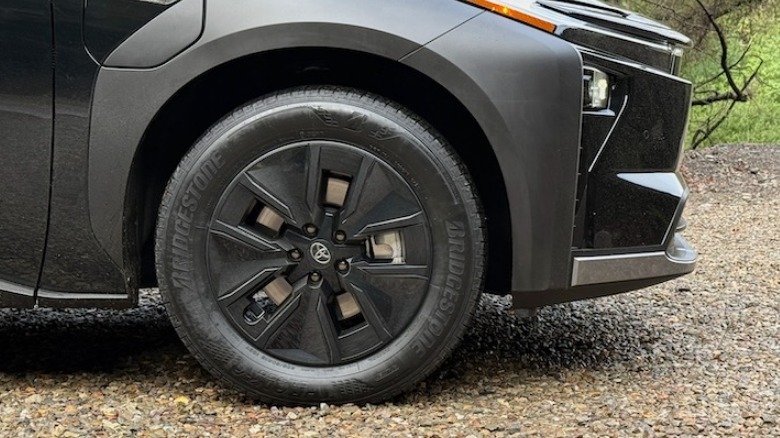
Exiting corners, the bZ Woodland's traction control lights would flash, even if I was only providing about half throttle inputs. The big 375 hp rating is great for launches and passing maneuvers, but it's hard to put all that power down via the relatively-narrow 235/60 all-season tires.
Opt for the all-terrain tires and things get even squirrellier. This wasn't a big enough issue to make the drive less enjoyable, but it did have me envisioning a world where some sort of performance variant of the bZ becomes available in the future. Give it stickier tires and a bit more of a high-performance vibe, and it would hardly need any more power to be a properly fun performance wagon.
More than you might expect in the twisties
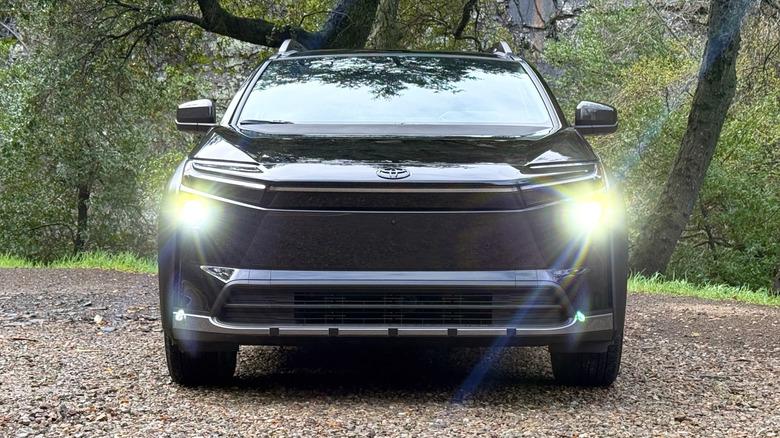
On top of being surprisingly lively on corner exit and properly fast in a straight line, the bZ Woodland was impressively good at moving between corners. While it was pretty much devoid of feeling (not uncommon for most EVs these days), the steering wheel felt well weighted at speed. The bZ Woodland in general, felt light on its feet. I didn't expect it to be so fun to drive in the twisties, but I was happily surprised when it was.
 Travis Langness/SlashGear
Braking is done via 12.9-inch rotors up front and 12.5-inch rotors in the rear, in tandem with the bZ Woodland's adjustable regenerative braking, and coming to a stop quickly is no issue. The folks at Toyota admit that the Woodland doesn't have one-pedal driving, so you do have to engage the brake pedal pretty often in stop-and-go traffic, but relying on the regen brakes in for most other tasks is relatively easy.
The paddles behind the steering wheel are technically adjustment levers for the Woodland's regen, and on the most aggressive setting, the car will get down to about 5 mph before you need to engage the physical brakes to come to a complete stop.
Can it really off-road?
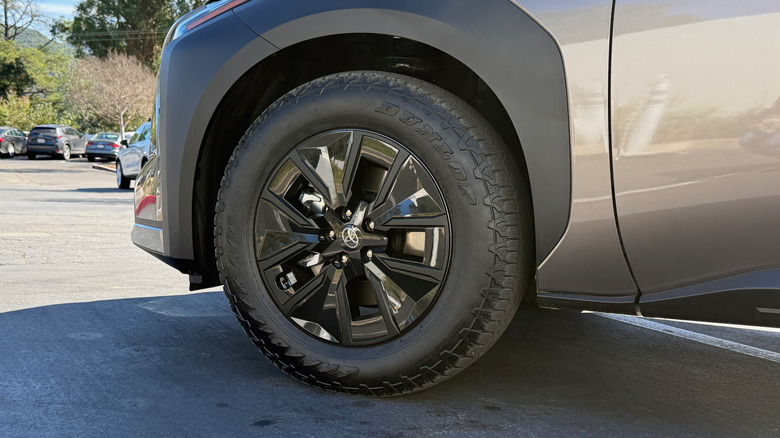
If you opt for them, the bZ Woodland wears marginally knobby tires (a no-cost option) that are a bit like a hiker wearing grippy hiking boots when they don't have any of the other gear needed for a long-distance backpacking trip. Yes, the Woodland has all-wheel drive, X-Mode software, and there's some plastic cladding over the fenders, but there aren't any substantial hardware changes designed to prepare it for serious off-roading.
Got some snow, a poorly-maintained dirt road, or a bit of mild mud to deal with? The Woodland will likely take on those obstacles without complaint. It has 8.4 inches of ground clearance, too, which is plenty for getting over most errant rocks. Rock crawling is out of the question, though.
As an FYI: Part of the drive program for the bZ Woodland was a planned bit of off-roading, or at least some driving in the dirt. Unfortunately, the area Toyota had secured for that had been washed out. A day of heavy rain caused mud and unstable surfaces in the off-road area, so it wasn't in the cards. Once we get our hands on a bZ Woodland for some more extensive test drives, we'll be better able to test its competence off-road.
Big screens lead the way
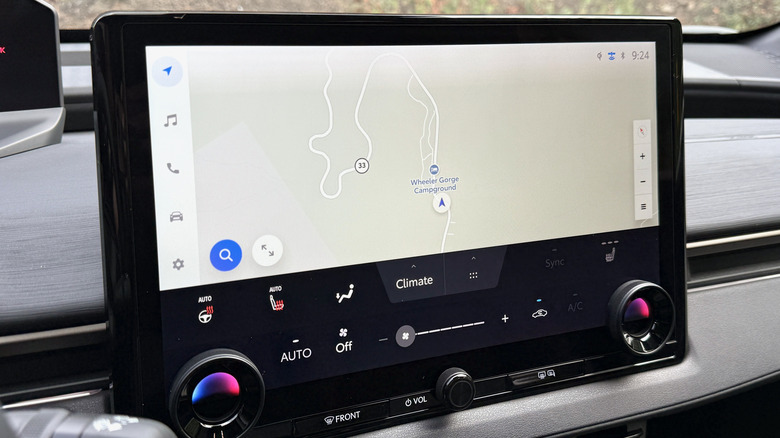
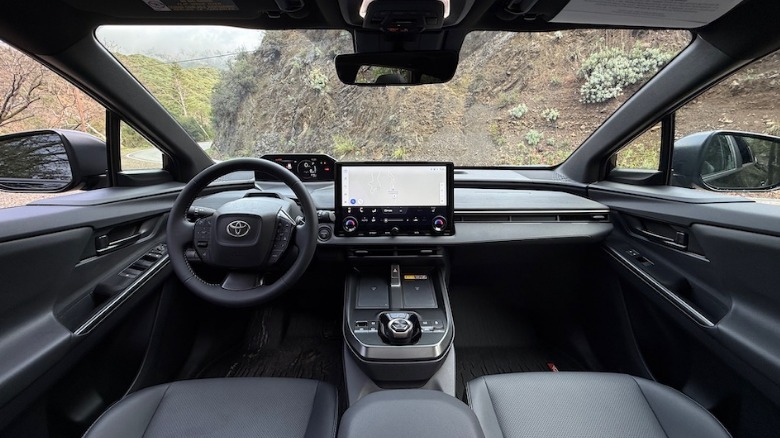
The centerpiece of the bZ Woodland's dashboard is Toyota's large new 14-inch touchscreen. The big center screen controls all the typical stuff like navigation, vehicle settings, and smartphone-connected commands, but it also has dominion over some of the cabin's critical climate functions like fan speed, seat heaters, and the heated steering wheel.
Two large circular buttons on the bottom corners of the screen control the dual-zone climate control's temperatures, and those are easy enough to use, but it does leave the volume knob to be relegated to an awkward placement (and using a smaller knob) in the center of the touchscreen.
 Travis Langness/SlashGear
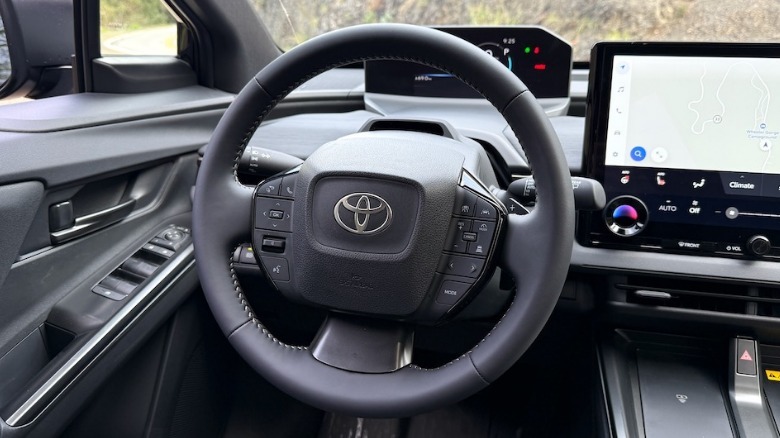
Thankfully, the center screen is high contrast, easy to see in bright light, and it responds quickly to inputs. It's also laid out in a relatively simple way – I had no trouble finding most of the crucial inputs. The driver display is a bit more difficult to see, with the top of the steering wheel blocking the view a bit when it's set for a pretty standard driving position. The bZ Woodland's steering wheel has a large number of buttons for various features, which would typically make for a steep learning curve, but these particular buttons are well organized and clearly labeled, giving it an all-around sense of functionality, even if there are some small design choices I take umbrage with.
Spacious and comfortable on the inside, but lacks panache
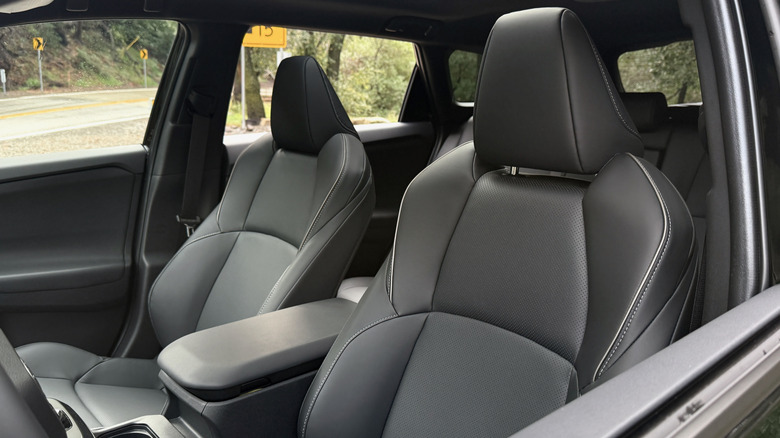
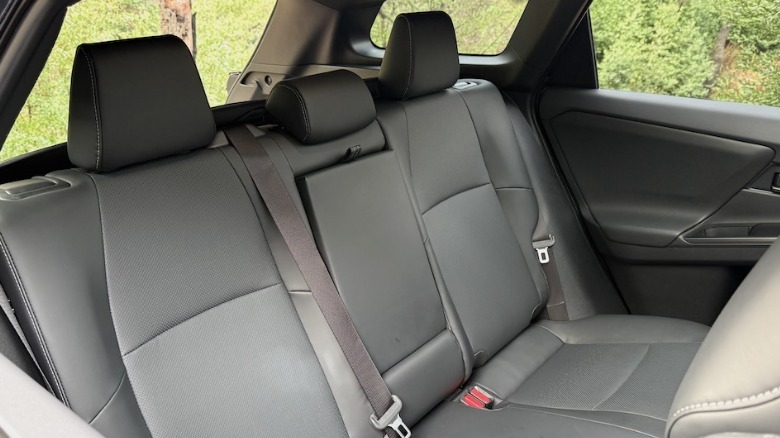
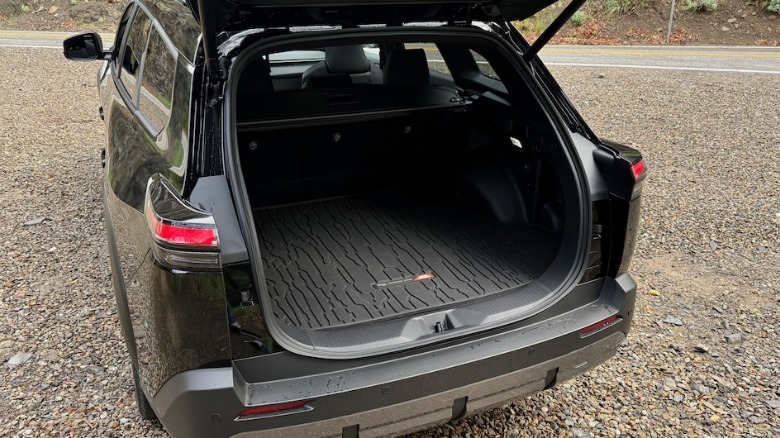
Considering what feels like relatively moderate exterior dimensions and its capability to move so well in the corners, the bZ Woodland feels pretty spacious on the inside. There's plenty of legroom in both the front and rear seats, and lots of headroom for average-height adults. The seats in both rows are comfy and, up front, they hold you in place pretty well along twisty mountain roads.
 Travis Langness/SlashGear
With the wagon-like shape and the relatively flat roofline, the rear door openings feel large, and headroom feels abundant – there's no need to duck to get in or out of the Woodland. It's also quiet on the highway, with little wind or road noise at highway speeds.
 Travis Langness/SlashGear
Some of the plastics and interior materials that are used on high-traffic areas like the door and center console feel a bit cheap. There's also a distinct lack of color and contrast on the inside of the Woodland. It's all various shades of gray and black, which makes for easy cleanup of muddy messes, but a banal feeling overall.
Pricing issues
There's a bit of a pricing conundrum with the bZ Woodland. The standard model has an MSRP of $46,750 (including $1,450 destination fee). The Premium trim adds another $2,100 to that , with its extra creature-comfort features. Those prices, in a vacuum, don't seem particularly high, but when you consider the fact that the Subaru Trailseeker — which is an identical car in just about every way — starts at $41,445, the bZ Woodland's pricing is harder to digest.
The top-trim Touring version of the Trailseeker has a much narrower gap, but it's still cheaper. It has an MSRP of $48,005, which is $845 less than Toyota's bZ Woodland Premium. Both have upgraded stereos, creature comforts like heated and ventilated front seats, and all-terrain tires. Their battery packs and horsepower outputs are identical, as are nearly all of their interior and exterior dimensions.
The Subaru offers larger wheels and tires on its Limited and Touring trim levels, which may even help the Trailseeker feel a bit more premium, at least in terms of curb appeal. And for an extra $300 the Subaru can be had with leather upholstery, an option you can't get on the Toyota.
2026 Toyota bZ Woodland verdict
The bZ Woodland is dynamically impressive. It's quick, fun to drive, comfortable from the driver's seat, and spacious. It has a big center touchscreen that's easy to use, a long list of modern driver aids, and a rugged vibe. But since it shares basically everything with the less-expensive Subaru Trailseeker, it's hard to make a case for the bZ Woodland instead, unless you really prefer the Toyota's front-end design.
Platform-shared vehicles aside, there are some pretty strong EV rivals worth considering too. Various versions of the Ford Mustang Mach-E are also extremely competitive with the bZ Woodland. The Mach-E also has a wider array of available trim levels if you're looking for more performance, but it's more expensive at the top of its respective range. Both the Kia EV6 and the Hyundai Ioniq 5 are worth a closer look for EV SUV/hatchback shoppers, and the Ioniq 5's XRT trim has considerable off-road appeal of its own (though its range isn't very impressive).
The bZ Woodland — and the standard bZ it's based on — are big improvements over the previous-year's bZ4X model, but they're entering a pretty contentious class, so it appears to be an uphill battle from the start.