

What Does $100 Buy From Ryobi Vs. Milwaukee?
We may receive a commission on purchases made from links.
Ryobi and Milwaukee are two of the largest tool companies in the American market. Both companies make a wide range of corded and cordless tools. Both offer powerful 18V battery-powered models and portable 12V models, and, of course, both sell hand tools. The two companies sell their products to the public predominantly through the same channel: Ryobi's U.S. distribution is handled almost exclusively by Home Depot, which also carries a significant number of Milwaukee products.
Basically, you'll often see similar Milwaukee and Ryobi products in the same store, if not on the same aisle. If money is no object, you'll choose the option with the best reviews and performance metrics. Otherwise, the question almost asks itself: which brand is a better investment if you're on a budget?
Let's get the obvious out of the way first: Ryobi tools are usually a bit cheaper than Milwaukee's, and occasionally, the two are in completely different price ranges. Sometimes, you can get a full Ryobi kit (including tool, battery, and charger) for less than a Milwaukee tool. Of course, the quality won't be the same. There are plenty of reasons to love Milwaukee tools despite the price, and the same reasons bring some professionals to avoid Ryobi. It just depends on who you are and what you're looking for. Let's look at some examples.
It's hard to find Milwaukee power tools for just $100
There's no way around it: Milwaukee is an expensive brand. If you're looking for tools with serious power and that can take a beating, you'll need to increase your budget or go with Ryobi instead. At the time of writing, Home Depot lists exactly one Milwaukee corded tool below $100: a small 4-1/2-inch angle grinder that doesn't even come with a disk.
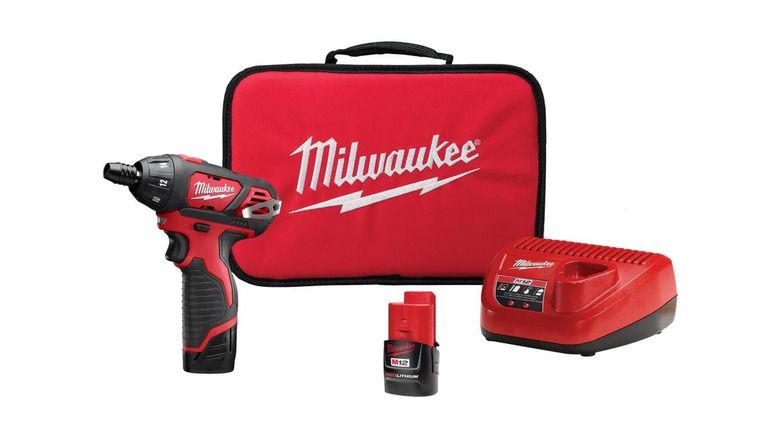
Cordless options below $100 include a few lights (multiple floodlights, a lantern-shaped LED light, and a handheld torch), only one of which includes a battery. There's also a $99 battery-powered fish tape drum that doesn't include a battery and has mediocre user reviews. Perhaps the best Milwaukee tool for the price is the M12 12V Lithium-Ion Cordless 1/4 in. Hex Screwdriver Kit. First, because it actually includes everything you need to start driving screws, from the power source (two 12V/1.5 batteries) to the tool itself — no additional purchase required. Second, because it's a capable tool that you're sure to find handy if you don't already have an electric screwdriver.
If you do have an electronic screwdriver, you'll find that Milwaukee's portable version isn't much more powerful than its size would imply. With up to 175 in-lbs of torque and a max speed of 500 rpm, it's about on par with Ikea's Trixig screwdriver/drill, which has slightly lower max torque and moderately faster speeds. The Milwaukee gets you two batteries instead of one and probably better build quality, but that's about it. It might seem odd to compare Milwaukee to a lesser-known Ikea home improvement tool, but the toolmaker's M12 line is more about portability and affordability.
Ryobi has plenty of budget options for power tools
Compared with Milwaukee, Ryobi offers many more budget-friendly power tool options. Just looking at the brand's page on Home Depot, it's clear the company caters to every kind of budget, including the elusive sub-$50. If you don't want to spend nearly $100 on an electric screwdriver, what about the Ryobi 4V Cordless 1/4 in. Screwdriver Kit? It even includes 15 impact-drive bits (five of which appear to be the same Philips #2 size, though). Is it as good as Milwaukee's $99 screwdriver? No, of course it isn't. It's a 4V tool that doesn't include a replaceable battery. It has very low torque (18 in-lbs max) and a rotation speed of 250 rpm.
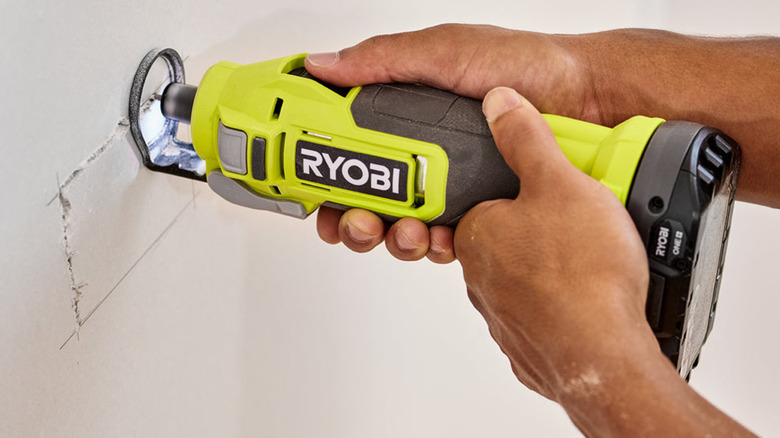
What makes this screwdriver noticeable isn't the quality; it's not even the quality-per-price ratio. What's important is that it exists, and that it's competing in a category where Milwaukee is simply not present. Broadly speaking, that's the case for all sub-$100 tools. Are you looking for a cheap drywall cutout tool? Milwaukee will sell you one for $149, nothing less, and that's just for the tool. If you need a battery, that'll be another $100. Ryobi, meanwhile, offers a kit that includes the ONE+ 18V Cut-Out Tool, a small battery, and a charger for $99. Often, Ryobi lets you get away with a decent tool for much less than $100, thanks to its USB Lithium line of (small, underpowered) tools most often sold for $50, battery included.
The price difference is forgettable for hand tools
Whichever company you go with, you'll find plenty of hand tools for less than $100. Of course, you will, as $100 is a lot of money to spend on a pair of pliers or a manual screwdriver. Let's look instead at how far $100 will take you when building a toolkit with hand tools from either company.
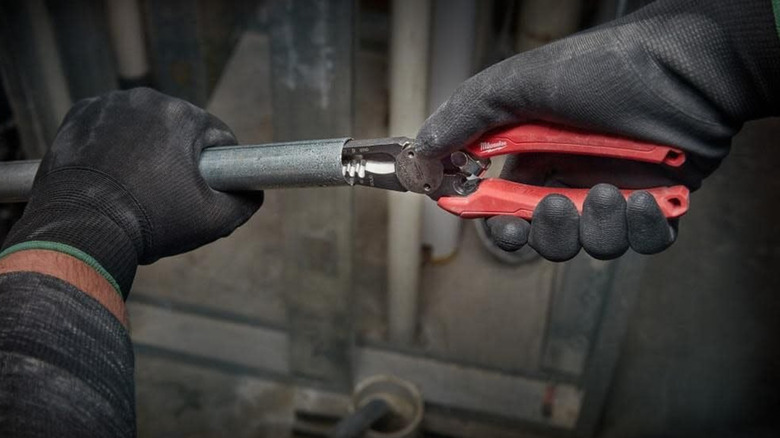
Milwaukee manufactures many tools, including hand tools. It also has more hand tools than Ryobi. You might find it difficult to build a full Milwaukee toolkit with $100 — you could spend $89 on just five pliers. However, these aren't standard pliers, and many users find this purchase well worth it, since the Electrician's Pliers Hand Tool Set fills a specific need. Of the company's many hand tools aimed toward all users, we couldn't ignore the 27-In-1 Ratcheting Multi-Bit Screwdriver; not because it's a great value (although, at $32, it is quite affordable), but because the tool hides its 27 bits inside the screwdriver's body, making it a convenient product to always keep at your side.
Ryobi, on the other hand, doesn't offer many hand tools, and what it does have is roughly comparable to Milwaukee's budget offerings. Ryobi's 11-in-1 Multi-bit Screwdriver is similar to Milwaukee's 14-in-1 version, but it's $7 cheaper. That's not much, we agree. The same applies to the two companies' tape measures and other hand tools. The price difference just isn't very noticeable. For this reason, you're better off looking at Milwaukee when building your hand tool collection.