

Meet HANX: The US Marine Corps Unveils First Modular 3D-Printed Drone
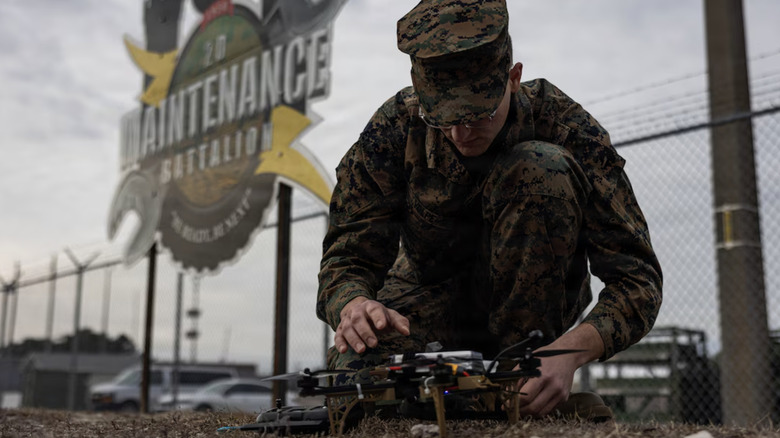
Drone technology has prompted military forces around the world to innovate defensive techniques as remote-controlled war machines get more capable, and affordable. Ukraine says its new mini-drone can go as fast as some hypercars and is using WWII-era prop planes to take out Russian attack drones. A joint U.S. military task force published new guidelines to defend the country from drones in January, and the nation's Marine Corps has a new 3D-printed drone that was designed by and built entirely by Marines. It's the Marines' first 3D-printed drone to be greenlit under the National Defense Authorizing Act, or NDAA. It's also cleared anti-spyware checks to get flight clearance from NAVAIR, the US Navy command responsible for managing naval equipment. The Marines are a separate branch from the Navy with its own wing in the Pentagon, but the two forces were joined as sister services in 1834 by Congress and President Andrew Jackson.
The Hanx is intended to be a "one-way attack" drone that deploys its weapons payload in a way that destroys the craft. This precludes the need for a return flight that an enemy could track, which has U.S. military commanders more than curious. In December 2025 the The Marines tested their first ship-launched one-way drone. The HANX is also modular, and when not tasked with delivering explosive payloads it could be outfitted for surveillance or logistics support. The Marines will also be able to produce spare parts for and repair damaged or malfunctioning HANX drones quickly. Instead of waiting for purchase orders to go through and a contractor to make and deliver parts, all the Marines need to fix a Hanx are digital blueprints and a 3D printer. It's the very same reason aircraft carriers are now using 3D-printed parts.
Who designed the Hanx drone?
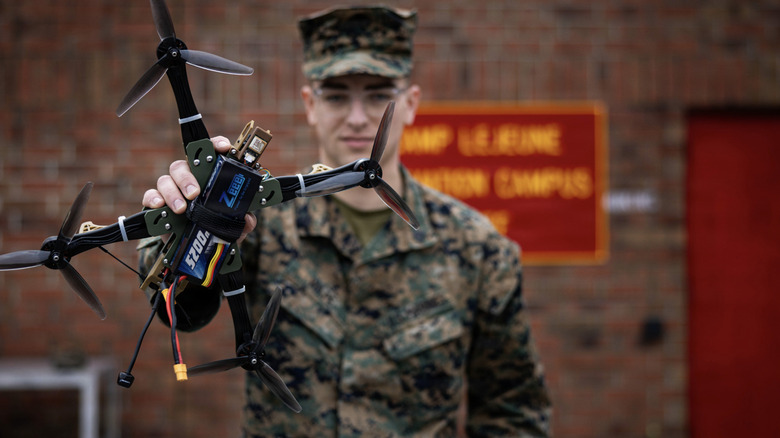
The Marine Corps has a Lego club and the COVID-19 pandemic partially to thank for its new drone. Sgt. Henry David Volpe joined a Lego robotics club in middle school, and in an interview on the Marine Corps website he credited his family with inspiring his love for technology. "Both my parents are engineers, so I feel like I've always had that encouragement to tinker and experiment with things," he said. Volpe started working as an auto mechanic while studying to be one in college, but the COVID pandemic made it hard for him do both simultaneously. He joined the Marines with the 2nd Maintenance Battalion, where he learned about the Expeditionary Force Innovation Campus at Camp Lejeune that worked with 3D printing and robotics. As he recalls, "I immediately went over to the innovation campus, shook hands with the master sergeant, and said, 'I want to work over here, I've got experience with this.'"
Volpe's problem solving skills (he was quickly able to repair a broken 3D printer at the facility) impressed Matthew Pine, the officer in charge of the campus. Pine and Volpe observed an Army drone project at Fort Campbell during a visit there. Volpe recalls being impressed, "but what I saw was a big price tag. I knew I could make something far cheaper without sacrificing too many features." Pine assembled a team of Marines to bring Volpe's vision to the workshop, and they were able to produce a prototype in just 90 days. The name "Hanx" comes from Volpe's nickname Hank, but he deflects credit for creating it. "This was only possible because of the collaboration with the team around me,"he explained. "I designed it, but I didn't work on it alone."