

4 Tasks ChatGPT Is Terrible At

We all know that ChatGPT isn't perfect. It makes mistakes, and there are questions it still can't answer. However, large language models (LLMs) like ChatGPT aren't likely to be terrible at the same things all the time. Regular users will have had instances where ChatGPT has answered a question incorrectly, or generated an image that defied the laws of physics.
But LLMs don't give the same answer to the same question every time, the randomness is part of how they work. So while it's a bad idea to rely on ChatGPT for advice on your relationship, finances, or health, that's not because it's incapable of giving correct answers. Mistakes aren't common, but any misinformation is deadly serious if someone is asking about something as serious as hospital test results.
It's surprisingly difficult to find tasks that ChatGPT is downright terrible at. We spent hours testing different functions that some users had reported issues with. We found that when it comes to many things, including changing conversational styles, transcribing text from images, and setting up regular reminders, ChatGPT is not terrible, which I'm sure is a relief to Sam Altman. However, there are some broad areas where ChatGPT is still not up for the job. Sometimes this is due to products being released before they're properly ready, other times it's because the promise of what AI can do is overhyped, and occasionally, it's because the chatbot was simply never intended to work that way.
Saving your work

If you log in to use ChatGPT — either with a free or Plus account — you'll see a record of your conversation history on the left side of the screen. You can click any of these conversations to resume a past chat. You can also find old conversations by searching for keywords. With all these tools, you might think that ChatGPT is a safe place to store all the important dialogue that you've had with the bot over the last few years. You'd be wrong. While you might be able to see conversations from six months ago, they can be deleted at a moment's notice — in fact, with no notice at all.
A professor at the University of Cologne in Germany found this out the hard way, when he made a change to his data settings and lost two years' worth of grant application templates, teaching material drafts, and exam result analyses. He contacted ChatGPT's support team, and when he finally managed to get past the customer service bots and speak to a human, they confirmed that all the work that had disappeared was lost forever.
This wasn't a glitch or a mistake on OpenAI's part. This is exactly how the tool is supposed to work. Its security and privacy policies ensure your conversations aren't backed up anywhere on OpenAI's servers. If they get deleted, that's it. So if you've got anything you'd be devastated to lose in your ChatGPT conversation history — whether it's your rough draft of a sprawling fantasy novel or a carefully tweaked bit of coding — make sure it's saved somewhere else, like OneDrive, which is specifically designed to help you recover accidentally deleted work.
Interacting with other apps

OpenAI has a couple of different ways you can use it to integrate with other tools — Apps and Agent, which used to be called Operator and was then combined with OpenAI's Deep Research. Testing the Apps feature was a frustrating experience, and reviewers have also encountered limitations and annoyances when trying to get Agent to carry out tasks. The term that comes up frequently is "half-baked". OpenAI prefers to call it "learning in public". Nevertheless, products are being rolled out when they still can't do what they say they can.
ChatGPT's third-party app integrations frequently misunderstand instructions, and trying to accomplish real tasks was often slow, confusing, and less successful than just using either app on its own. For example, ChatGPT will tell you it's made changes to a Canva design when it hasn't, or provide incorrect property and availability details from Booking.com. It's easy to see why companies are keen to have their apps integrated here, but the benefits to users at the moment seem few.
Agent has also had problems. While it can be useful for some routine tasks, it is often unable to progress tasks due to technical, safety, and operational limitations. The Verge called it sluggish, unreliable, and glitchy, and Wired reported that "the ChatGPT Agent often clicked wrong or fumbled through other errors," even when the tasks were those suggested by ChatGPT itself, concluding that it seemed like "a proof of concept instead of a fully baked release".
Saving You Time

When it announced the release of ChatGPT-5.2, OpenAI said that its enterprise version was already saving workers roughly three to 10 hours per week. Of course, any company with a vested interest in selling you AI will tell you that AI makes employees more productive. However, a recent study tells a different story. Research by the Harvard Business Review (HBR) found that so much poor-quality AI-generated "workslop" was being churned out that the businesses were having to spend hours fixing it.
Workslop was defined by HBR as "AI generated work content that masquerades as good work, but lacks the substance to meaningfully advance a given task." This vague, businesslike-looking fluff ends up creating work for those who receive it, as they need to spend time working out what it's talking about, then either sending it back or redoing it themselves.
The results of this ongoing study by HBR revealed that people needed to spend an average of almost two hours dealing with every bit of workslop they received. HBR estimated that the time individuals spend fixing bad AI is equivalent to $186 per month. There are also similar issues when it comes to coding. A study by Model Evaluation & Threat Research (METR) found that using AI slows down the completion of tasks by 19%. Interestingly, users still assumed that AI had saved them time even when it hadn't.
Making money
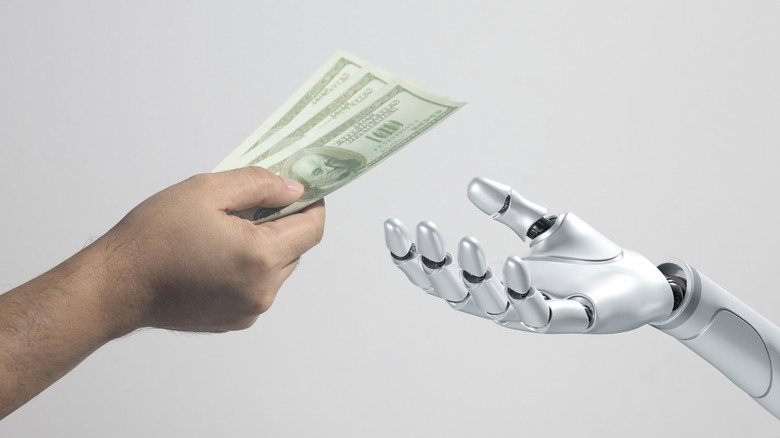
This leads us to the inevitable question — how useful actually is AI at the moment? And if it's not useful, then why are businesses and, indeed, whole countries pouring so much money into it, despite the environmental cost of its water-guzzling data centers? An astonishing 95% of businesses using AI have yet to see any kind of measurable return, despite an estimated enterprise investment of around $35 billion, according to MIT's Project NANDA (Networked AI Agents in Decentralized Architecture). So much money is being spent in this field — with very little by way of tangible results — that many experts are saying we are in a soon-to-be-burst AI bubble, much like the dotcom bubble of the late 1990s.
At the World Economic Forum meeting in Davos, Microsoft's CEO Satya Nadella said that AI companies "have to get to a point where we are using this to do something useful". He warned that if not, they would lose the "social permission" to keep using the planet's scarce resources to power AI.
There's interest in the quirky novelty of AI (or "AI in its abstract form", as Nadella put it), but that doesn't translate into regular consumers wanting to shell out money. OpenAI still isn't turning a profit. And it has far more users than any other AI company out there. This is why OpenAI is now looking at introducing adverts in its chatbots. ChatGPT has to make money for its creators, somehow. But given that nobody likes ads, this could soon be another "terrible" ChatGPT feature to add to the list.