

5 Of The Coolest Supercars Of The '80s, Ranked By Current Value
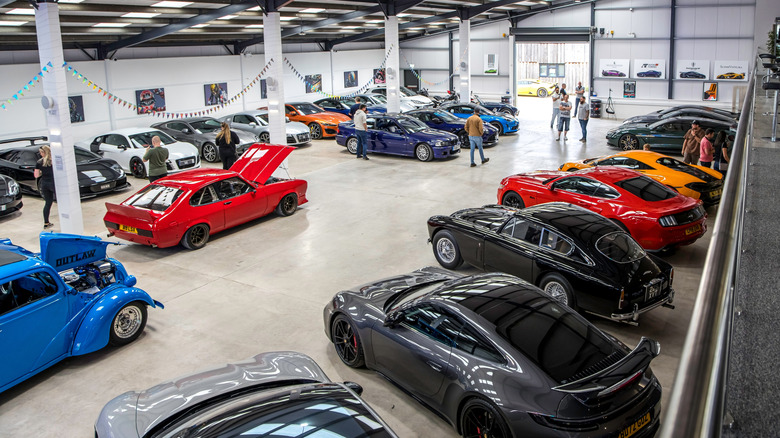
From waterbeds and Jazzercise to hair metal and beyond, the 1980s were known for unique trends. While those years produced some of the worst-looking automobiles you've ever seen, it was not all about Malaise Era aesthetics. At the top end of the auto spectrum, car designers put out some bona fide supercars that carry their cool into the modern era.
Yet not every car fad from the 1980s made it out alive. Pop-up headlights, for example, are virtually impossible to pull off today due to governmental regulations. T-Tops have likewise long since gone the way of the dodo bird. And when's the last time you saw rear window louvers on a factory car?
While the 1980s are much-maligned for boxy styling and chugging detuned V8s struggling to meet emissions standards, the fact remains that over four decades later, a collection of quintessentially '80s supercars still attract the eye — and the interest — of gearheads everywhere.
The Ferrari F40s and Lambourghini Countachs get a ton of press, but the supercar well of the '80s is surprisingly deep. It was the Decade of Decadence, after all, and what says conspicuous consumption better than a completely impractical, wildly overpriced supercar? We explore some of the coolest supercars of the period to find out not just what made them special but what it would cost to get behind the wheel of one today.
Lotus Esprit Turbo X180 — $25,000-$36,000
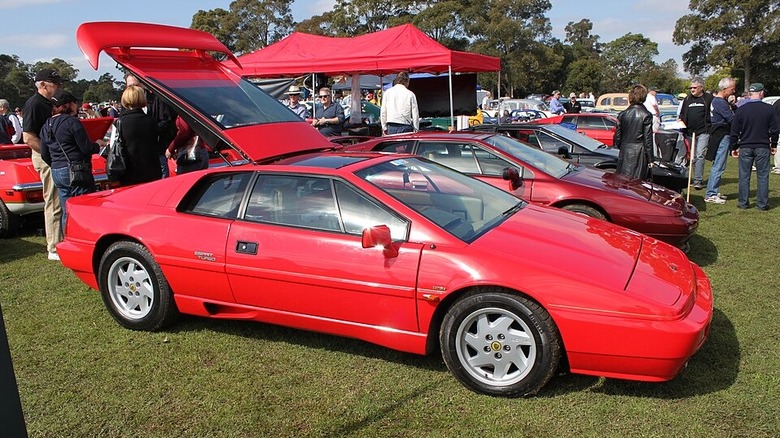
The Lotus Esprit's career spanned four decades, from its debut at the 1975 Paris Motor Show to its 2004 retirement. That career included stints as a Bond car-turned-submersible in 1977's "The Spy Who Loved Me". But the '70s Esprits were underpowered, with the 1976 debut model featuring a 2.0-liter mid-mounted four-cylinder producing just 156 horsepower. For the new decade, Lotus resolved to beef up its supercar, adding the most '80s of upgrades with a turbocharging system for the Essex edition of the 1980 model year.
By 1987, the Esprit's '70s design was aging. Lotus used the proven chassis with a resculpted body. The wedge shape remained, but the new design eliminated the sharp origami angles in favor of rounded curves and all-new glass. The X180 Turbo used a 2.2-liter turbocharged four-cylinder, making around 215 hp and 220 lb-ft of torque (a naturally aspirated version made 173 hp). The drivetrain was largely unchanged, save for a new Renault GTA transmission replacing the old Citroën unit. The new Euro-spec Esprit hit 60 miles per hour in 5.3 seconds on its way to a 152 mph top speed.
Perhaps the most notable thing about the X180 is that it's accessible as a supercar today, at least from a purchase price perspective. Overshadowed by the Porsche 911 Turbo, Ferrari 288, and Lotus' own financial issues, the Esprit Turbo went largely under the radar, where it remains today. Classic.com reported an average price of $25,145 in March 2025. By January 2026, that average rose significantly to $34,735, but it remains shockingly low for a bona fide supercar. That's not to say finding, repairing, and driving the X180 will be a pleasure cruise. They're known for cramped interiors, poor build quality, and onerous maintenance, but what antique isn't?
De Tomaso Pantera GT5-S — $200,000 - $350,000
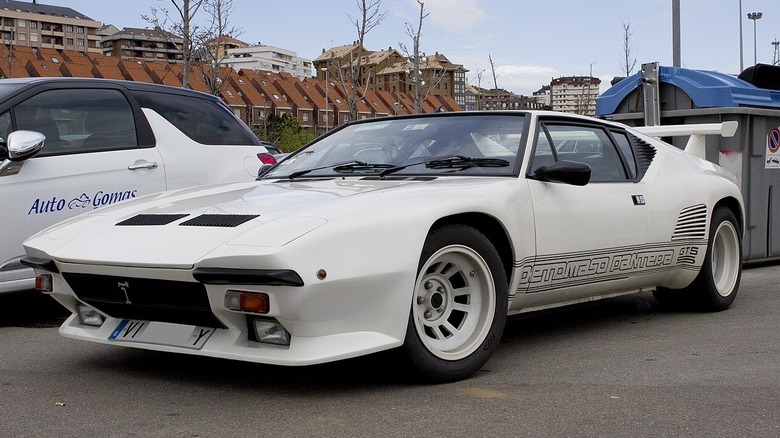
Founded by Argentinian-born Italian transplant racing driver Alejandro De Tomaso, the namesake company made headway on Europe's racing circuits with innovative fiberglass bodies and mid-engined balance. The company's cachet grew through the '60s, skyrocketing with the introduction of the 1971 De Tomaso Pantera. U.S. emissions requirements prompted De Tomaso's owner, Ford, to discontinue importing the Pantera after 1975, but businessman George Stauffer continued to do so in the early 1980s, by which time the GT5-S had arrived.
The GT5-S picked up where the vanilla (if you want to call it that) Pantera left off, supplementing its distinctive wedge with flared fenders, a body kit that makes the original design look like a yokel with an overbite, and an oh-so-'80s Countach-inspired rear wing. Under the engine cover of this European exotic beat the heart of American engineering in the form of a 351 cubic-inch Cleveland V8 generating 350 horsepower and 333 lb-ft of torque. If that sounds prosaic, the 5.3-second sprint to 62 mph and 158 mph top speed earned enough respect to become part of the '80s supercar zeitgeist.
The GT5-S's distinctive styling was complemented by luxurious options lacking in the original Pantera, including a leather-wrapped steering wheel, along with power windows and a burled wood finish. These touches ensured it was no bare-bones race car, but a vehicle suitable for the most demanding Wall Street executive. And an executive salary was required; the 1987 GT5-S demanded a price tag of $71,950 — approximately $200,000 in 2026. Surprisingly, that number is not far from what the De Tomaso goes for today. Classic.com reports an average sale price of $207,592, though its small sample size may be skewing the results. In 2024, a Mecum auction for a 1986 model ended at $352,000.
Aston Martin V8 Zagato — $259,000
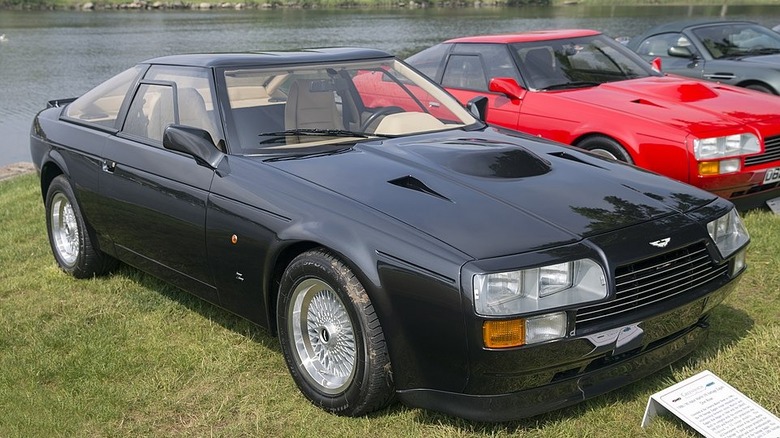
When Aston Martin introduced its new supercar at the 1986 Geneva Motor Show, it was called the Zagato after the Italian coachbuilder that worked on it. However, it's more popularly known as the V8 Zagato or V8 Vantage Zagato. That's because the vehicle featured a monstrous (at least for English cars) 5.3-liter V8. The powerplant was good for 432 horsepower and 395 lb-ft of torque.
Aston Martin built the Zagato with its competition in mind. It took the chassis from the V8 Vantage, shortened the wheelbase for handling, and dumped nearly 400 pounds off the curb weight with a lighter composite body. In wind tunnel testing, this new design achieved an impressive drag coefficient (cD) of 0.29. The Zagato was no pure racer, but rather a grand touring-oriented cruiser.
Aston Martin is famous for its beautiful designs, yet the Zagato's looks are polarizing. To be honest, it hasn't aged all that well. Looking something like a boxy version of the Nissan 240SX (or rather, the Nissan looked like the Zagato, as the 240SX debuted in 1989), it doesn't elicit gasps the way some supercars do. A functional blister in the hood for the quad carburetor setup resembles an unpopped zit. Still, the Zagato was a pound-for-pound supercar with wicked speed and performance. At the time of writing, Hagerty values a V8 Zagato in good condition at around $259,000.
Porsche 924 Carrera GTS — $417,000
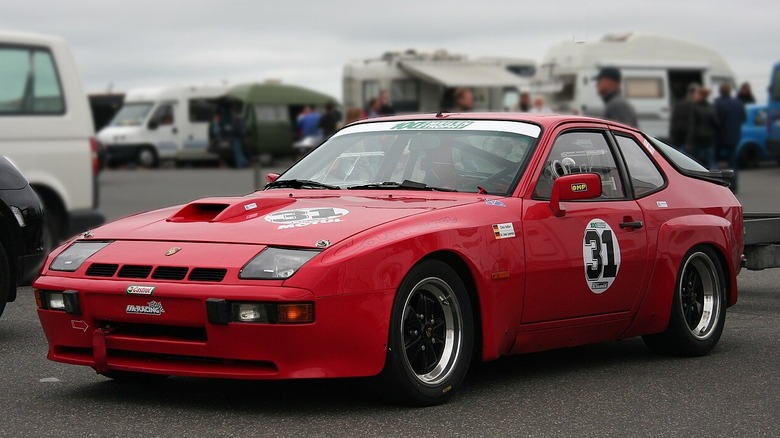
Supercars feature wild design and performance, but the upper echelon is inhabited by limited-production specialty editions of fine cars. Few do that better than Porsche. The eternal contender from Stuttgart has been doing so since 1948, and its sublime 911 GT3 has instant classic written all over it today. It's no secret that interesting and rare Porsches from the '80s are setting records at auction, such as specimens from the 292-production run of the Porsche 959 valued at more than $1 million.
Even rarer is the 924 Carrera GTS. Porsche sought to homologate its 1981 924 Carrera GTR race car; that translated into 400 924 Carrera GTs with all the high-performance goodies. From there, Porsche diverted 50 of those to become the competition-spec GTS. In went a 2.0-liter turbocharged in-line four-cylinder making 245 horsepower and delivering a 6.2-second to 60 mph sprint. The GTS got a sport chassis, McPherson struts, lightweight aluminum suspension components, and ventilated brakes. Out went anything that favored comfort over weight, including sound insulation; the result was a car that weighed just 2471 pounds. It was not the boxer engine Porsche of fame and lore. but it was something special and rare.
Today, these ultra-limited homologation rally supercars are appreciated by fans as a highly collectible part of Porsche's history. Even getting one in the first place was hard; a Coloradan ophthalmologist who ordered one new in 1982 received a letter reinforcing that it was not for street use. That particular example, which sold via RM Sotheby's, brought a winning bid of $417,000.
Ford RS200 Evo — $250,000-$615,000
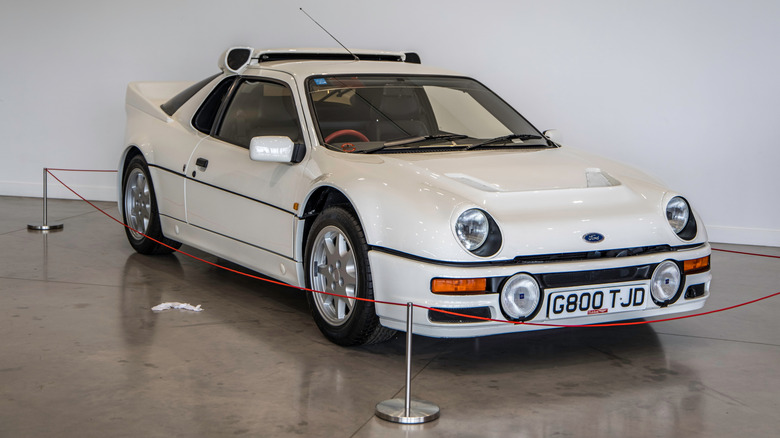
Supercars are long and low and mean with freakish flair. But they can also be a legend in the now-banned Group B rally scene, the cream of Ford's relationship with engine-builder Cosworth wrapped in an All Wheel Drive package.
The Ford RS200 Evolution might not look like a supercar, but it is. Otherworldly power? The Cosworth-engineered 2.1-liter turbo four-cylinder made 600 horsepower and 400 lb-ft of torque. That's 600 horsepower in 1986. In fact, it's the most powerful vehicle on this list of respectable '80s supercars. Trick handling? A five-speed transmission diverted power to either rear-wheel drive for asphalt or all-wheel drive on gravel or dirt. Limited numbers? Ford barely built 200.
Unfortunately, it was an RS200 Evo involved in a tragic crash into race spectators that contributed to Group B's demise. It was too crazy a car in a racing segment known specifically for being way out of control to begin with. That's supercar material if we've ever heard it. And investors seem to agree. Classic.com reports several listings for RS200s sold in the past two years in the $250,000 to $615,000 range.