

If You Owned Any Of These 5 Cars In The '70s, You Were Living The Dream
Back in the 1970s, there were cars that identified their drivers as very special people. These were the cars that delivered either super-high performance, exotic show-car styling, the highest levels of opulent, over-the-top luxury appointments, or an intentional combination of these traits. If you were behind the wheel of one of these cars, you definitely drew the crowd's attention. The drivers of these cars were well aware of the appeal their vehicles held.
The specific cars in this article are from several European countries. Two are from Italy, two are from Great Britain, and one is from Germany. One of them can claim to be the original exotic car, one takes the crown as the ultimate luxury car of its day, and one is a thoroughbred sports car that had both a successful racing career and what appeared to be a starring role in a trend-setting TV show. One of these cars used advanced technology to deliver the performance of Italian exotics while remaining a daily driver without compromise, as long as you avoided terminal oversteer. And one combined luxury and high performance into a unique blend that to this day is still associated with the public's favorite fictional secret agent. Enjoy our diverse selection of "Living the Dream" cars.
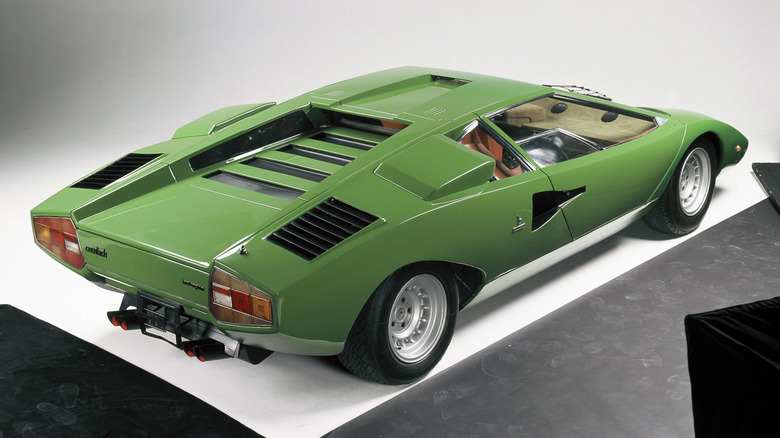
1974-79 Lamborghini Countach
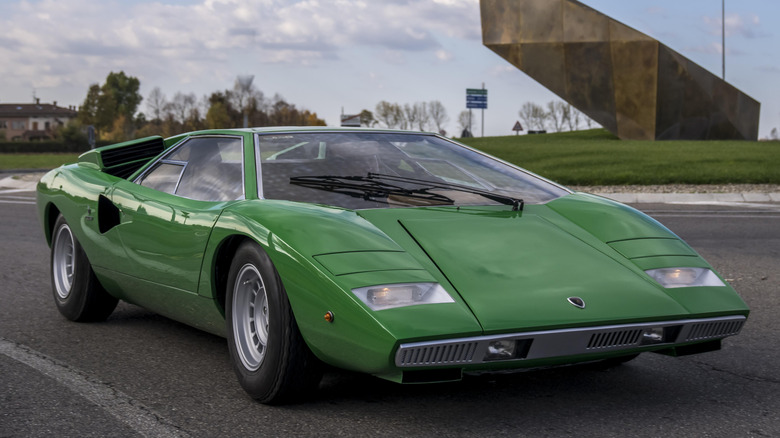
Let's start with one of the most outrageously styled and high-performance exotic cars of the 1970s and beyond — the Lamborghini Countach, which turned 50 years old in 2021. Although it debuted at the 1971 Geneva Motor Show, Lamborghini did not put it into production until 1974. The very first Countach, the LP 400 chassis 0001, was made from 1974 to 1978 in a quantity of 152 cars. It was followed by the Countach LP 400 S, which featured the now-familiar fender flares, huge rear wing, large front spoiler, and telephone-dial-styled wheels. Produced from 1978 through 1982, 235 examples of the LP 400 S were made. These two models, made in the 1970s, were followed by three more powerful versions of the Countach, which endured until the car was discontinued in 1990.
Powering the LP 400 was a 3.9-liter V12 engine with 375 horsepower, mounted behind the driver and driving the rear wheels through a five-speed manual gearbox. Motor Trend performance testing of a Countach LP 400 generated a 0-60 mph time of 5.2 seconds and a top speed of 162 mph. Fun fact — the Countach was the first Lamborghini to have its body produced in-house. Before this, Lamborghini used outside coachbuilders.
1971-79 Rolls-Royce Corniche Convertible
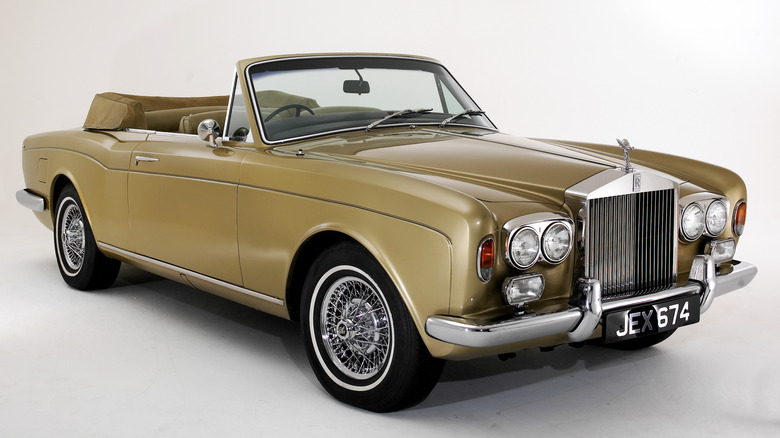
The Rolls-Royce Corniche Convertible was made from 1971 until 1996, outlasting its coupe counterpart by 14 years. This iconic symbol of financial success was owned by luminaries such as Paul McCartney, David Bowie, Elton John, Tom Jones, and Dean Martin, with Frank Sinatra also owning one. Named for the roads running along the Côte d'Azur in France, the Corniche Convertible was a luxurious, comfortable yacht that cruised on land. In the words of the Robb Report, the Corniche was, "...the automotive equivalent of lighting a Cuban cigar with a hundred-dollar bill."
The Rolls-Royce Corniche Convertible was derived from the 1965 Rolls-Royce Silver Shadow, which featured a contemporary monocoque body. Coachbuilt by hand at London's Mulliner Park Ward, the Corniche Convertible measured 17 feet long, weighed nearly 5,000 pounds, and took months to build. The Corniche Convertible's 6.75-liter V8 engine's output was described as "adequate," as Rolls-Royce liked to say. Its three-speed automatic transmission sent its power directly to the rear wheels. Rolls-Royce performance estimates for this vehicle included a 0-62 mph acceleration in 11 seconds and a top speed of approximately 124 mph.
Needless to say, luxurious accommodations abound in the Rolls-Royce Corniche Convertible. From the gorgeous wood dash and door trim to the sumptuous Connolly leather seats to the heavy carpeting underfoot, you are treated to a truly upscale experience. The standard equipment list also included air conditioning and power windows. These were items that were definitely not included on all luxury cars back in the 1970s.
1968-73 Ferrari 365 GTB/4 Daytona
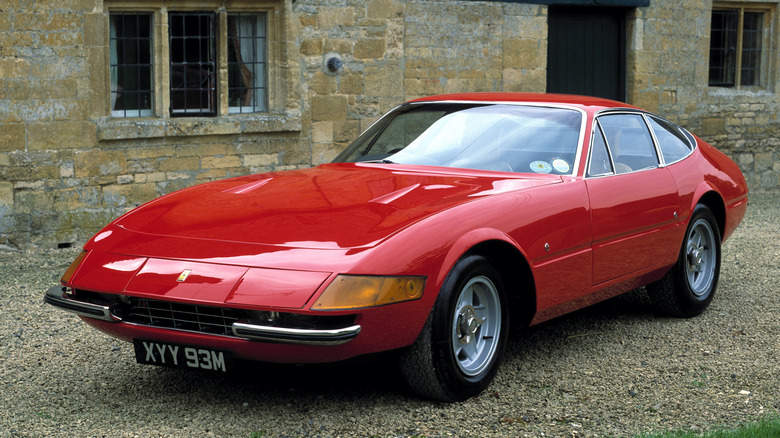
The Ferrari 365 GTB/4 Daytona was Ferrari's top dog and most powerful road car to date, with 352 horsepower from its front-mounted 4.4-liter V12 engine and a top speed of 174 mph. Produced from 1968-73, it was called by Road and Track at the time, "...the best sports car in the world..." Unofficially named for Ferrari's 1-2-3 sweep of the 1967 Daytona 24-hour race, most Daytonas (1,284 of 1,406) were coupes or Berlinettas in Ferrari lingo, while the rest were Spyder versions, identified as the 365 GTS/4. If you were behind the wheel of one of these, you stood out, both in terms of style and street cred.
Another interesting historical footnote about the 365 GTB/4 Daytona is that it won the second running of the unsanctioned Cannonball Baker Sea-to-Shining-Sea Memorial Trophy Dash, driven by famous racer Dan Gurney and auto journalist Brock Yates. This was an "outlaw" cross-country race that went from New York City to Los Angeles, which Gurney and Yates completed in an incredible 35 hours and 54 minutes. Another bit of notoriety was achieved by what appeared to be a 365 GTS/4 Daytona Spyder that was featured in a starring role in the 1980s TV series "Miami Vice," but it wasn't a Ferrari at all.
The Ferrari 365 GTB/4 Daytona was also successful as a racing car. Its outstanding durability made it an excellent endurance racer. At the 1972 24 Hours of Le Mans, the Ferrari Daytona claimed the top five spots in its class.
1976-79 Porsche 911 Turbo
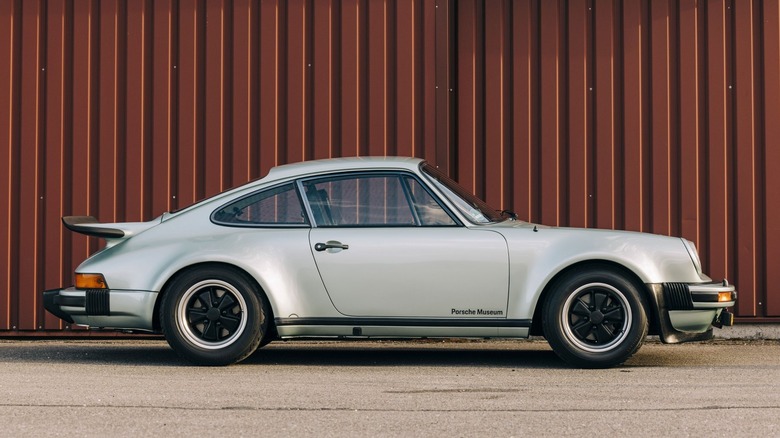
The Porsche 911 Turbo Carrera, also known as type 930, was first shown to the public as a concept at the 1973 Frankfurt International Automobile Show. While it was released by Porsche for the 1975 model year, none of these first-year cars, which were both under-braked and under-tired, came to the U.S. We got the 1976 model, which ran through 1977 and was then replaced with the slightly renamed 911 Turbo, which had a larger, 3.3-liter engine (up from 3.0 liters) and an air-to-air intercooler to cool the intake air after its trip through the turbocharger. The 911 Turbo 3.3 was available in the U.S. through the 1979 model year, but thanks to emissions regulations, wouldn't return until 1986.
The Porsche 911 Turbo, in either version available through the 1970s, was a performance legend but could be difficult to handle at its limits, which earned it a nickname, "The Widowmaker." Car and Driver tested its 1976 911 Turbo Carrera, with 234 horsepower, achieving 0-60 mph in 4.9 seconds, a quarter-mile time of 13.5 seconds at 105 mph, and an observed top speed of 156 mph. Roadholding came in at .93g. This was very impressive for 1976.
The Porsche 911 Turbo will take its place as the first production sports car to be fitted with a turbocharger. It delivered performance comparable to the Lamborghinis and Ferraris of the day, while retaining the 911 hallmark of everyday practicality. Driving a 911 Turbo puts you in a special category.
1969-72 Aston Martin DBS
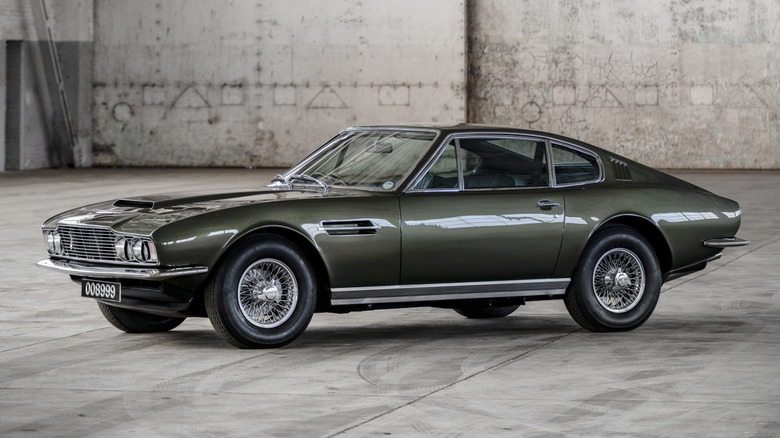
The Aston Martin DBS followed the Aston Martin DB6. The DB6's predecessor, the DB5, had already become well known as James Bond's ride in the early Bond films and also appeared in later ones. The DBS also starred in a Bond film, 1969's "On Her Majesty's Secret Service," starring George Lazenby. Aston Martin celebrated the film's 50th Anniversary by making a limited edition of 50 2019 Aston Martin DBS Superleggeras. Fun fact — after the DBS appeared in its single film role, a full 18 years would go by before Bond would next drive an Aston Martin in a 007 film.
The DBS was originally powered by the same 4.0-liter inline-six-cylinder engine used in the DB6, as the planned V8 engine was not yet ready. The DBS was heavier than the DB6, as it was designed as a GT capable of comfortably seating four. The DBS V8 featured a 5.3-liter V8 engine with Bosch fuel injection and four overhead cams producing 320 horsepower, good for a 0-60 mph run in 6.0 seconds and a top speed of 160 mph. This made the DBS V8 the fastest four-seat production car in the world. You could think of the Aston DBS V8 as a cross between the Rolls-Royce Corniche and the Ferrari Daytona — furnished in Connolly leather, with well-built seats and plush carpeting inside, but also possessing the performance to humble anything else on the road in its day. Driving one made you feel special.