

Will France's 'Super' Dassault Rafale Stealth Fighter Trump America's F-35?
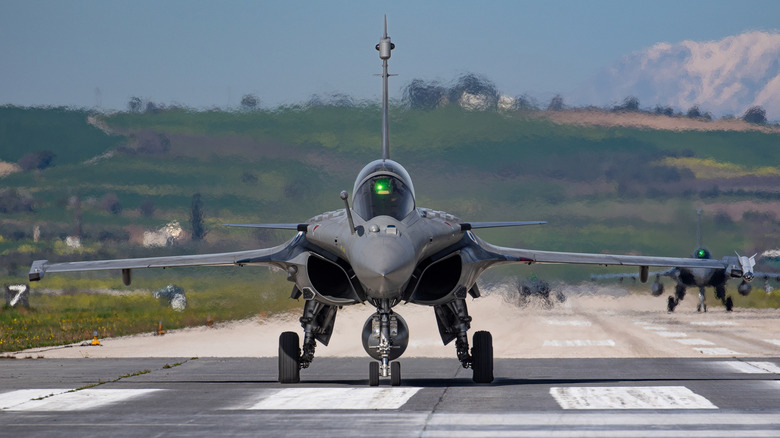
Whenever there's a discussion around fighter jets, it usually veers towards U.S., Russian, and Chinese-made planes. These include usual suspects like the Lockheed-Martin F-35 Lightning, Russia's Sukhoi Su-57, and the Chinese J-20. While these are advanced planes without an iota of doubt, what most people tend to forget about is the Dassault Rafale. A fourth generation multirole fighter jet designed and developed by French aviation major Dassault, the Rafale is widely thought to be one of the most advanced and formidable fighter jets to ever exist.
Operational since 2004, more than 300 Rafales have been manufactured and have been deployed around the world. Dassault has regularly updated the Rafale, starting with the F1 standard Rafale in 2004, the F2 standard Rafale in 2006, and the F3 standard Rafale developed in 2008. In 2018, Dassault debuted the F-3R Standard Rafale, which was followed by the newest generation of the fighter, the F4 standard Rafale, along with the F4.1 and 4.2 sub-variants.
Given that Dassault has steadily improved and added newer capabilities to the Rafale over the years, it's not surprising that the company has planned further upgrades to the fighter to keep it operational and relevant well into the 2060s. Dassault's next major upgrade path for the Rafale is the Rafale F5 Standard, which is also unofficially dubbed by many as the Super Dassault Rafale.
Predictably the upcoming Rafale variant will be compared against America's F-35. However, most aviation enthusiasts would know that these two fighter jets cannot be directly compared. The F-35 and the Rafale F5 are not only built for different purposes, they also belong to two entirely different generations of fighter jets.
Super Dassault Rafale vs. Lockheed Martin F-35 Lightning: The key differences
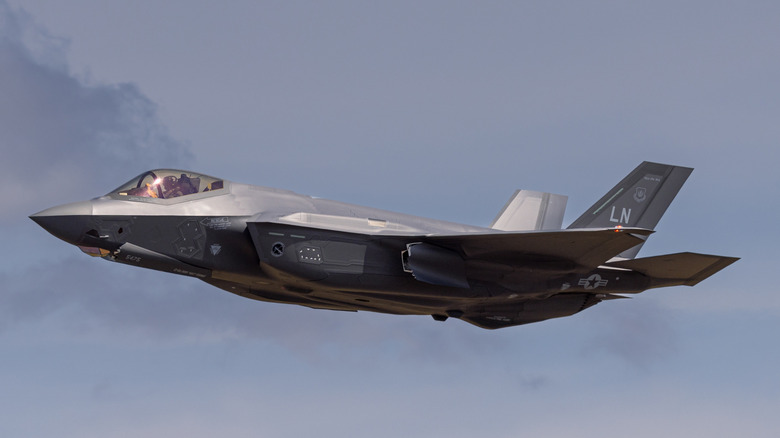
Before comparing the Super Dassault Rafale and the F-35, it is important to note that only one of these planes is in service today: the F-35 Lightning. We have already discussed how the Rafale F5 Standard is still in its developmental stages, and per current projections, this version will only enter service in 2030 or later.
Moving on to the capabilities of both planes, the biggest advantage the F-35 has over the Rafale F5 is that it is based on a newer and more advanced platform. The F-35 is a fifth-generation fighter, built from the ground up as a stealth aircraft. It stands out from the current generation of multirole fighters in several ways, and it is widely considered to be the most advanced fighter jet in existence today.
The Rafale, on the other hand, started life as a fourth-generation fighter, and following several upgrades, it is now classified as a 4.5 or 4.5+ generation aircraft. While it cannot match the F-35 in terms of stealth, the Rafale has excellent electronic warfare capabilities, it can carry a larger number of weapons in typical combat missions, and is cheaper to buy and operate. The Super Dassault Rafale is also slated to receive support for UCAS (Unmanned Combat Air System) drones, a capability that the U.S. is also currently working on.
In simpler words, while the Super Dassault Rafale will be a formidable, advanced 4.5-generation multirole fighter jet, it falls short of the F-35 in several areas, simply based on fact that the F-35 is a newer-generation fighter. A more direct competitor to the F-35 would be the upcoming sixth-gen fighters; including Europe's Future Combat Air System (FCAS), as well as the U.S.' own, in-development GCAP fighters.