

5 Ways Toyota's Risking Its 'Most Reliable' Reputation
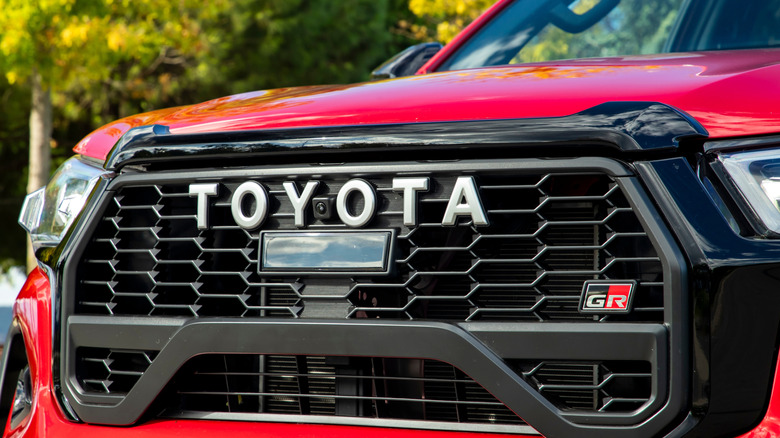
The Toyota brand is a juggernaut in the automotive marketplace. Toyotas are ubiquitous on American roadways, with numerous vehicles across categories receiving high acclaim and consistently large sales volumes. Even vehicles like the Toyota Hilux, which was essentially banned in the U.S., remain vaunted examples of Toyota's history and innovation.
However, in recent years, Toyota has experienced a few setbacks. The brand is frequently ranked as the most reliable automaker by Consumer Reports, but in early 2025, the outlet's rankings highlighted a new reliability champion. Subaru claimed the top spot, and Lexus came in second (a luxury brand owned by Toyota, but not the flagship badge of the corporation).
Toyota had to settle for third place, and even though the automaker has regained the top spot in Consumer Reports' most recent rankings, the fluctuation highlights creeping instability within the Toyota catalog.
Major recall issues
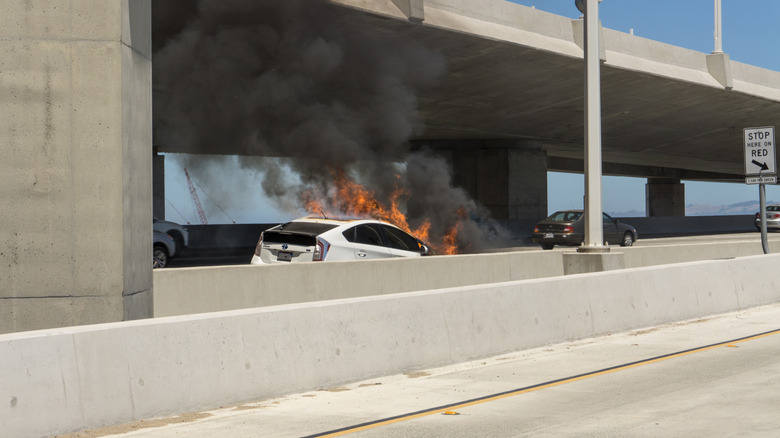
Recalls are never good, especially for brands with a reputation for trust and reliability. Since automakers build tens of millions of vehicles in the U.S. alone each year (roughly 16.5 million per year from 2015 to 2019 and almost 13 million in 2022, the last year data is available for, via USA Facts), there are bound to be pain points that require fixing. Sometimes these are simple issues, but other problems are far more jarring. For instance, in 2023, NHTSA investigated reports of the Tesla Model Y inexplicably allowing its steering wheel to come off.
Last year, Ford experienced the highest number of total recall orders. 12.9 million Ford vehicles were potentially affected by problems highlighted in recall orders. Toyota didn't experience nearly as many recalls, but still came second on the list with 3.2 million potentially affected vehicles. Toyota was one of just five brands with more than 1 million vehicles affected, even as it was subjected to just 15 individual complaints.
Unfortunately for Toyota's reputation, many of its recent problems were high-profile issues rather than small quirks. In 2024, more than 380,000 older Tacomas were recalled due to improper rear axle fixtures, and new Tacoma models have had problematic transmissions. Another highly visible issue involves GR Corollas catching fire. These recalls will remain contentious, even though Toyota's recalls are significantly smaller than Ford's.
Toyota's new Tacoma, Tundra, and bZ4X SUV all underperformed user satisfaction expectations
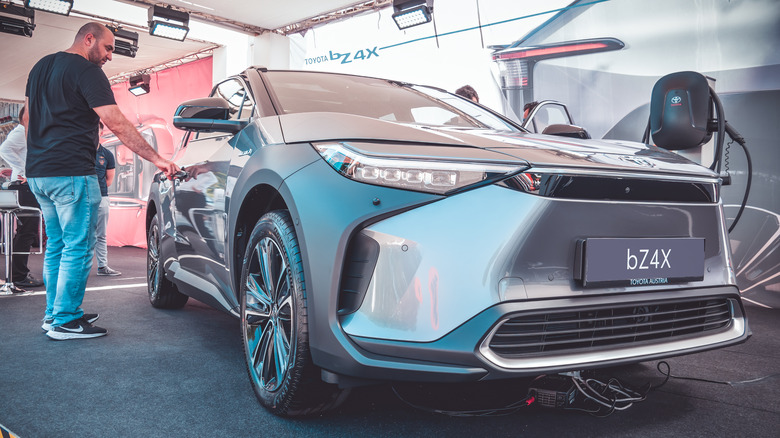
In December 2025, Consumer Reports named Toyota the most reliable car maker. But a year prior, Toyota tumbled for a collection of issues, crowning Subaru as the leader of the pack. In large part, this fall came because drivers were underwhelmed or even unhappy with three of Toyota's new models. User satisfaction scores showed significant drop-offs with the new Tacoma, Tundra, and Toyota's all-electric SUV, the bZ4X.
All three models scored below average on their reliability marks. This knock in overall performance came at the same time Subaru had just one underperforming model. Many of the satisfaction issues arose from a suite of big updates. Many automakers deliver small updates for a few consecutive years, keeping the parts and general aesthetics relatively unchanged from one model to the next.
But 2024 saw a big update to the look and feel of many Toyota vehicles, and it appears that users didn't like the new style as much as Toyota would have hoped. Conversely, Subaru is well known to make as few visual and functional changes as possible, leading to a more stable expectation and experience from one year to the next.
2021 saw a new engine build, and manufacturing issues left metal shavings behind

In 2021, Toyota phased out its V8 engines for a newly formatted twin-turbo V6 model. This was a striking decision for those who know and love Toyota vehicles. The brand has long been associated with simpler designs that make maintaining cars easier over the long term.
Toyotas feature significant overall durability, and their critical components last a long time, in part because they're built to be highly functional with as few complications as possible. The old V8 that powered Toyotas fit that bill perfectly, while its replacement delivered solid power and performance, but relied on far more internal pressure, a higher volume of moving parts, and greater technical complexities. The benefit of this swap was evident, though: In particular, it offered immense low-end torque that's ideal for hauling material in a truckbed or with its hitch.
Concerns over the change mounted before real drivers had tested the vehicle on real roads, but a manufacturing issue doomed the engines to fail for a different reason. Over 100,000 Toyota Tundras and Lexus LXs were recalled in 2024 because the engines' manufacturing process left tiny metal shavings within the structure, allowing them to migrate to sensitive, internal nooks and crannies and cause the engines to fail. Engine failure is certainly a major issue, but the root cause of this problem should have been entirely avoidable.
Toyota is being sued in 2026 for secretly tracking drivers
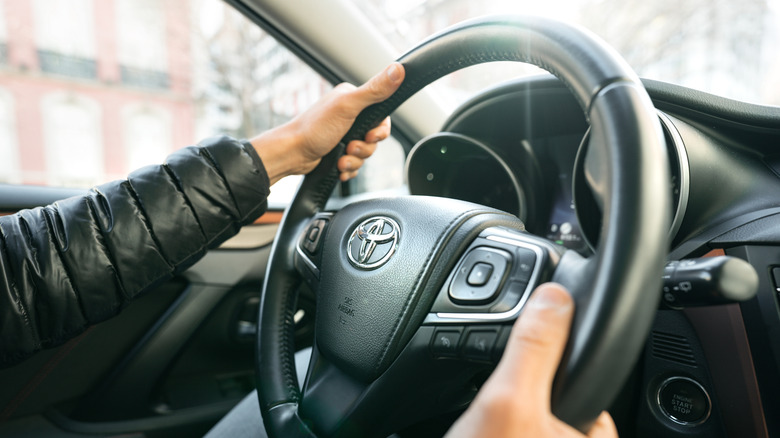
Toyota is already facing an issue in 2026, and it may impact countless owners. A Florida man is suing Toyota because his 2021 RAV4 has been collecting telemetry data on his driving habits, and that information was recently used to form a profile that raised his insurance rates.
Toyota has argued that his acceptance of the terms and conditions in using the vehicle's connected services clearly indicates the collection of data such as this. However, within that agreement, there isn't a clear indication of whether Toyota reserves the right to sell or otherwise disseminate that information to third parties, including buyers like insurance companies.
In the past, other automakers have been flagged for quietly sharing data with third-party users. GM was barred from selling data, in particular, after its Smart Driver program was exposed as a data collection effort that generated a lucrative side enterprise without user consent. After these dubious allegations, drivers may be wary of the information they share with Toyota.
New improvements are in the works, but drivers have long disliked Toyota's touchscreen controls
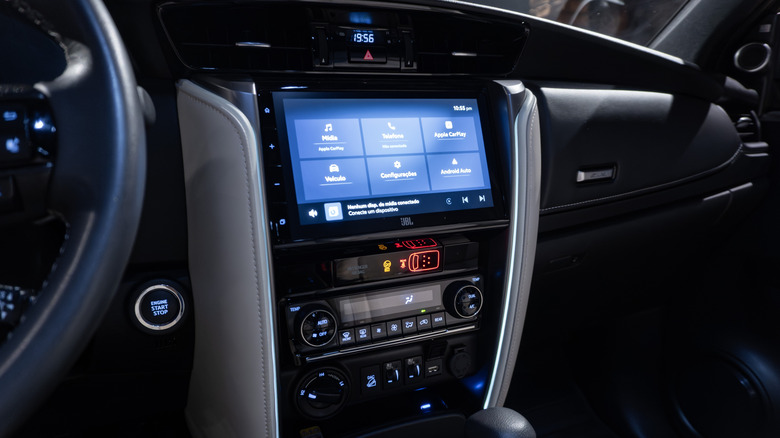
Beyond a car's performance and technical specifications, there's the 'infotainment' system, which has become a central feature in most modern cars. Gone are the days of analog dials and buttons to control various features of the passenger environment.
Like its peers, Toyota packs air conditioning, GPS, and a radio into a single interface. That can be effective, but Toyotas have long had unpopular touchscreen control systems. In Toyota's luxury Lexus models, much of the disdain is directed at the vehicles' touchpad or joystick control elements.
However, recent updates look to change this within the Toyota universe. Since the early 2020s, Toyota's infotainment systems have far more processing power than their predecessors. The brand may have retained a visually outdated user interface that feels cheap and uninspiring, but new voice controls, greater responsiveness, and standard integrations like Android Auto and Apple CarPlay have made a marked difference.