

This One-Off Lamborghini Put Out 440HP All The Way Back In 1970
With only 763 examples built between 1966 and 1972, the Lamborghini Miura is an extraordinarily rare and pivotal machine. So pivotal, in fact, that it essentially invented the word "supercar" in popular culture, representing the world's first true supercar to enter mass production (if 763 hand-built units can indeed be categorized as "mass-produced"). Lamborghini built three separate variants: the standard P400, the P400S, and the P400SV, each with a 4-liter V12 engine making 350, 370, and 385 hp, respectively. But what if you wanted more power, better handling, and a lighter chassis? What if you wanted a true Miura racecar? Enter the Miura Jota (pronounced "Yota"): Lamborghini test driver Bob Wallace's mad one-off creation.
Wallace — an experienced mechanic and racing driver — clearly saw potential in the Miura chassis, so much so that he set about crafting a lightened, tuned variant in his spare time. He used the shop floor as his personal laboratory, sculpting a more streamlined body and beefing up the engine to a healthy 440 hp. From a distance, the car still superficially resembled a Miura, but the devil was in the details here.
From bespoke bodywork to a stripped-out interior, this was a serious racing machine for serious track time. The Jota covered around 12,400 miles, mostly in testing, before being sold in 1972. Sadly, though, this story doesn't have a happy ending; the Jota was destroyed in a fiery accident. But the Jota's spirit lives on, so let's dive into this unique piece of Lamborghini's history.
Anatomy of the Miura Jota
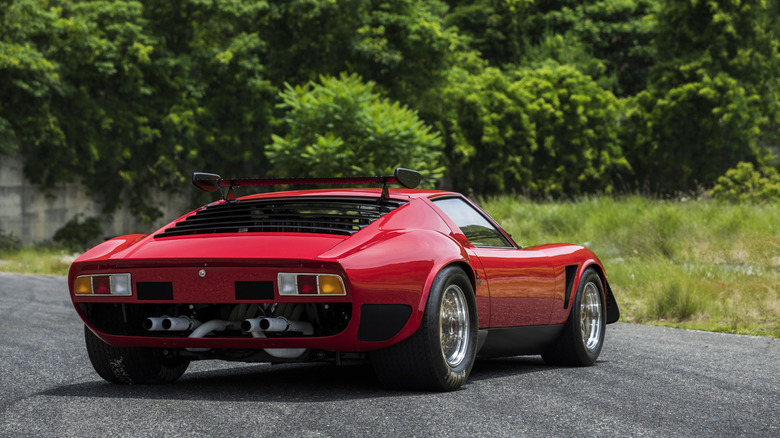
The Lamborghini Miura Jota was, in a phrase, a bespoke racing Miura, and it had the components to match. The original Miura was one of the fastest cars of the 1970s, but the Jota took things to the extreme. The bodywork was significantly altered and lightened, with BobWallace working to overcome the vehicle's natural weaknesses. For example, he built a custom chin splitter to add downforce, countering the front's tendency to lift under high-speed driving. He also removed the fuel tank, normally sitting behind the front axle, and replaced it with twin tanks in the door sills to improve the car's center of mass. He also crafted the body out of aluminum alloys, creating lighter and wider panels to fit extra-wide racing tires.
The standard Miura was already producing some 385 hp by this point, but Wallace wanted more here, too. Extensive tuning, including higher compression and a dry-sump oil system, resulted in some 440 hp at 8,000 rpm, providing potent and high-revving power for the track. Other modifications included custom suspension geometry and a stripped-out interior with a roll cage. Most of these changes were internal, with the only dead giveaways on the exterior being the wider body, aerodynamic elements, and fared-in headlights instead of the classic pop-ups.
The original vehicle was actually sold to a customer, who sadly destroyed the car in a high-speed accident when one of the fuel tanks ruptured, promptly burning the world's rarest Lamborghini to cinders. That's not the end of the story for the Jota, however; customers liked what they were seeing and wanted more, and Lamborghini was happy to oblige for one lucky individual.
What happened to the Jota?
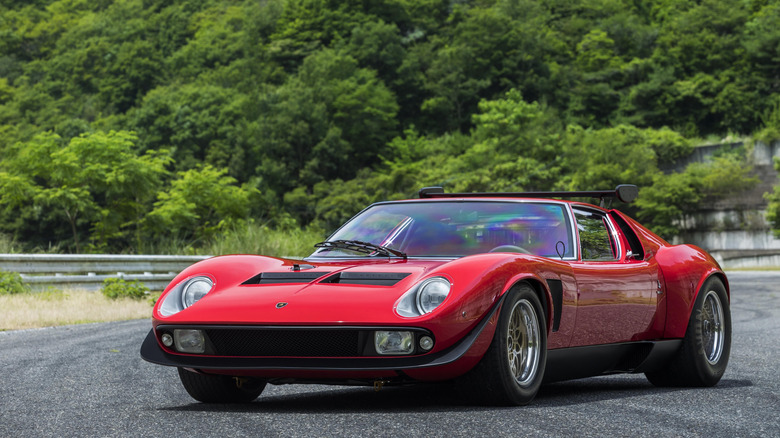
While the original car was sadly totaled, Lamborghini was commissioned by the owner of Chassis #3781 to build something equally ludicrous as an official successor to the Jota: the Lamborghini Miura SVR, with the "R" standing for "Racing." Originally a Miura S painted in Verde Miura (light green) with a black interior, the car's ninth owner approached Lamborghini with the unusual request in 1974. The company surprisingly acquiesced, and 18 months later, the Miura SVR was born. It was subsequently delivered to Japan, inspiring the massively successful "Circuit Wolf" comic book series.
While the Miura SVR remains the truest homage to the original Jota, it was nevertheless neglected over the years and was in need of a full restoration by the late 2010s. Lamborghini Polo Storico, based out of Lamborghini's headquarters in Sant'Agata Bolognese, received the car in pieces and painstakingly brought it back to its former glory over the course of 19 months. The team relied on specifications listed in the original 1974 modifications and completed the restoration in mid-2018.
The Jota itself may have had a sad ending to its tale, but the Jota and its SVR successor are nevertheless integral to the history of supercars and their role in motor racing. Not only was the SVR the star of a comic book, but it also found its way into households as a 1:18 scale car produced by Kyosho. While Lamborghini likely won't be producing a new Miura, this one-off certainly formed a lasting legacy of its own that has helped keep the nameplate alive and well in automotive culture to this day.