

How The First Wireless TV Remote Control Worked Without Electronics Or Batteries
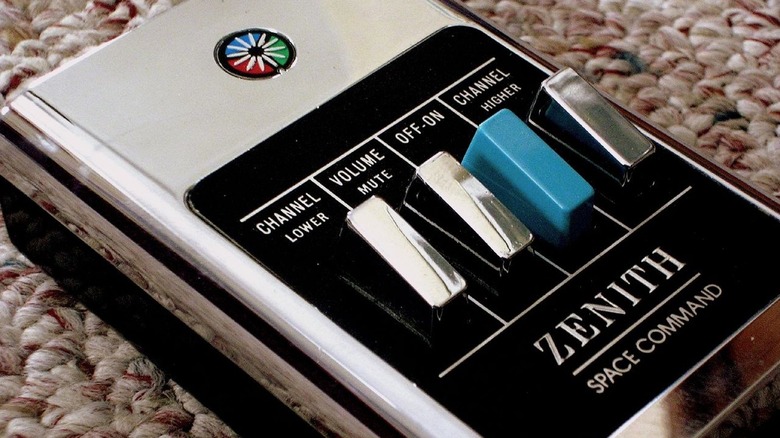
Before the advent of the television remote control, if you wanted to change the channel or adjust the volume, you were forced to get up from the couch, trudge across the room, and manually turn a knob on the TV to do each of those things — every single time. Interestingly, the very first one came out more than three-quarters of a century ago, so it's not a particularly recent concept. Over the years, though, what made them work drastically changed as technology advanced and subsequently produced some of the weirdest TVs ever made.
For decades, Zenith was the leading television brand in all the land. It started in 1918 as a wireless radio company but later evolved into a leader in the development of television and remote controls. In 1999, it was acquired by LG Electronics and, as a brand, vanished much like the dinosaurs not long after. The first practical wireless TV remote control is considered to be Zenith's Space Command (developed by Robert Adler in 1956), and it operated without batteries or electronics.
The Space Command was an all-mechanical auditory masterpiece. Pushing a button on the remote fired a tiny hammer that struck one of four various-length aluminum rods. When hit, each produced a unique high-frequency sound just like a tuning fork, which the television converted into commands that controlled different functions: "channel-up," "channel-down," "sound on or off," and "power on or off." Ironically, the clicking sound a button made when pushed was so loud it soon earned the nickname "clicker," which became a ubiquitous catch-all term for every remote for decades.
Sound once made TVs do its bidding
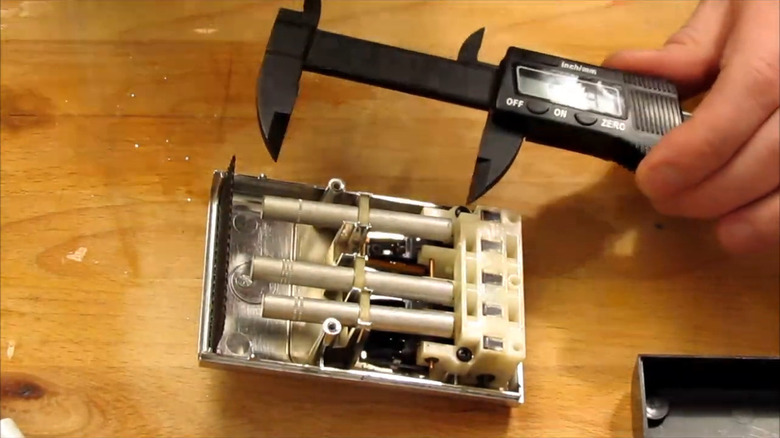
The original Space Command remote was expensive and added as much as 30% to the set's retail price because the advanced-for-its-time receiver inside the television needed six additional vacuum tubes to hear and process the sounds. Still, the tech caught on and soon became an industry standard until solid-state circuitry started replacing vacuum tubes in the early 1960s. Soon after, battery-powered remotes capable of sending inaudible ultrasonic signals emerged, a tech that lasted well into the 1980s and shipped over nine million units.
Ah, but the Space Command (which has nothing to do with the U.S. Space Force) wasn't the very first television remote. That honor goes to a wired contraption called "The Lazy Bones," which Zenith also developed in 1950. Even back then, one of its founders, Commander Eugene F. McDonald Jr., thought commercials were too loud and intrusive, and wanted a way to turn off the sound whenever they appeared. "Lazy Bones" had buttons for changing channels, turning the set on and off, and, of course, raising or lowering the volume. A wire ran from the remote to a motor inside that rotated the set's channel and volume tuners. It worked, but people quickly found the cord an annoying and dangerous tripping hazard.
According to Guinness World Records, the first wireless remote dropped five years later (1955) with the "Flash-Matic," designed by Zenith engineer Eugene Polley. This system was odd in that the hand-held remote itself wasn't much more than a simple directional flashlight that looked an awful lot like a ray gun from the old Flash Gordon serials.
From real to infrared -- light has always lit the way
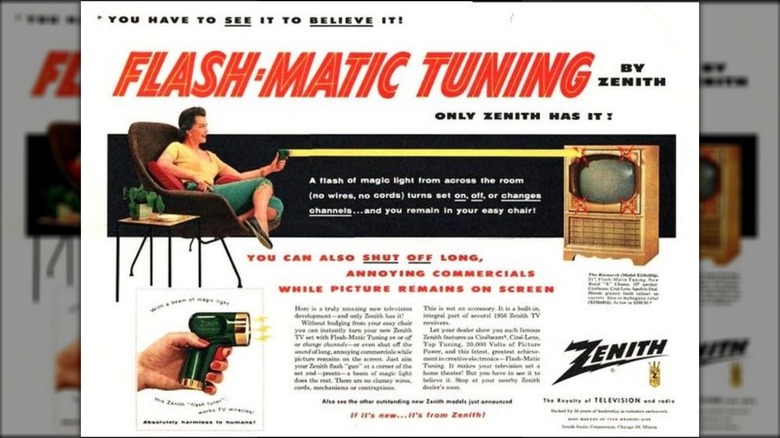
By aiming a focused light beam at one of four photocells located at each corner of the TV, you could turn the set on or off, raise or lower the volume, and change channels. The volume and channel knobs located on the set were physically turned by a motor each time the remote's light hit the photocell.
The hand-held remote for the Flash-Matic really was just a flashlight powered by two C batteries. All the "real" technology sat inside the TV, but it had no protection circuits. And therein was the system's most significant problem — ambient light often triggered the photocells. And if the TV was placed in a part of the room that received direct sunlight, the knobs would frequently rotate on their own. At the time, the whole setup was quite expensive — the television alone retailed at $400 (almost $4,800 in today's money), and the remote cost an additional $100 (or roughly $1,200 today). This flashlight remote lasted just a single production year, with an estimated 30,000 produced (and only in the United States).
The development of solid-state circuitry led to the universal adoption of infrared (IR) remote technology in the early 1980s. These function by firing a low-frequency light beam undetectable to the human eye at the television, which in turn converts that light signal into commands. IR remotes are just one of the many technological advances that have pushed the television industry forward, much as these 12 upgrades (under $50) will change your viewing experience.