

What's The Tab On A Car's Rearview Mirror For?
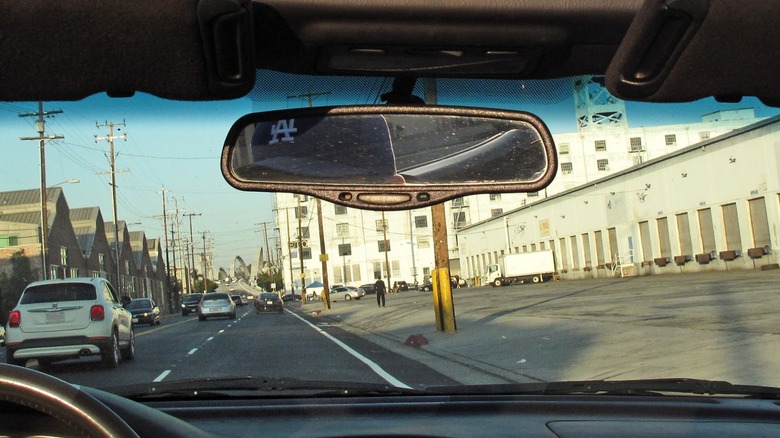
From newly-licensed drivers to veterans who have been driving for decades, American roads and those around the world are busier than ever with a wide variety of vehicles. What we sometimes don't often think about are all the safety measures built into our vehicles. For instance, the mirrors are some of the most important aids to a driver's visibility, with the rearview mirror providing a view behind the vehicle. Adjustments are one crucial way to minimize blind spots in your car, and the rearview mirror features a tab that has a function some drivers may not be aware of.
Ford notes that some vehicles have a Manual Dimming Mirror, so the driver is able to "pull the tab below the mirror towards [themselves] to reduce the effect of bright light from behind." Models that do this automatically have become increasingly dominant, but there are still some models that require this manual adjustment. Let's take a look at why this is such a crucial feature, when it was introduced, and how it works to help protect drivers (and by extension passengers) on the roads. Your rearview mirror may have multiple buttons, but this is the one we're focusing on here.
How manual dimming mirrors work

Anything that compromises a driver's vision or distracts them could have disastrous consequences. This may be caused by other vehicles' lights or behaviors, or something like the sun peeking through clouds or around hills. The driver and the passenger seat typically have a sun visor that can be flipped down, butit's impractical to obscure the rearview mirror the same way as a sun visor.
To solve this, a manual dimming mirror achieves what are sometimes referred to as Night and Day modes by using prismatic mirrors. The prism inside allows the angle to change when the tab is adjusted. This works because of the unique shaping and positioning of the mirror. In the "night" position, the light is reflected upwards in order to be less disruptive. HowStuffWorks explains that "What looks to be flat is actually a ... angled mirror with a wedge of glass ... in front of it at an angle." The angle change means that the brighter light is directed towards the driver in day mode, and away from them when the switch is flipped to nighttime. It's surprisingly advanced technology for something that looks so simple from the driver's perspective.
The advantages of automatic dimming mirrors

The issue with manually adjusting the tab is that while it's a quick motion, it's still one that can distract a driver. As a potential solution, some cars feature an electrochromic mirror. The concept is similar to photochromic lenses in glasses, which react to sunlight and darken to protect the user's eyes, dimming again when out of the intense light. The automatic dimming rearview mirrors, Ford reports, are equipped with sensors both in front and behind, and will react similarly to the lenses, except when the vehicle is reversing.
For the feature to work best, it needs a proportional dimming to the amount of light. Too much or too little would result in a limited benefit for the driver. The surface of the mirror and the glass interior are held together with a sort of gel that reacts to the light. The sensors on the mirror's body provide an electrical charge that increases or decreases the effect, providing the driver with a suitable amount of visibility for the conditions. This is why you may notice wires behind your rear-view mirror. It's an effect that, because it's automatic, a lot of drivers wouldn't even notice happening that much, and without it, there's no doubt that the road would be a more dangerous place.