

Flip-Style Vs Book-Style Folding Phones: What's The Difference?
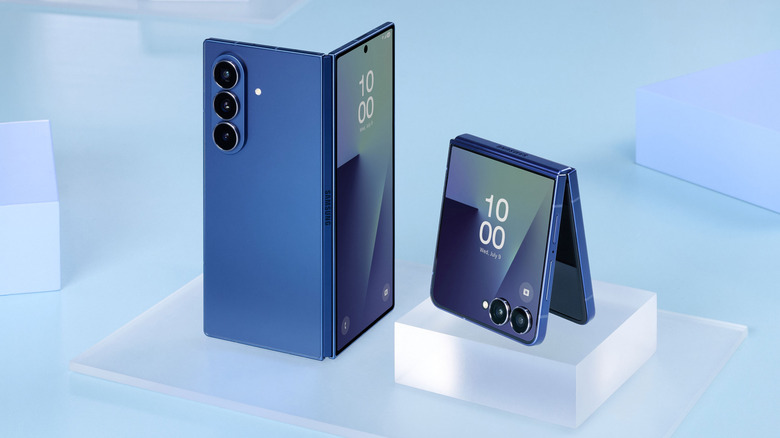
When foldable phones first hit the market in 2019, it was unclear whether they would stick around. The first mass-market folding phone, the Samsung Galaxy Z Fold, had durability issues and was even recalled briefly. But nearly seven years later, the market is only growing. More companies than ever make folding phones, and Apple is rumored to be releasing its first foldable iPhone in 2026. By now, two dominant form factors have emerged: the flip-style and the book-style foldable, and they represent two different visions of our flexible future.
On the surface, the difference between the two is self-evident. A flip-style foldable, also known as a flip phone, looks like a normal smartphone when unfolded along its horizontal axis. Typical flip phones include the Samsung Galaxy Z Flip 7 and Motorola Razr. By contrast, a book-style foldable looks like a normal smartphone when folded, but opens up to reveal a much larger display when unfolded along its vertical axis. It is typified by models like the Samsung Galaxy Z Fold 7 and Google Pixel 10 Pro Fold.
But though both are foldables, the experience of using a flip phone is vastly different from that of using a book-style foldable. They suit different use cases, in terms of portability, software and hardware features, and quirks unique to each phone's implementation of the style. Someone whose needs are satisfied by a book-style foldable may find themselves unsuited to a flip phone, and vice versa. If you're in the market for a folding phone, you'll need to decide which kind of device is best for you. Here's what you need to know.
A phone that expands, or a tablet that shrinks?
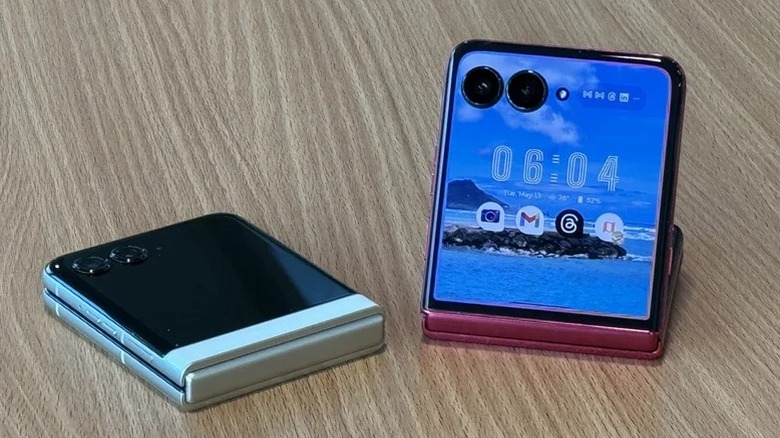
The most useful way to conceive of the practical differences between a flip phone and a book-style foldable is that the former is a phone that expands, and the latter is a tablet that shrinks. A flip phone gives you the same screen real estate as a regular, slab-style phone when unfolded, but takes up less space in your pocket or purse when folded. It slims down your carry. On the other hand, a book-style foldable is the size of a slab phone when closed, but it opens up into a canvas the size of a small to medium tablet. It may be chunkier, but it makes up for the added bulk with increased functionality.
Flip phones tend to have small cover displays with decreased functionality. Although some, such as the Motorola Razr Ultra, run apps on the outer display, others are limited to widgets. The Samsung Galaxy Z Flip 7 can run apps on its cover display as of a late 2025 update, but you wouldn't necessarily want to do so on such a small screen. You'll need to unfold the phone to its full size to use all of its functions, so some users purchase flip phones as a way of cutting down on distractions.
Book-style foldable phones take a more maximalist approach. When closed, they have a full-sized display and work just like a conventional iPhone or Android. Once unfolded to reveal the tablet-sized inner display, they gain additional functionality. For example, you can run two apps side-by-side at full scale. On the OnePlus Open, you can run a sort of continuous app canvas, fluidly moving across multiple open apps at a time.
Function follows form for foldables
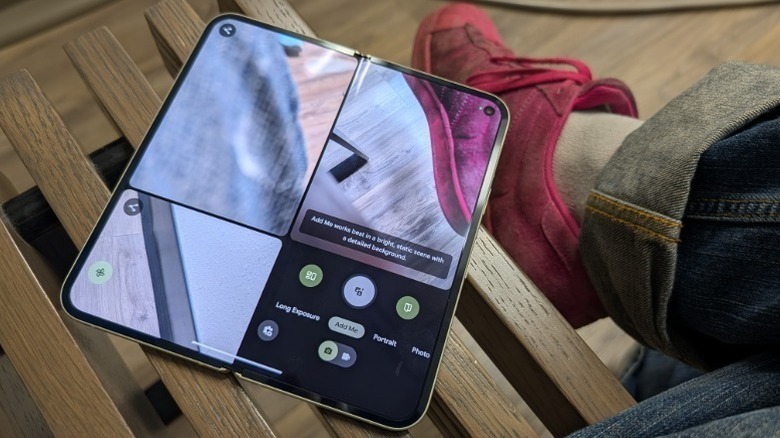
Despite their inherent differences, there are some features and capabilities shared between both book and flip-style foldable phones. For instance, since both devices can be unfolded so that their outer displays face in the same direction as their primary cameras, both types of foldable devices can take a high-quality selfie with the main camera while using the outer display as a viewfinder. Some manufacturers, like Samsung, also include special modes for when the phone is partially unfolded. For instance, you can partially unfold either a Galaxy Z Fold 7 or Z Flip 7 to use its cameras hands-free, and you can also use the bottom half of either display as a trackpad to navigate content on the top half. Some apps, such as YouTube, will place controls on the bottom half of the display. Samsung calls this "flex mode."
But we've only scratched the surface here. While the rest of the smartphone market has settled on the so-called slab or candy bar style phone, typified by the "glass sandwich" design of many iPhones, foldables are the one area where experimentation is still robust. Along with Samsung, Google, and Motorola, companies such as Oppo, Honor, Vivo, Xiaomi, and Huawei are all offering their own takes on the foldable concept. Many of the folding phones on the market differentiate themselves through unique hardware or software features. Which foldable is right for you can only be partially determined through form factor alone. Once you decide between a book or flip-style foldable, it's a good idea to keep researching until you find a model that speaks to your personal needs.