

If A Gas Station Sells You Bad Fuel, Here's Your Next Move
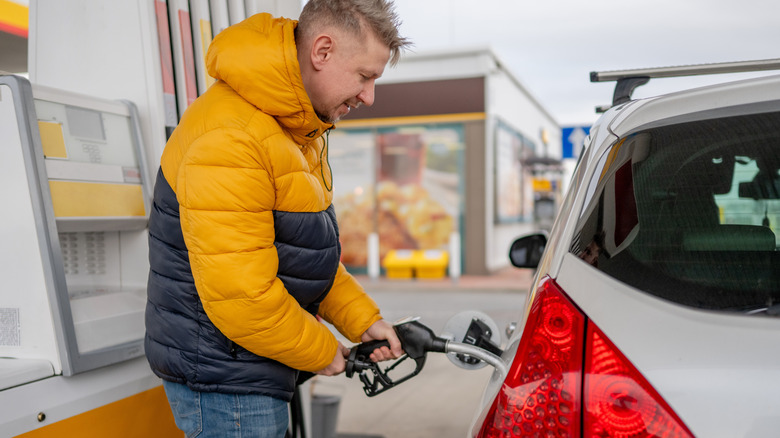
The United States consumed between eight and nine million barrels of gas every single day in 2025, reminding us of just how dependent we are on automobiles. A Consumer Expenditure survey from mid-2025 showed that we spend around $2,148 a year on gas, which might not seem like a lot, but the last thing you want is to put tainted gas in your car, as the results will be costly.
You may not know it, but the gasoline we use to power motor vehicles actually has a shelf-life, and can go "bad" if it gets too old. But that's not what we're talking about here. By contaminated, we mean something that's been added to the fuel (i.e., water, dirt, and even the odd microbe) that makes it "bad" — whether at the refinery, during transportation, or at the gas station. And it happens more than you might think. Just recently, 46 gas stations (including pumps at Costco, Circle K, and Safeway) in 11 counties across Colorado sold contaminated gas.
If your vehicle suddenly starts sputtering and/or the engine light pops on shortly after visiting a station, you likely pumped in harmful gas. If the engine shutting off didn't force you to the side of the road, safely pull over and turn off the ignition immediately. Making the motor chug more infected fuel is only going to make things worse. Chances are you'll need to have your car towed somewhere, so having roadside assistance (like AAA) at the ready will come in very handy at times like these.
Bad gas won't get you far
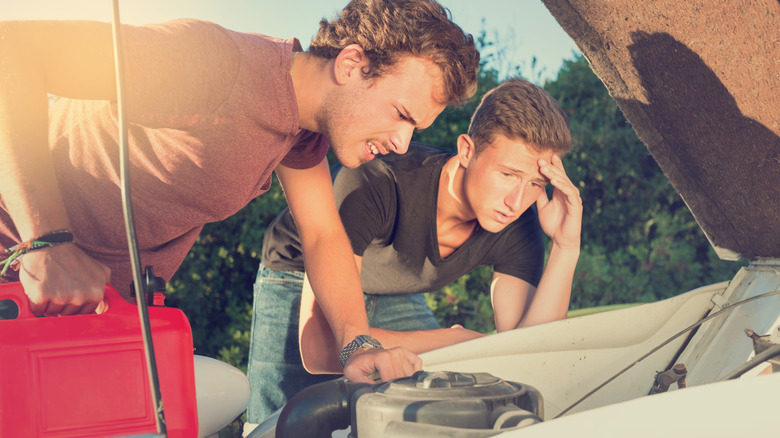
Once at the shop, be sure to have the mechanic get a sample of the suspected contaminated gasoline, because, again, the more proof you have, the better. This shouldn't be difficult since they'll almost certainly have to drain the tank, flush the lines, and if you're lucky, simply replace some spark plugs. Even that minimal amount of work will set you back hundreds of dollars. Worst case, it completely ruins the engine and costs thousands to replace.
Whatever the scenario, you should be able to file a claim, and that starts by going back to the station where you bought the gas (as soon as possible). Reputable big-brand stations shouldn't push back and can likely begin processing the complaint through internal channels on the spot. Secondly, you should contact the state agency (each is different) that monitors fuel standards and gas station practices. In Colorado, it's the Department of Labor and Employment's Division of Oil and Public Safety (OPS). Meanwhile, in Oregon, it's the Department of Agriculture, and in Texas, the Department of Licensing and Regulation.
Some other things to keep in mind: if you're not already grabbing a receipt when you fill your tank, start doing so because having an unequivocal paper trail proving you bought the gasoline (which has an interesting and complex process of being made) when and where you said you did is vital. Additionally, your automobile insurance may cover fuel-related issues like this, so call your agent and fill them in on what happened. Last but not least, if the station is at all reluctant, contacting an attorney might be needed.