

5 Old Honda Models From The '70s We Could Never Forget
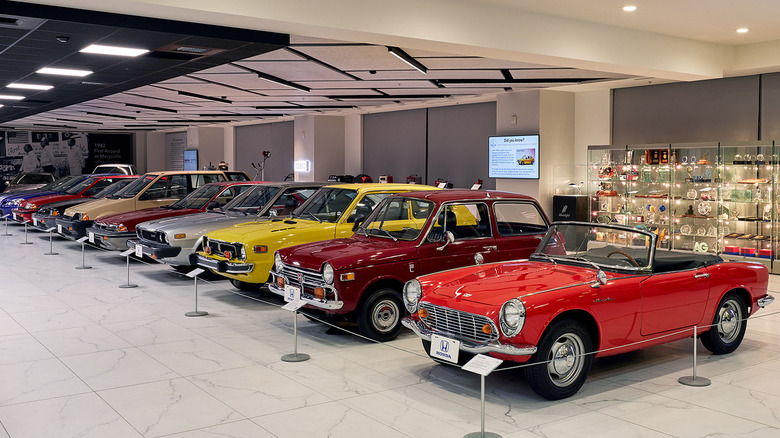
It's hard to understate just how important the decade of the 1970s was for the Japanese auto industry, both domestically and in terms of its larger global presence. As the 1970s began, Japan's carmakers were still getting their footing after a long period of post-World War II rebuilding. Just 10 years later, as the 1980s rolled around, the Japanese auto industry was entering its era of global dominance.
But it wasn't just growth that defined Japan's auto industry during the '70s, the decade also produced some incredibly memorable and important cars. Honda was no exception to this. To put things in perspective, in 1970, Honda was still in the early stages of its expansion from a successful motorcycle-builder into the world of automobiles. Yet by 1980, four-wheeled Hondas were everywhere, with cars like the Civic and Accord having taken the market by storm.
For Honda, the '70s were filled with cars that were both iconic and groundbreaking, along with a few ahead-of-their-time models that helped lay the foundation for important vehicles to come With this in mind, we've selected five of the most memorable and important 1970s Hondas that represent some of the brand's achievements and the evolution that Honda underwent during the decade. It's a mix of classics that includes everything from a tiny micro van to a highly experimental mid-engined supercar prototype.
Honda S800
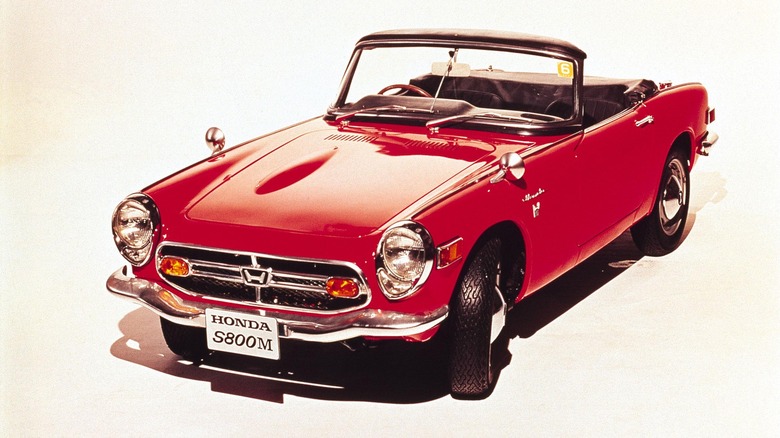
For those not familiar with the company's history, it might seem strange that one of the first production automobiles to put Honda on the map was a two-seat sports car, rather than the more practical models that would define the brand later. But it all makes sense when you consider that the Honda S800 was directly evolved from motorcycles, and its engine itself came from straight from Honda's bike-building expertise.
The S800 was the final iteration of Honda's early S-badged sports cars, with the last models being built in 1970. The car had evolved a lot from its introduction in the early '60s, with its engine growing larger and more powerful, and with the S800 leaving behind the chain-driven mechanism of the early cars for a more traditional driveshaft to the rear wheels.
Today, the S800, along with the earlier S500s and S600s, is a bona fide Japanese classic, beloved for its racing pedigree and a high-winding, small-displacement engine that would come to define Honda's cars for years to come. While the S800 would disappear after 1970, its spirit would be found in later sports cars like the Honda Beat of the early '90s. And things really came full circle in the late '90s with the launch of the Honda S2000 – a car that has become a classic even more prolific than the original 'S' cars that inspired it.
Honda Life Step Van
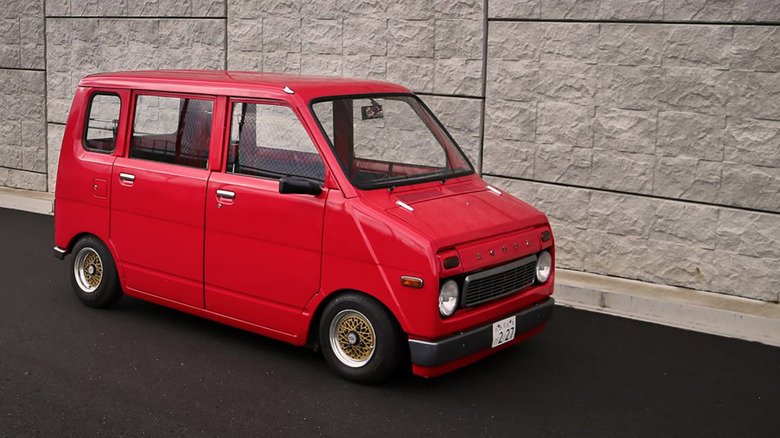
When it comes to memorable and influential 1970s Honda models in the Japanese home market, the Life Step Van ranks among the top. At the time it was released in 1972, the Step Van was a strange vehicle even by JDM standards. Based on the existing Honda Life kei car, the Step Van took the same platform, re-shaped into a micro van with a tall roof and a low-load floor. A tiny 356cc engine combined a front-drive layout meant the little van was efficient, inexpensive, and incredibly roomy for its small footprint
The 1970s Step Van was ahead of its time in many ways. Though it was only on sale for a couple of years, the little van's profile would later become prolific, as it laid the groundwork for an entire segment of tall kei cars that would come decades later. Today, more than 50 years after the Step Van debuted, both its shape and hints of its styling can be found in the modern kei vans that fill the streets of Japan right now – including Honda's latest N-Van.
And even for people who grew up in the places where Honda didn't sell the Life Step Van, the cute little machine has developed a bit of a cult following thanks to its inclusion in video games like Gran Turismo.
Honda Civic
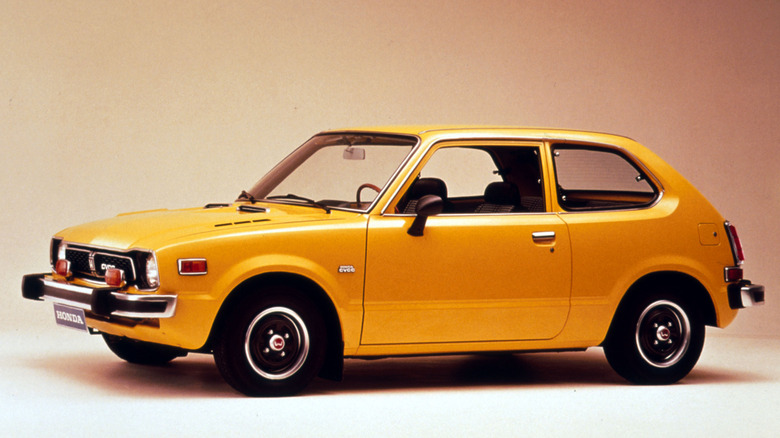
It would be impossible to put together a list of the most memorable Hondas of the 1970s without including the very first Honda Civic. This was the car that started at all, and one that continues to be an extremely popular model more than 50 years later. The longest-running nameplate in Honda history, the original 1972 Civic was a culmination of everything that Honda had learned building cars (and motorcycles) up to that point.
Unlike some of Honda's earlier efforts, which were primarily built with the Japanese market in mind, the Civic was designed to be a global car, with its specific sights set on the American market, which it quickly won over. It's not hard to see why the first-generation Civic was such a game-changer. It was inexpensive, well-built, roomy for its size — and most importantly for car buyers in the fuel-crunched 1970s, it was extremely fuel efficient.
But beyond that, there was something more to the Civic than just being a cheap car that was good on gas. The first-generation Civic had things you didn't typically see in economy cars, like four-wheel independent suspension and motors laced with Honda's motorcycle DNA. The high-performance Civic RS model would join the lineup in 1974, paving the way for many more enthusiast-oriented Civics to come, including the almighty Civic Type R.
Honda Mid-Engine V8 Prototype

By the 1970s, Honda had already earned success in Formula 1 racing, and that racing experience, combined with a growing production automobile presence, led Honda to scheme up a road-going performance car that took the brand's aspirations to a new level. Plans called for a mid-engined supercar to use a small-displacement V8 engine with Honda's CVCC technology. But just as it was taking shape, the fuel crisis of the mid '70s dashed any hopes of this unnamed model reaching production. But you can easily see its potential through the design plans and clay models that Honda was working on.
But why would a little-known prototype that never got near production be worthy of a spot among the most notable Hondas of the 1970s? Because of three letters that would come a little later — NSX. More than 15 years later, with the gas crisis in the mirror and Japan's economy booming, Honda's supercar dreams would take flight again. And this time the idea would be fully realized in the form of the game-changing 1991 Acura/Honda NSX.
More broadly, this abandoned supercar project shows just how high Honda's sights were set during the '70s. With racing in its DNA, the company already had visions of building world-class, high-performance road cars — even as most drivers were just getting to know its fuel-sipping compacts.
Honda Prelude
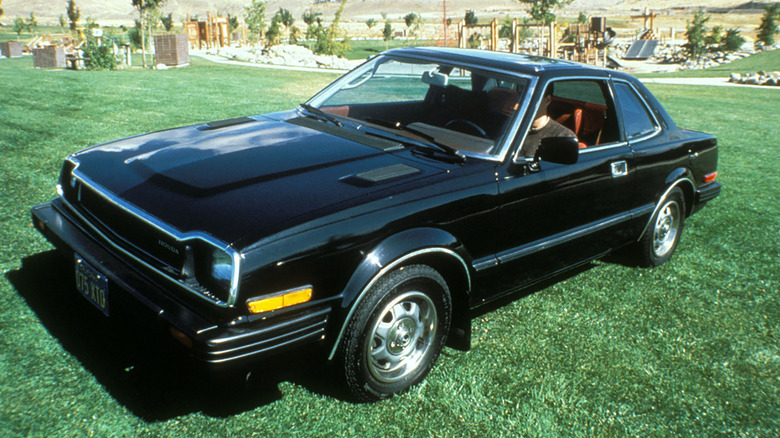
Representing the tail end of Honda's 1970s achievements is the first-generation Honda Prelude, which debuted in 1978. By the late '70s, mainstream Hondas like the Civic and Accord were doing very well, and the introduction of the Prelude represented a big move as Honda expanded its lineup to include more stylish and performance-oriented offerings.
The Prelude's DNA was pretty simple, using parts from the existing Accord and Civic platforms to create a higher-end coupe, which Honda marketed as a 'sports car for grown-ups' in a time of 55-mile-per-hour speed limits and strict emissions rules. The Prelude was a fun-to-drive, eye-catching two-door that was as easy to own as any other Honda. Among its accomplishments was being the first car to have a power-operated sunroof as standard equipment.
This original model of the late '70s would end up becoming the first of five generations of Honda Prelude that would carry on the tradition into the early 2000s. And beyond just the Prelude lineage itself, it also helped lay the ground for future sporty and luxurious Honda models in the '80s like the Integra or the more upmarket Acura Legend. If there was any further doubt as to the enduring legacy of this sleek Honda, you might be aware that Honda has recently brought back the Prelude nameplate after a long hiatus – this time as a stylish, hybrid-powered coupe for the late 2020s.