

5 Cheaper Toyota Alternatives To Lexus Cars
Being the luxury variant of Toyota, the Lexus brand generally shares its lineup with its more mainstream sibling. This can either be a direct rip from the Toyota lineup, as seen throughout certain models' histories (Lexus LX and Toyota Land Cruiser, for example), or two vehicles sharing the same platform and role but with more distinct architectures, like the Lexus RX and Toyota RAV4. We'll take a look at all of these and more; both companies have dozens of models across multiple powertrain styles, from basic sedans to fancy hybrid SUVs and everything in between. It's quite daunting at first, and the connections between these models aren't always obvious.
Of course, having so many models is a good news / bad news situation; if you need wheels, Toyota generally will have you covered, regardless of what type and what you need them for. The same goes for Lexus, naturally, but the latter company's base prices can sometimes soar to over double that of the Toyota equivalent. With many Lexus models fetching well over $100,000 in comparison to Toyota's more budget-friendly options, is it really all represented there, or is it just brand recognition and flexing?
Surely some of that budget is going into the allure of a luxury brand. After all, a more prestigious-looking vehicle carrying a certain reputation will command a fitting price. But let's suppose that you took an equivalent Toyota and optioned it up to the point where it was toe-to-toe with the Lexus counterpart — which cars are the best options?
In this article, we won't restrict ourselves to mere badge-engineering, but rather look at cars with clearly overlapping roles and target demographics. We'll also be using the Toyota and Lexus webpages, respectively, to generate vehicles with roughly equivalent specs.
Toyota Camry / Lexus ES

The Lexus ES was the luxury marque's equivalent of a Camry since the brand's inception, with the original ES based around the same powertrain, body, and aesthetic. It was originally billed as something of a Camry for the country club; fast forward some 36 years, and not much has changed. The ES represents Lexus's midsize luxury sedan option, featuring a plethora of trim levels and packages to suit a wide audience — much like the Camry. Most features were carried over from one car to the other, such as the option for a hybrid EV powertrain, base-model and performance variants alike, and luxury amenities.
It's the latter that we'll focus on here, given that the vast majority of each vehicle is identical underneath the bodywork, and the styling is purely subjective. A 2026 Camry, when well-optioned, is certainly generously apportioned for its price-point, featuring a 9-speaker JBL sound system, 10-inch heads-up display, panoramic roof, digital key capability, leather interior, a plethora of safety features, and more, for around the low-$40,000 range depending on aesthetic choices. The larger rims, accessories, and certain paint options will tip the scales well into the mid-high $40,000 range.
That's already equaling the price of the Lexus ES, which starts at $43,435 for the base-model — which, granted, comes with AWD, whereas the Camry must be optioned with that. Even so, to get the equivalent safety features and accessories, one would have to add another ~$10,000 on top of that price, meaning the Lexus commands around that much in a premium over the equivalent Camry. All that price would likely go into the general quality of materials, if anything, which is only noticeable on a test drive.
Toyota Grand Highlander / Lexus TX
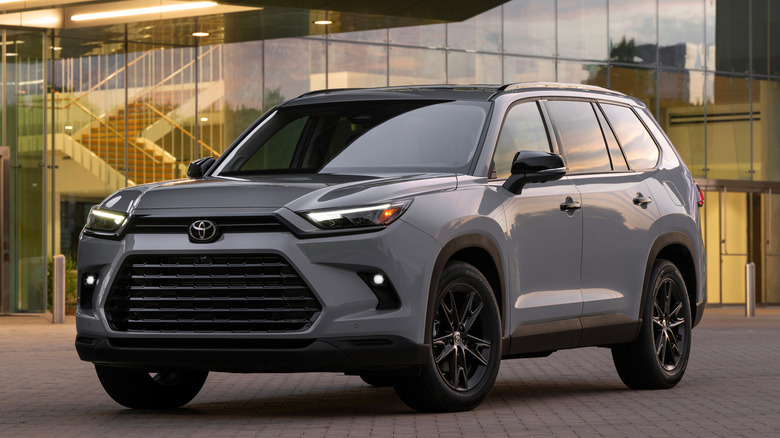
Much like the Camry / ES, this represents one of the more popular family-oriented options in the automotive sphere: a decently-sized SUV, fit for longer trips with more passengers and cargo aboard. The Grand Highlander is Toyota's offering against the likes of the Ford Explorer, Chevrolet Traverse, and Dodge Durango, whereas the Lexus TX targets the Range Rover, BMW X5, Infiniti QX60, and so on. And also like the Camry, the Grand Highlander is seemingly endlessly customizable, with Toyota offering no fewer than ten different trim levels for the midsize, as does Lexus with the TX, current mainstay of the company's new 2026 SUV fleet.
Both models actually feature fairly similar MSRPs, with a Toyota Grand Highlander Platinum starting at $56,340 versus the base-model Lexus TX with a $57,090 price tag. Certain accessories will quickly add up; for example, the Lexus cross-bar roof rack is $420, compared to Toyota's $325. The all-weather floor package for the Grand Highlander is $388, whereas the Lexus must be optioned in sections, adding up to $410. Basically, the more you order, the more disparaging the pricing will be, but the actual car underneath is functionally identical down to the luxury offerings. At this level, the difference between Toyota and Lexus is purely that of styling and a few grand at the bottom line.
Overall, this represents one of the closest battles between the two marques, with both vehicles delivering similar promises in terms of their features and general price points. One could feasibly option up a Grand Highlander to be equivalent to a Lexus TX, but a well-optioned TX will always exceed the Grand Highlander, albeit for a hefty price. The highest trim TX can easily approach $90,000, against the highest trim of Grand Highlander at around $65,000.
Toyota Land Cruiser / Lexus GX
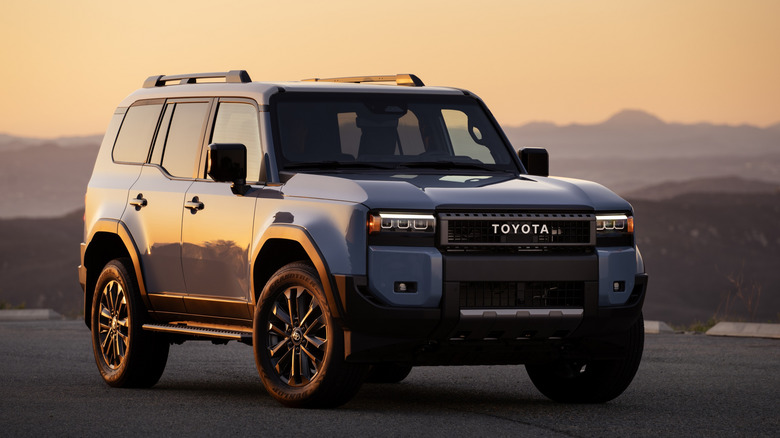
This name is a bit of a misnomer, since the modern Toyota Land Cruiser is, in fact, a Land Cruiser Prado. The Prado is, essentially, a retro-styled, smaller variant of the Land Cruiser, filling the midsize 4x4 gap and providing a more rugged alternative to the Grand Highlander. This is the vehicle you want if you're looking for a light-duty truck akin to a Ford Bronco or Jeep Wrangler, but with a more traditional body. The Land Cruiser comes in two flavors: the standard model and the cheaper 1958 Edition, noted for its rounded headlights and retro-inspired front fascia.
The Lexus GX most closely approximates the standard Land Cruiser, sharing the more modernized front-end; from the side, the two vehicles are nearly indistinguishable, a trend extending back to the first-gen Lexus LX, which was just straight-up a well-optioned Land Cruiser with a Lexus badge and nicer interior. Sadly, Toyota discontinued the Land Cruiser for sale in the U.S. in 2021, with the smaller Prado taking over, but you can technically cheat and get a real Land Cruiser by buying an LX anyway. Toyota still offers the smaller variant, however, and these two models are effectively the same thing, just with different logos.
If you want a premium Land Cruiser (Prado), that'll run you over $71,000 for an example with the premium package (nicer than the Lexus) and 20-inch rims. The closest Lexus variant is the mid-spec GX 550 Luxury, which runs around $80,000 for the same offerings. That same price discrepancy continues throughout the model line from base to top-level, with a low five-figure difference between the two throughout. This is likely one of the most blatant price-ups for the badge across Lexus's model line.
Toyota RAV4 / Lexus RX
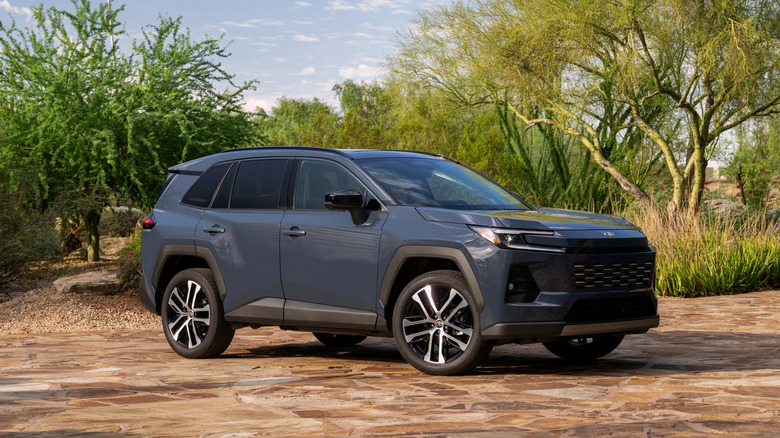
Few vehicles hold a candle to the Toyota RAV4 when it comes to the pedestrian crossover market today. These cars are among the most popular on the planet, with RAV4 sales in the U.S. coming in third place behind the Ford F-series and Chevrolet Silverado, respectively. They represent possibly the most ubiquitous crossover of all time; when someone mentions the word "crossover," it's likely their brain is defaulting to the generic shape of a RAV4. They were never particularly ostentatious, nor were they exceptional in any way apart from being robust, reliable transportation. It's a simple formula that solidified the RAV4 throughout the world.
What if you want something a little more premium, though? Well, then you have two options: You can either option up a RAV4, or opt for a Lexus RX. The latter isn't a direct copy in the same way as the Lexus GX, for instance; rather, it's simply the Lexus equivalent of a comfortable, practical midsize crossover. The RAV4 starts at $31,900 in 2026, with the top-shelf Limited trim reaching to $43,300 base, including all the usual refinements — panoramic moonroof, upgraded sound, nicer rims, and so on.
Lexus's answer to the RAV4 Limited is the base-model RX 350, housing a number of the same features for a total of $51,175. Indeed, the cheapest RX is about 20 percent more expensive than the top-level RAV4, for a vehicle that functionally does the same thing. Is it a perfect one-to-one copy? Not at all. But the price discrepancy only grows with additional features like hybrid powertrain options, making the RAV4 the clearly better deal for the driver looking for convenience without the image.
Toyota bZ / Lexus RZ

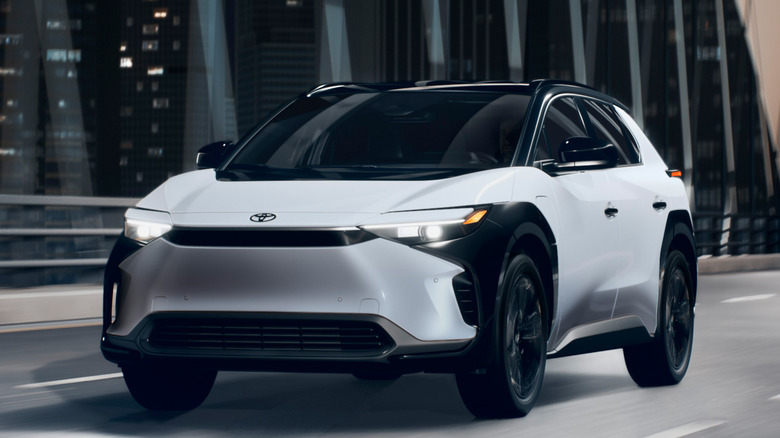
Debuting as Toyota's latest electric crossover, the bZ features a compact body type intended to compete against the likes of the Tesla Model Y. Smaller and handier than a RAV4, the bZ sits dimensionally between that and a more compact Prius, being more tailored towards commuting and city driving. And for its size, the car is relatively rich in features and options despite only having two trim levels, with the base model being only $34,900 and housing a respectable degree of functionality, range, and amenities for the price. It's by no means an incapable car, and certainly on the cheaper side for an EV. But what about a more luxurious option?
Enter the Lexus RZ, another carbon-copy that's nigh-indistinguishable, doubly so owing to the lack of a substantial front grille. The base-model RZ 350e, however, costs a whopping $47,295, about 25 percent more than the base bZ. And for that price, you get the same size infotainment, the same powertrain, the same general interior layout, the same safety features, and so on. Of course, the Lexus comes with a host of luxuries, such as a card key, NuLuxe trimmed seats, 8-way adjustable driver and passenger seating, and a host of other features as standard. But most of that can be optioned up on the Toyota as well; doing so still keeps the price below the mark at around $44,000.
Overall, like all the other vehicles, an equivalent Toyota is a fraction cheaper than the Lexus for what's ultimately a near-identical feeling end product, albeit without the Lexus pedigree. If you want proper luxury, however, you'll need to option up, and in that case, only Lexus offers the full suite. Soon enough, however, that title will pass on to Century, Toyota's latest flagship luxury brand.