

5 Antique Harley-Davidsons With High Resale Value

Harley-Davidson is quite possibly the most famous name in American motorcycles, and that reputation didn't build itself. The company was founded in 1903, with friends William S. Harley and Arthur Davidson producing their first motorcycle, the Model 1, in a shed that same year. Soon enough, the budding firm went from handmade, niche motorcycles to full-blown factory production, branching out into mass-market motorcycles, land speed record bikes, military models, and more. Such a diverse resume naturally leads to an equally diverse array of specialized models, one-offs, hard-to-find originals, and all manner of quirky but cool idiosyncrasies.
But let's say, for argument's sake, that you have a mid to high six-figure sum taking up space in your wallet, or you just have a morbid curiosity as to how much these machines can actually sell for. What are some of the priciest antique Harley Davidsons at auction and on the open market today? Naturally, there are quite a few; early Harleys went through a number of revisions and editions, each one frequently having its own designation and nickname (Model 1, 2, 3, etc., along with names like Strap-Tank and Shovelhead).
Before we take a look, there are a few disclaimers. First off, what defines a motorcycle as "antique," in this case? For simplicity's sake, let's say any motorcycle manufactured before 1976, so over 50 years old. Newer motorcycles can still be "classics," but "antique" implies something from before their time. Second, we'll be looking at auctions as the primary source, and only looking at motorcycles that were sold to the general public or under mass-production contracts. Otherwise, there cannot be a "resale" if the vehicle was never sold in the first place. Let's dive into it and see some wicked-cool bikes.
Early-production FL - $60,000
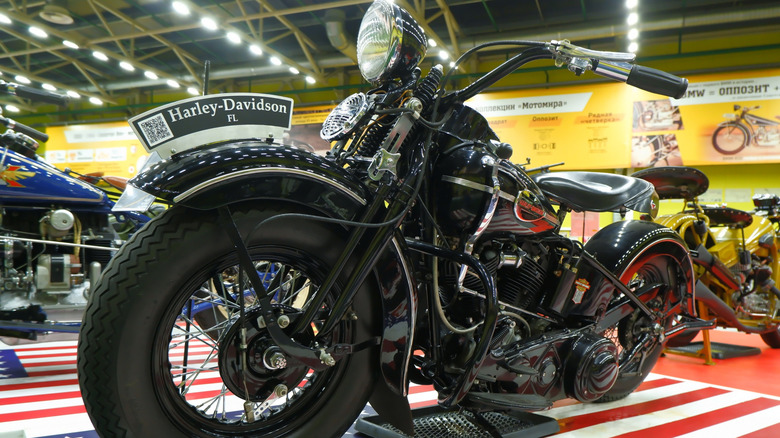
For our first foray, we take a look at one of the most prolific names in all of Harley Davidson's history, the FL. In continuous production since 1941, the original "FL" designation referred to touring models equipped with a high-compression Knucklehead V-twin. They adopted many names over the years, being widely known by their "-Glide" designations, such as Hydra-Glide and Electra-Glide, among others. It's tough to get more ubiquitous than these when picturing that classic "Harley" look as well, with that iconic touring silhouette, plethora of comfort-oriented options, and massive popularity.
The first FL motorcycles utilized a 74 cubic-inch V-twin fitted to a relatively generously-sized frame, a trend that hasn't really changed up to today. A modern FL comes equipped with all the usual amenities one would expect: a 105-horsepower powerplant, shark nose fairing with LED lighting, digital instrumentation, and so on. These are motorcycles designed for long, comfortable trips down the interstate, a task they were so well-suited to that they're still a perennial front-pager on Harley's homepage.
Of course, being such a long-lived motorcycle, the FL has seen a dizzying array of specific editions, years, and particular motorcycles that hold tremendous value, sometimes to the tune of several hundred thousand dollars. But in general, the "classic" models from the 90s to 2000s don't command particularly expensive prices in the last year, nor do the newer models outside of their initial value. Older antiques, however, from the 1976 Bicentennial and prior, vary wildly in price — but for a good one, expect to pay around twice the amount you would for a new FL off the factory line.
Model 10 - $65,000
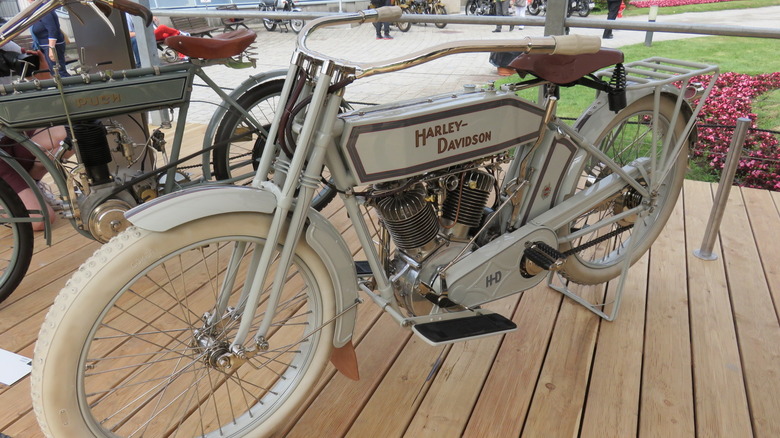
Prewar motorcycles were more or less in a league of their own as far as what a consumer could realistically buy. This was an era dominated by the Ford Model T, the world's first mass-produced car, which served as the backbone of early American roads. But if you wanted something far quicker, your best bet was two wheels, not four. And the 1914 Model 10 was among the finest of these motorcycles, marking a significant technical leap forward for the fledgling manufacturer: this was Harley's first ever multi-speed motorcycle, featuring a two-speed manual transmission.
The innovative design was not unlike bicycles, with a two-speed selector incorporated into the rear hub. Moreover, this was also Harley's first example of a kick-starter, marketed as the "Step Starter," allowing the Model 10 to incorporate traditional floorboards. Basically, this was the first proper touring motorcycle that Harley-Davidson ever built, with a long top gear and a comfortable seated position for longer trips. The transmission also eliminated the need for a traditional pedaling gear, and the floorboards allowed the use of a foot-actuated clutch.
Considering the Model 10's relative historical significance due to its plethora of technical advancements, these antiques are among the most consistently valuable (and reasonably usable) mass-produced prewar Harley designs. None of them are crazily expensive, with the highest numbers climbing to low six-digit figures. However, the general average sits around the $60,000 to $70,000 range, depending on the motorcycle's general condition and provenance. Rougher examples may still sell for half that, roughly the same price as a brand-new Street Glide.
Interwar Model E Knucklehead - $70,000
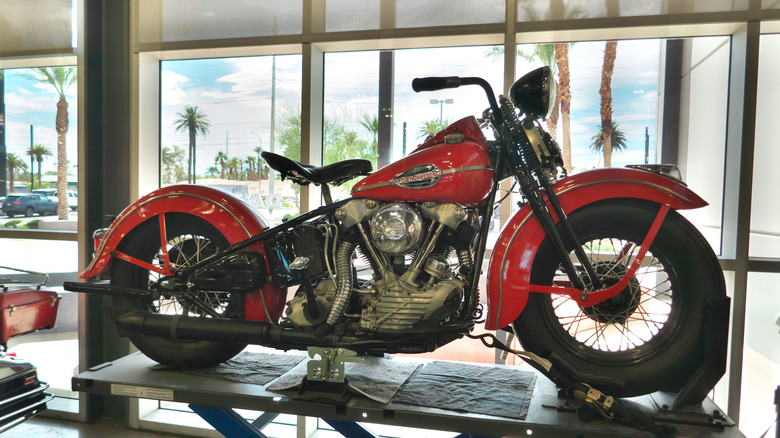
The Model E family consists of several different variations, such as the base E alongside the fancier ES and EL trims, produced from 1936 to 1948. Most bike enthusiasts would likely better recognize the name "Knucklehead," which originated with the Model E. For the layperson not familiar with the name, what exactly is a Knucklehead, though? The term refers specifically to the engine configuration; the Model E was built in direct competition with the likes of the faster Indian models, which overtook Harley in sales by this period. So Harley execs came up with the Knucklehead engine design, featuring an innovative overhead-valve configuration.
Original EL sport-trim Knuckleheads produced some 40 horsepower, which seems modest today, but bear in mind that this was the 1930s. These bikes, for their time (and even today), were fast, mated with four-speed transmissions and that characteristically overbuilt wartime frame. By comparison, the first model of Volkswagen Beetle, built during the same timeframe, boasted just 25 horsepower, not matching the Knucklehead's power until the 1300-pattern H4 in the early 1960s. Basically, a Knucklehead is like taking an automotive engine and bolting it onto a 1930s-pattern bike; no wonder these things were so beefy.
Model E's are still around on various auction websites, with pristine EL examples on offer for low six-figures; think around $200,000 or thereabouts for best-of-show contenders. However, owing to the wide timeframe and wartime production, prices vary wildly, with the average hovering at around $70,000 — still the same price as a brand-new Ford F-series, mind you. Although, for our money, we think the Knucklehead with a couple of saddlebags makes for a way cooler grocery-getter.
1911 Model 7 - $100,000
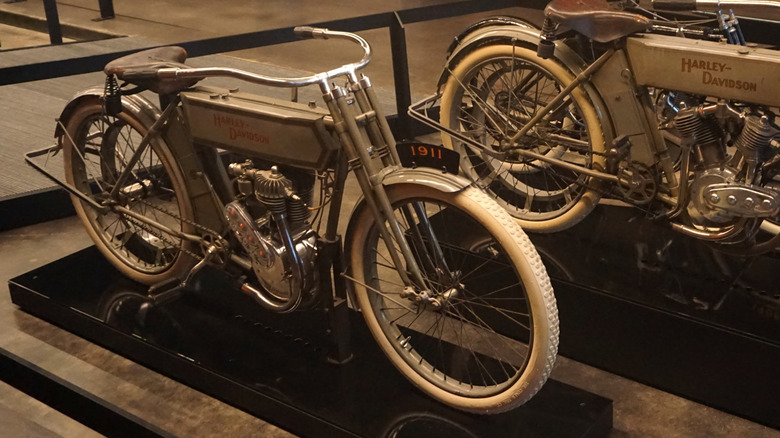
The 1911 Model 7 and 7D certainly isn't as iconic as the Knucklehead, but it arguably features an even more groundbreaking engine design for Harley-Davidson; this was the company's first ever V-twin motorcycle, featured on the latter 7D model. Moreover, it was one of their first that could arguably be labeled as "mass-production," being the first bike produced by Harley after the company underwent its transformative expansion from 150 to over 500 employees. This led to a total production of over 5,600 units for the year, by far the most the company had ever done to that point.
The V-twin configuration, also known as a V-2, is basically the default engine layout for many motorcycles around the world, Harley included. It's easily identified by the engine's orientation and appearance; a V-twin, like its namesake, resembles a basic "V" with both cylinders at various bank angles, with different angles producing different engine characteristics. The V-twin evolved over time to suit the contemporary styling, sensibilities, and customer demands, remaining the gold standard for Harley to this day.
The original Harley V-twin already has provenance by itself, given the insane legacy it began. Adding to that, its status as one of the earliest mass-production Harleys means that this motorcycle is still relatively available, provided you're willing to part with around $100,000 to get one. It's likely one of the most pivotal motorcycles ever designed by Harley, so naturally, that also makes it one of the most collectible; auctions with Model 7s and 7Ds pop up regularly, though obviously, the V-Twin 7D commands a steeper price.
Strap-Tank - $150,000-plus
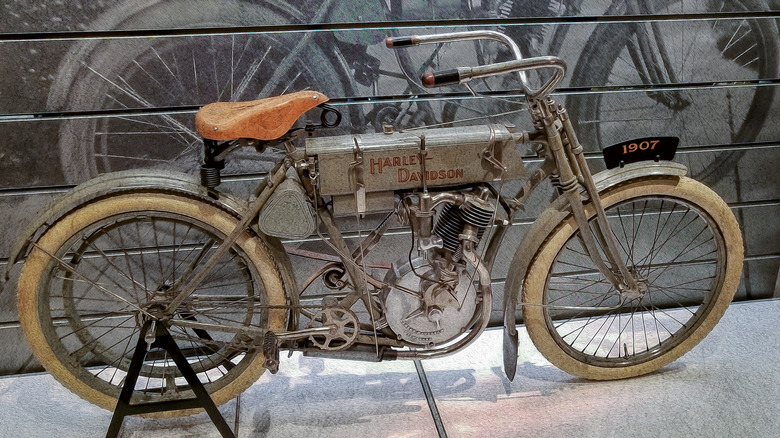
Anyone who knows antique Harleys would likely not be surprised to see the Strap-Tank topping this list; these are consistently the most expensive Harleys ever sold at auction, and among the most valuable motorcycles, period. So-called because of the nickel-plated straps holding the gas and oil tanks to the frame, the Strap-Tank is effectively the earliest production Harley-Davidson one is ever likely to find outside of an oddball prototype. With 50 leaving the factory in 1906, 150 built in 1907, and 450 in 1908, they were hardly what we would categorize as "mass-production" today, but nevertheless, they represented the genesis of Harley as a reputable company.
Motorcycles with this level of historical provenance are always going to be worth their weight in gold, and the Strap-Tank is no exception. With its iconic, almost ad-hoc design, propensity to disappear over time, and general significance to American history, these are among the rarest vehicles in general that one is likely to encounter at auction, much less motorcycles, and are priced accordingly.
Only a low double-digit amount of original Strap-Tanks are known to exist today, a figure owing to the ravages of time, human error, modification, and general neglect. This makes Strap-Tanks in their factory configuration particularly sought-after among collectors. For instance, an original example, sold by Mecum in 2023, became the most expensive single Harley-Davidson ever sold, collecting an eye-watering $935,000 at the hammer. Even "less desirable" examples virtually never dip below six figures, with the lowest salebeing around being $110,000. These machines are truly unicorn motorcycles, almost only ever glimpsed at a major museum or on an auction pedestal.